
THE BELS IN VILLARDEBELLE AND BELCASTEL & BUC
VIII. THE BELS IN THE SOUTH OF FRANCE
"…L'Histoire est une Dame à tel point exigeante que l'homme l'évite au lieu de la consulter…"
Frater André Louis Saumier d´Albis (1915 -2004)
“…History is a so high demanding Lady that man avoids her instead of consulting her…”
THE BELS IN VILLARDEBELLE AND BELCASTEL-ET-BUC
And incredibly, as it may sound, here is another surprise. Some 32 km northeast of Rennes-le-Château is a very small old village (69 Inhabitants) called Villardebelle.
This toponym is made of two words: “Villar + de Belle”.
By now, we all know that “de Belle” (Flemish) means “de Balliol” (Latin). What the word “Villar” means, I had no clue until I found the word in a dictionary of Medieval Latin. That word means either “Manor” or “Village”.
Is Villardebelle a Manor (small castle) belonging to the Belle or of a village called, for a mysterious reason, “de Belle”? Good electronic translations of Villardebelle give unequivocally: “Un village de Belle” (a village or a manor of the Belle). One cannot be more explicit!
In appreciation for 14 years of loyal service to our Dynasty and its Order of Chivalry, Fra. Jürgen Bels, Knight Ordinis Balliolensis, received the High Barony of Villardebelle from his feudal overlord Mgr. Fra. Robert Adelsohn Bels. Fra. Jürgen Bels has, since the 28th of May 2022 in Saarbrücken, the title of High Baron (Baronobis) of Feudal nobility. Fra. Jürgen keeps his Seignorial title of Sire d’Oosthoven, he received after a ceremony of feudal homage performed on 28 May 2008, in the Church of Diepenbeek (Belgium).
Fra. Jürgen’s new charter was handed over by H.E. the countess Caroline Safian Krawiec Brownstone, Knight and Chancellor of North America from Order of St. Stanislas
If the word “de Belle” was used in those times instead of the Latin word “de Balliol”, that may have been the result of a clear intention of its inhabitants, out of Flanders, to mark their settlement for the future. Introducing a Flemish toponym in the south of France, instead of a Latin one that may be interpreted quite differently in the far away future, was for them a kind of insurance that someday linguists and/or historians would discover the hidden message. And that may be: We, in Villardebelle, settled here coming “from Belle” (Flanders).
We encounter exactly the same intention of the Bell (De Bel), from Flanders, who lived in Northumberland, north of England, some 1700 km from Villardebelle! The Bell called their family seat “Bellasis”, what is a contraction of “Bell+assise” or “Bell+seat”. Here, like in Villardebelle, the message may have been: “We, in Bellasis, settled here coming “from Belle” (Flanders).
The locality of Villardebelle (1330 hectares, highest elevation above sea level is 857m and lowest 414m) and/or the manor must have existed at a time the Medieval Latin was still in use. That ranges from the Vth until the XVth century. And that is the case: the church of the village, in Roman Style, was built in the XIIth century. So, the village is at least one thousand years old.
Located west of Villardebelle is another place called Belcastel-et-Buc (from the name of the small River that runs down in the valley). Some 3 km south of this village are the silent and rather mysterious ruins of Belcastel-et-Buc (castle of the Bels) also called “the Castle of Villardebelle” some 12 km away. Picture taken by Ms. Ani Williams of Rennes-les-Bains, on 25th October 2025.
Picture just freed from the morning fog that hung over the mountain in the background. The ruins of the Belcastel-et-Buc (XIth century) rises isolated but majestically on its rocky piton in the Hautes-. Corbières (France), some 30 km north-northeast from Rennes-le-Château. Left the chapel and the cemetery still in use in 2012. View taken from the road D429. Coordinates: 43.02965, 2.35397
According to historians the castle, already mentioned in anno 1082 and later in 1221, under the name “castellum pulchrum” (ce qui, par certains signes apparents, promet d'être bon), was known as the castle of Villardebelle. It was built on a hill about 510 m high in an isolated place north of the Corbières, a wild, hot, and dry mountainous area with the highest elevation culminating at 1231 m (Pic du Bugarach). The absence of round towers means the castle is at least 900 years old.
The castle was, together with the castle of Claramunt, on the trade route to Barcelona's, the most important checkpoint in the lower valley of the Llobregat. The bridge over the river is also dated XIIth century BCE.
The dungeon has the typical architecture for Gothic castles built around the year 1000. Walls surrounding the site, are still visible on satellite pictures.
Belcastel-et-Buc is also located in the middle of the Cathars and Templars region. However, and unlike several other nearby castles such as Arques, Termes and the Abbeys of Saint Hilaire and Saint Polycarpe, it seems to have been miraculously and mysteriously spared from the horrible Albigian events, which shook the South of France, starting anno 1209, with the crusade against the Albigians, under Simon de Montfort. Why was this castle spared?
The Middle Age hamlet that surrounded the castle was devastated by a fire and abandoned ever since. The castle and house building stones were used to build the sole house (Villa) of Belcastel-et-Buc down the road west. Left, the much more recent, but almost abandoned, chapel and its graveyard counting a dozen tombs!
* Note: Due to the vagaries of history, the lands, on which the ruins of the castle are located today, were acquired, decades ago, by the family Pages. Correspondence with the owner Madame Pages and with the municipality of Belcastel-et-Buc, through the mayor, Madame Anne Valmigere, has been implemented on 17th Nov. 2019, to buy back these lands. Since Madame Pages passed away, I have been requested to contact one of her sons, Mr François Pages, au Domaine des Candellières, in Belcastel-et-Buc.
Interesting to note is the presence of two particular tombs. One of a Free Mason Mr Victor Serie (°1847 †1874) and one from a Templar Knight: Jean Barbaza (°1817 †1890). It is most unusual indeed to find such tombs in a so far and remote place as Belcastel-et-Buc, in the Corbières!
These tombs give us the indirect proofs that, not far away from Rennes-le-Château, there were, in the region and at the time of Bérenger Saunière, some members of secret organisations active!
For being buried in this Belcastel-et-Buc mini-cemetery, they must have lived in Belcastel-et-Buc or its immediate vicinity. Bérenger Saunière may most probably have received from a Free Mason Lodge, a Templar´s Commandery or a Rosicrucian’s lodge, whose presence are betrayed by these two tombs, some knowledge and maybe even a kind of initiation in some of their secret symbols that he subsequently used to encode his church. Fact is that the church Marie-Madeleine of Rennes-le-Chateau (RLC) is full of Templar, Masonic and Rosicrucian signs. Strange enough to allow us to ask some pertinent questions about this priest! What is sure is that Bérenger Saunière is the tree that hides the forest!
I know rather well the region and I can tell you that, except for Belcastel-et-Buc and for Villerouge-Termenès, some 40 km of Belcastel-et-Buc, no one castle has been spared from the destructive craziness of the Church crusaders. An important crusader detachment came from Carcassonne, followed the Aude River valley, and headed for Limoux.
There they turned east towards the Corbières Mountains marching on the nowadays called D129 and D40 (Departmental) roads. From the D129, abreast of the village Belcastel-et-Buc, it was totally impossible not to see the small castle of Belcastel-et-Buc for it is perched high on a mountaintop, as the crop flies less than 700 m from the road and very well visible against the light.
That year, 1209, Simon de Montfort seized the castle of Bertrand de Blanquefort (1109-1169) and gave it, as its surrounding lands, to his comrade in arms Pierre de Voisins. The lands included Rennes-le-Château, where De Voisins found a permanent residence in what is today the Château Hautpoul. However, not a single mention has ever been found in documents, being they old or modern, as far as the Belcastel-et-Buc is concerned.
We know that the bishopric of Alet-les-Bains received the castle of Bertrand de Blanquefort, and that Lord Bertrand swore allegiance to the Viscount Bernard Aton of Alet-les-Bains. Since the castle of the Viscount is practical at an equal distance between Belcastel-et-Buc (19 km) than the Blanchefort´s Castle (15 km), there is no explanation why there is only the mention of the Blanchefort castle and not a single word about the Belcastel-et-Buc! The lords of Belcastel-et-Buc did not swear allegiance to the Viscount otherwise, the fact should have been recorded. Why were they exempt from this usually unavoidable feudal obligation?
Archaeological research would help us to have a good overview of the castle, because nowadays one is only walking over stones of collapsed walls and next to walls that may collapse at every moment. The site is very dangerous and absolutely not a safe place to picnic or to hang around.
«…Le Donjon. Dans la salle principale ou plutôt le bâtiment le plus imposant, je suis en admiration devant l'équilibre des pierres. J'ai l'impression que la ruine ne veut pas mourir et s'accroche au ciel...». Dixit: Le chevalier Dauphinois, publié dans: Châteaux en Languedoc : 11-30-34-48.
“...The Dungeon (also called the Keep). In the main room or rather the most imposing building, I am lost in admiration in front of the equilibrium of stones. I have the impression that the ruin will not die and clings to the sky...”.
The castle seems to have had a particular history, most probably a Dynastic one that may explain why the Belle Dynasty properties and estates remained untouched by the religious events.
The dungeon of the castle may have been, at least 30-35m height. The main building had several floors. This proposition can be deducted by the height of the dungeon and by the construction holes still visible in the walls of the main building.
Something interesting about this castle is the total absence of a defensive system. It was, of course, perched high on a hill, but unlike other early medieval castles, in Belcastel-et-Buc there are no traces of battlements, arrow slits or machicolations. Its curtain walls are surprisingly thin and the size as the multitude of windows, are by no means to ensure an adequate protection to the inhabitants in case of attack.
In the Middle Ages, it was mandatory to keep the horses inside the walls of the castle. I do not know if Belcastel-et-Buc had some stables or not. I am searching for a plan or a drawing from the castle that could tell me more about it.
There is no trace left of neither a well nor wells that would have given some autonomy to the inhabitants in case of a siege. Wells were, of course, dug inside the castle but also in the keep itself. This would enable the besieged to hold longer in the case of falling curtain walls under the enemy siege.
On the site, the debris, several meters thick, are far too important to locate a well. The danger of falling stones and even collapsing walls is far much too real. It would be virtually suicidal to begin excavating the site without having previously secured it by consolidating works.
Question: What was then the real purpose of this castle? Why building a castle that has no defensive capacities, other than the natural protection of its location that limited and rendered the access to the castle rather difficult, and its “thin” walls?
Were they “castellani” (inhabitants) not afraid to be attacked? And if not, what made them so sure?
As said, the castle’s first mention was 1082, what means that it must have existed there for a longer time. Half a century seems a good working hypothesis what brings us back to anno 1030. Going further back in time is very risky because we know that the very early medieval castles, built with stones and rocks, started around that period.
So is anno 1030 extremely close to anno 1014 when the Baron and Knight Bels (prob. Arnulfius Bels de Cerdanya) appeared, undersigning the document of Vacarisses, for the Count Ramon (972-1017) x in 1001, Lady Ermessen de Carcassonne. In those times, Vacarisses together with the Razes region, that included Rennes-le-Château, Villardebelle, Belcastel-et-Buc and Baillessats, were the estates of the Counts of Barcelona.
As the knight Bels was a baron (baronobis) attached, like his heirs and ancestors, to the court of the aforementioned counts, it is not unfounded to suppose that other members of his family also settled in Baillessats, Villardebelle and that some of them were the builders of Belcastel-et-Buc.
The castle, built on a rocky hook high above the brook “le Buc”, could be better defended than the high plateau of Villardebelle. But as seen earlier, the castle had probably no defence capabilities. Any castle building was either designed to control, defend and/or to protect inhabitants. Belcastel-et-Buc was, at least in its early years, an isolated castle with only a few inhabitants around it, with no strategic roads to control and/or to protect. Only centuries later, from the XIVth century onward, did a small locality develop itself at his feet. But by then, its inhabitants had already abandoned the castle.
Is it evident that, although Belcastel-et-Buc is referred as being the castle of Villardebelle, it may have had not very much to do with this village. The castle could never protect the inhabitants of Villardebelle, at the very most the Lord of the castle, in case of danger. The distance between the two locations, some 12 km, was just next door, but still much too substantial in case of an emergency retreat.
Anno 1082 is also relatively close to 1130. It is the year that Bertrand de Blanquefort asked the Knights Templars to start exploiting a gold mine near his castle and some other not far away. In fact, he ordered important underground constructions made by German miners. A big cover-up operation either to dig up, among others, the treasure of the Visigoths which was gathered during the sack of Rome in August, anno 410, by the Visigoth leader Alaric Ist, the Goth, or from the Merovingians. Or was the operation to create new secret underground galleries and chambers? In that case, the German miners were no longer there to dig up something... but most probably to dig something in (sic) !
Where did the miners dig? Was it in the biggest mine of the Corbières (4 stories deep into the mountain) called “Mine Belle Isis”, in the village of Bouisse? Again, we encounter the patronymic “Belle” ! Pure chance one may retort! What then about the fact that this mine is not located some hundred kilometers away from the ruins of Belcastel-et-Buc but only 13 km from it and only 8 km from the village of Villardebelle? Bouisse is the village next door from Villardebelle!
Or were they working in the old mining complex of Camp-sur-l´Agly near the Mount Bugarach, some 20 km from Bertrand de Blanquefort´s castle? Or in caves from the area? If yes, then we are going to lose ourselves into conjectures because there are dozens of caves in the direct vicinity.
Just to quote three of them. One cave in the Bugarach Mountain, the «Bufo Fret», has a big hall some 50m long and 20m high and the length of its galleries reaches almost 6 km. The “Bufo Fret” and the «Font de Dotz» are the two biggest cavities out of 50 that criss-cross the Bugarach Mountain.
The third big cave in the Bugarach is the “Grotte Cathérale” (picture from the Spéléo Club de l´Aude). Another cave, at the Col de St-Louis has, as of today, no less than 20 km of explored galleries! These caves are situated respectively 12 km and 16 km from Bertrand’s castle. Sufficient places to hide several treasures!
The last inhabitants of the Belcastel-et-Buc abandoned it sometimes during the XIVth century. According to historians, the ruins have been inhabited and totally abandoned ever since. Did the last inhabitants belong to the Bels-Belle Lineage or Dynasty?
The small locality that later developed itself, at the feet of the ruins of the castle, burned out totally decennia ago. Most of the stones were used to create the magnificent villa and estates (some 150ha) distant less than 1.000m from the ruins.
The Knight Jim Elton Bell (Ordinis Balliolensis), an excellent historian, quickly reacted after the publication of this article, by his correspondence dated 18 July 2011:
“... How nice to hear about your new South France findings and possible connections to the Flemish Bels. I admire your ability to piece together new tidbits of data, compare to previously known facts and declare the possibilities. That is the only way to weave possibilities into new history, i.e. even others may pick up on your work and help you prove these as later proven facts.
I have too many associated researcher friends who simply refuse to venture out unless they work with absolute proven facts; hence the reason that few of them ever really discover or contribute anything new... Anyway, your hypothesis is exciting and challenging, and I commend you for continuing the good work that will become so important to our beloved Order...”. Warmest Regards, Brother Jim.
There are four more Belcastel localities in France. All are in the vicinity of Albi! These locations are not necessarily linked to the “Belle” family as Belcastel-et-Buc does.
Question: Belle (Beyle, Bayle, etc.) in Flanders and the others in Languedoc are some 1000 km apart. What was our Lineage doing that far south?
It is known that the Cathars encouraged the establishment of a class of skilled craftsmen. Workshops specialized in the manufacture of textiles and by-products were developed. Moreover, who were the best textile “skilled craftsmen” in those times, but the Flemish?
Ypres was a drapery industry power of the first importance in Middle Age Europe. And it is precisely with this trade that the Bels and Belle were excelling. The astonishing financial fortune they gathered through the centuries came mostly out of the trade and business made with textile.
One of the several mentions about this fact, the records (1250-54-67) of Salomon Belle (†1272) fs. of Jourdain Belle, state: "The gathered notes on Salomon Belle, from Ypres, prove us his wealth and his strength".
It would therefore not be a real surprise if someone would propound the business or commercial hypothesis as a motive behind the settlement of people from our lineages down amidst the Cathars, in south-western France.
In fact, there are some precedents to this sort of skilled artisans’ settlements. Remember the Bels in Limburg (Belgium) dealing with textile in a region that had absolutely nothing to do with it. See “ca. 1492” and in the French part of this Essay under: “Les Belles, Bellis, Bellens sont des Bels”.
There is, however, one stumbling block to this suggestion: Members from our Lineages seem to have settled down in the south of France long before the Cathars! The first reference about the Cathars comes from a letter of the Prior Ebwin von Steinfeld, dated 1145 and addressed to Bernard de Clairvaux. This does not mean that there were no Cathars in the region before this date. But they may have been so few and so insignificant, that they could hardly have been the driving force behind these hypothetical settlements.
The Catharism arose when a priest called Bogomil preached a dualistic form of belief in Bulgaria around 930 CE. The religion itself was born in Persia and was the product of a certain Mani. Paradoxically, the feared contamination ran the opposite direction of the routes taken by the crusades whose intentions were to counteract the “Islamic” contamination (sic).
This infiltration was dangerous for the Roman Catholic Church because, as written by Tim Wallace-Murphy: “…The Gospel of Love, otherwise known as The Secret Gospel of John, taught the simple message that Jesus came to reveal and not to redeem. In this sense, the first identifiable parent of the Cathar faith can be found within the First church in Jerusalem led by James de Just, the brother of Jesus...”.
During my next study trip, I will take more time to visit the village of Villardebelle and try to find out if there has ever been a Manor at this location (as it was the case in Ambels) or if the toponym refers only to the village!
As seen before, Nicole and Alain Bels from Albi told me that the word “Sats” is related to the verb “to know”.
The meaning of the word “Les Baillessats” is thus: “Les Bailles savent” or “The Bailles know”.
- What were the Bailles supposed to know?
- Where did they get the information?
- Why was there such a need to inform the future generations about their “knowledge”?
Due to the extremely short distance (some 30 km) between “Les Baillessats” and “Rennes-le-Château” and its procession of mysteries whose secrets were kept for more than a thousand years, we may speculate if our Lineage knew something about what was going on in Redae, in Rennes-le-Château, with the Merovingian, with the Cathars, with the Templars or with all of them together because they all were interconnected.
All the places our lineages settled in France, and which were named after them, are in the Cathars and Templars region: Albi, Ambels, Ambialet but also, as we will see subsequently Bales, Bayle, Les Bayles, Baillessats, Les Baihards, Montbel, Les Bels, Ambels. They are all located amid the Cathars country such as: Albi, le Bézu, the Château de Blanchefort, the fortress of Peyrepertuse, Rennes-le-Château, the fortress of Montségur, etc.
Our links with the Templar Order, whether on the continent or in England and Scotland, etc., are also firmly established. In addition, our lineage is also linked to some of the most important lineages of the south of France and of the north of Spain such as the one of the Counts of Barcelona, later Kings of Navarre, the Counts of Toulouse and the Counts of Razès, only to quote them!
The small valley south of the elevation (hill) of Rennes-le-Château, in which runs the stream “de Couleurs”, is called “La vallée des Bals” or “The Valley of the Bals”. The chance of finding outside Flanders a toponym linked to our Dynasty or lineage, such as “Bals” - “Bels” - “Bayle”, etc., may be roughly the same as to get the Jackpot on the Lotto (1 upon 100.000.000)! But are we really speaking here of pure mathematical chance, a product of a Cartesian spirit, or from a voluntary intention we still have to discover the reason?
We know that the patronymic “Bals”, together with “Baels” and “Balles”, is a Flemish variant of the name “Bels”. Except for very few occurrences of “Bals” in the south of France, there is no such place in whole continental Europe. It is as if we would encounter, in France, places called after other typical Flemish patronymics such as Beyens, Borrekens, Caloen, Coppens, Festraets, Kerkhove, Mertens, Terlinden, Vantieghem, Verhaeghe, Verwilghen, Vandernoot, etc., and want them to be of French origin!
Apropos, there is a “Vandernoot” married with Castera, buried in a big family vault, in the cemetery of Massat (four kilometers from Les Bels). This “Vandernoot”, is definitively a Flemish person.
This is also true for places encountered, in northern France, such as: Dunkerque (Duinkerke), Coudequerke (Koudekerke), Morbecque (Moerbeke), Steenbecque (Steenbeek), Haverskerque (Haveskerke), Steenwerck (Steenwerk), Steenvoorde (Steenvoord), Oudezeele (Oudezele), Godewaersvelde (Godsvelde or Godewaarsvelde). Even the more exotic Auderuicq comes from the Flemish Ouderwijk.
Nobody, in the northwestern part of France (Nord - Picardie), will ever doubt on the Flemish origin of these toponyms because this part of France is known to have been usurped from Flanders. In these two French departments, people still speak Flemish, as a second language.
We encounter the same phenomenon in the north-eastern part of France (Lorraine - Alsace). In these regions, most encountered toponyms, are of German origin: Windstein, Drachenbronn (Drachenbrunnen), Surburg (Sauerburg), Steinmauern, Fleckenstein, Wintershouse (Wintershausen), Lichtenberg, Baerentall (Bärentall), etc. And people also still speak German!
However, the situation would be quite different if we encountered typical Flemish or German names in the south of France! These would be, to say the least, quite out of place! Like “a hair in the soup”! How should historians react if they encountered, down there, villages called “Baerentall” or “Steinmauern”? Would they want them to be of French origin?
It is precisely what happens with the Flemish patronymics Bels - Bayles! Of course, there is still the possibility that the word “Bals” is taken, in the south of France, in its Provencal acceptation of the term:
“…Bals (Les) - En Provencal, “baou” signifie “rochers”. D´après Amedée Thierry, ce mot aurait une origine ligurienne. A Villebazy, les Bals forment des escarpements, près de Crausse, ils ont donné leur nom à une Metairie…”: In this case the “La valée des Bals” may designate “the valley of the rocks” ! Source: Bedos Amédée Antonin.
Bénédicte et Jean-Jacques Fénie, have not reported a single of these “Flemish” words in their list of Occitan toponyms in the region of the Languedoc speaking. This region encompasses:
- The Aquitaine, South of the Department of the Dordogne, Velines in Sarlat, The Oriental extemity of the Gironde, the plateau and the “serres” de l´Agenais both sides of the valley of the Lot in the Lot et Garonne.
- The Auvergne, District of Aurillac in the Cantal.
- The Languedoc-Roussillon, Aude, West of the Gard d´Ales to Lunel, the Herault and the high Basin of the Agly in the Oriental Pyrennées.
- The Midi-Pyrennée, l´Ariège east of the line Col de Port - le Fossat, l´Aveyron, la Haute-Garonne West from the line Auterive - Toulouse. The Lot, the Tarn and the Tarn et Garonne east of the big Aquitain river.
If the toponyms Bels and Bayles are neither of French nor of Occitan origin, what are they then? It is evident that they are quite out of place!
In fact, there are only three places called “Bels” in France. All three are of Flemish origin and are situated in the south of France. One is designating a small road called “Chemin des Bels” or “Path of the Bels” leading to the locality called “Les Bels”. This locality is some 8 km South from Castres, in the Cathars and Templars region. A very important sign appears right here. The city’s toponym of Castres (43000 inhabitants in 2008) is identical with the one of the Flemish villages called Caestre (1670 Inhabitants in 1999).
As Castres was, in France, in the Templar region, its pendant Caestre happened, by pure chance, to be also in the Templar region but in Flanders. Right in the middle of the first seven Commanderies built in Flanders (around 1128), in the Diocese of Thérouanne. They were in Ypres, Nieuwpoort, Furnes, Caestre, Cassel Steenwerck and Bas-Warneton. Seven others were in the diocese of Tournai: Slijpe, Leffinghe, Steene, Brugge, Ghent, Kortrijk, Pérenchies near Armentières and La Haye in Lomme, next to Lille. Source: E.M Braekman.
Is this not strange to find so many Flemish toponym and patronymics so close to each other, 1000 km away from Flanders. Idem for the blazon of two cities related in Flanders but at first glance totally unrelated in South of France? Left (1) from the city of Tournai (B) and right (2) from Castres (F).
Caestres, in Belgium, belonged to the Balliols of Flanders, who had the well-known Arms with the Pal Vair (3-4-5). The Balliols were also big Lords in Scotland. Why did this Flemish city (6) take the same heraldic elements of the Arms (7) of the Scottish Lords of Barnard Castle, 650 km away, when the Balliols of Flanders, their own Lords (10 km away) had their own?
Did a subtle heraldist want us to realize that the Scottish Balliols, conspiratorially pretended by the French to be of Normandy, were in the past, the Flemish Lords of Balliol (Belle) to whom Caestres (Flanders) depended? How else could we explain all these apparent coincidences?
Back to the “Chemin des Bels”.
The name of the road and of the locality is also quite abnormal. The road should be called “Chemin de Bels” instead of “Chemin des Bels” respectively “Path of Bels” instead of “Path of (to) the Bels” ! The first appellation would mean: “Path leading to a place called Bels” which is the primary purpose of a road sign. The second one would mean: “Path leading to the people called the Bels”.
- “The Bronson Road” is quite different indeed from “The Bronson´s Road” or its genitive pendent
- “The road to (of) the Bronson”! The same is true for the toponym of the locality itself “Bels”: It is, after all, nothing else than the patronymic of a Flemish family!
The other pseudo-toponym I found is the one of a small mountain location (alt 900 m) on the slope of the Pyrenean Mountains, some 4 km northeast of Massat (on the Departmental Road Nr 46). It is called “Les Bels” or “The Bels” (15 houses, only a few permanently inhabited). We have here again the same abnormality as described here above. The name of the locality means “a place where live some people called Bels!”. Compare with an English version as example: “I am driving to Bronson” and “I am driving to the Bronson”. This is quite different!
In addition, but side by side and only separated by some 700 m rough terrain, there is another locality (alt 860 m) named after another Flemish patronymic version of “Bels”, the homonym “Les Bayles” (10 houses). See picture next page. We have seen throughout the previous chapters of this Essay, that both patronymics belong to the same family lineages of Flanders.
That Bayles is a typical Flemish name is also proved by the history of the Bayles in England. As seen “in 1617”: “...The first authentic record of the Bayless, or Bayles family was the appearance of a refugee named John Bayles (Bayley or Baylie), (°1617 in the Parish of St. Peters of Mancrofts in Norwich, Norfolk, England) at Colchester, England.”
John Bayles is said to have come from the Low Countries [Flanders] as a Huguenot who migrated from northern France to escape the death, which overtook so many thousands of Huguenots at the massacre of St. Bartholomew on August 24, 1572. Almost twenty years later, John and two other brothers boarded the “Truelove” and sailed to America they reached on June 10, 1635.
And, as we have seen, there is just on the other side of the mountain, north of “Les Bels” and “Les Bayles” another small settlement called “Balès”. It has the same phonetic identity, a toponym synonymous with “Bels”, “Belles”, and “Baels”.
Some historians assert that the proximity of three hamlets bearing surnames that later evolved into place names supports the hypothesis of a shared origin or lineage, or, at the very least, of an orthographic or phonetic variation of a common name. References to "Bels" and "Bayles" appear in the cartularies of Cerdagne, Osona, Foix, and Béziers, as well as in notarial records from the regions of Carcassonne and Narbonne.
Some troubadours occasionally indicate the author(s) of their songs. This is how the following note A. del Monte 26-42, came to appear: “de Bels m'es lo chans et de Lo pair' e.l filh de Bernart de Venzac, et de Ja ogan pel temps florit d’Adhemar lo Negre..” Source: Annales du Midi.
Or in English: “The song is by Bels, and by the father and the son of Bernart de Venzac, and also by Ja Ogan in the flourishing time of Adhemar the Black.”
“de Bels m'es lo chans” means “the song is attributed to ‘Bels’”, either as a name of the author (a senhal, or poetic pseudonym), or as a patronymic.
“de Lo pair' e.l filh de Bernart de Venzac” indicates a complementary attribution, either to other authors, or to alternative versions of the song.
The term “Bels” can here be interpreted as a surname or patronymic used by a troubadour. In this case, the expression “de Bels” would literally mean “of the family or place Bels”, in keeping with the toponymic conventions commonly found in medieval onomastics.
This interpretation is corroborated by the attested presence of the name “de Bels” in several Occitan and Catalan medieval documents, notably in charters, cartularies (such as those of Cerdagne, Osona, or Foix), as well as in various genealogical annotations. It is further supported by references found in the Annales du Midi, which underscore the persistence of such names in regional literary and poetic corpora.
It is therefore not unlikely that this name, rooted in the local aristocracy or in minor noble lineages, found its way into local or regional songs of southern France, possibly even employed by troubadours themselves, whether as authors or as fictional poetic personae.
Bernart de Venzac was an Occitan troubadour, likely originating from Venzac in the Rouergue region, then part of the County of Rodez. He lived during the period preceding the Albigensian Crusade, a time marked by increasing religious tension in southern France. His poetry is distinguished by its sharp, satirical tone, often aimed at the nobility and clergy, as well as by its profound moral reflections. Bernart openly denounced the corruption of the Church and the moral decay of the aristocracy and elite.
Bernart appears to have been active between approximately 1180 and 1210, though it is possible he was born around the year 1150. He may have been a minor noble or a cleric, a status that could explain his association with the figure known as "Bels." The Bels to whom Bernart refers may have been his contemporary. If this hypothesis holds, the individual I tentatively identify as the "Bels poet" may likewise have been born around 1150.
There is no evidence that Bernart adhered to Cathar beliefs, and none of his surviving poems mention the Albigensian Crusade (1209-1229). This silence suggests that he may have ceased composing, or possibly died, shortly after the outbreak of the conflict, around July 1210. However, it is also plausible that this absence is simply due to the loss of manuscripts. Personally, I suspect that Bernart may have been among the early victims of the Inquisition.
I wrote a CM (Magisterial Communication Nr 490a), dated 29 February 2016, to a Dynast directly concerned: Mr Françis Bels (°1 Oct 1950), mayor of Roquefère and member of the Departmental Council of the Aude (France) whose father is: Roger Bels!
"... Mister mayor, I am the author of an Essay (written in English), on the right track of completion, on the history of the Bels and other homonymous patronymics, distributed in Western Europe. I allow myself to come to you for the following reasons:
The Bels are members of a very old family. Their first tracks take shape at about the year 286. In the Merovingian times, they become "obvious" and eventually “official” due to their publications in official acts such as:
- The Treaty of Verdun (Thionville) in 843.
- The Trial of and in Vacarisses (Catalonia) in 1014, instituted by Guillem de Montcada, Viscount of Barcelona, against the vicar of Olesa de Monserrat.
My research started in Flanders (Belgium), brought me, among others, in the south of France.
Mister Bels, being of passage in June 2016, in the “Cité” (name given to the ancient part of the City of Carcassonne), it would especially be very pleasant and very instructive to me, to be able to meet you there. Do you glimpse the possibility of such a meeting? Looking forward to the real pleasure to read you and/or to meet you, deign to receive, Mister Bels, mayor of Roquefère, my respectful greetings ".
The Email apparently stranded somewhere on the western slope of the Mount Kailash (Tibet), because I never received an answer! However, on 21 July 2016, I finally made contact. Having Mr Françis Bels personally on the line, I could explain to him what I was looking for. Mr Françis informed me that he would use his long-standing good connections to find out some information pertaining to my research and send me anything that might be of some interest. He himself has no idea how the “Les Bels “and “Les Bayles” toponyms could be explained in the south of France. He will investigate.
On June 17, 2016, wanting to gather some information upon the origin of these names, the year of their first appearance in old documents as well as the number of inhabitants by locality, I drove to the Pyrenean Mountain range to meet Madame Marie-Christine Soula, the mayor of Boussenac, the locality on which the "Les Bels" and the "Les Bayles" hamlets depend administratively. Their respectively coordinates are: 42.907626, 1.367095 and 42.904640, 1.354809
Since these localities are literally lost in time and space, on the other slope of a mountain, I had the very unpleasant and tedious time to zigzag up the road (D618) to the mountain pass, called “Col de Port” (Alt.1.249m), to then zigzagging it down to these places. I was lucky, the weather conditions being good, the pass road was open!
Lady Emmanuelle’s father is Pierre Bels, as is her grandfather’s name. The Lady has absolutely no clue where her ancestors originated from. Further research is in the process.
That Miss Emmanuelle Bels is living, or came back to the area, less than 15 km from the medieval locality of “Les Bels”, is unbelievable. If we compare the chances we would have to find anywhere, outside Flanders, a Miss “Vanmuysen” (Flemish name) living 15 km from a locality called after the Flemish name of “Vanmuysen”, which is next to another locality bearing the Flemish synonym “Van Muijsen”, we would quickly realise that the odds are close to zero!
Meeting with Madame Soula, in her mayor´s office (picture right), she told me she had no idea where these toponyms originated from but added that their consonance is definitively not French or from the regional speaking.
As she could not answer my question on the date or time of the toponym´s first apparition, she advised me to contact some historians specialised in this matter. The town hall of Boussenac is not in the Boussenac locality but some 3 km east from it, somewhere on the Départementale D618, south of the “Les Bels” locality, at 42.903831,1.368948
En route to the “Col de Port” there is a locality called “Saurat”, it counts some 580 inhabitants. There lives the dynast Miss Emmanuelle Bels. This, unfortunately, I only found out after my return from my trip to the Pyrenées!
There is yet another truly striking coincidence. Within the triangle formed by Belcastel-et-Buc, Villardebelle, and Terroles, there once existed a locality, belonging administratively to the latter village, called “Les Bels.” It depended upon the seigneurial terriers of the domains of Belcastel-et-Buc, and was situated approximately 6 km from Villardebelle, 11 km from Belcastel-et-Buc, and 14 km from Rennes-le-Château, at the very heart of the Belcastel-et-Buc , Villardebelle, Fenouillet , Quéribus corridor.
This “Les Bels” of the Aude is distinct from the one in Ariège previously discussed, and it remains untraceable today. I read this information somewhere, though I no longer recall where. It is, in truth, becoming quite the “Hals-Eimer” mystery!
Nevertheless, there is an intriguing locality called “Fels” to the north of Terroles. This word “Fels,” which is not of French origin, could it perhaps be a phonetic variant of “Bels,” as is so often the case? The mutation of B into F is real and well attested in the mountain Occitan linguistic zones (Aude, Upper Ariège, Fenouillèdes).
Moreover, whatever its precise toponymic form, this place was a direct dependency of the seigneury of the Bels of Belcastel-et-Buc. It lies precisely in the strategic zone of the passage between Belcastel-et-Buc and Quéribus. This place called “Fels” does not appear to be there by accident. In any case, I continue my research to relocate the primary source of this information.
When my maternal grandfather, Charles-Alphonse Valcke died, March 28, 1974, an announcement of death was printed and distributed. On this announcement, although printed in a Flemish village, by Flemish personal used to deal with Flemish names, the typical spelling error happened once again. The couple Robert Gérard Bels x Suzanne Valcke, my parents, was named “Beyls-Valcke” instead of “Bels-Valcke” ! The same happened in 2025, in Rennes-le-Château on my Parking ID. The Municipality wrote “Belz” instead of “Bels”.
Our Dynast Willy Bels wrote me: “…for your information. In the Ypres´s loan registers one Jonkvrouw, wife of Rycquart (Ryckewaert) Van der Gracht, appears under the following names, sometimes as Marie Belle, then Marie Belles and also as Marie Bels. It should be noted that each time it is the same lady. About the spelling of the name, there was little or no concern at the time…”. Source: Willy Bels, out of Leenregister van de Zaal van Ieper (1514-1515) Johan Beun anno 2001.
If such mistakes could happen in modern times and in a country where more than 99% of the people are literate, then we better understand why so many patronymics variants appeared in the Middle Ages. In those times, the spelling of a name being only phonetic, the name Bels became indistinctly Beils, Beyls, Bells, Belles, Bellis, Belis, Bailes, Bailles, Bails, Bayls, Baillies, etc. Simply because they all sounded exactly the same!
from Bels to Bayles is phonetically plausible, particularly in certain dialectal variants of Languedoc or Rouergue, where the open "e" diphthongizes. This phenomenon did not happen only in Flanders.
Note that the phonetic change from "Bels" to "Bayles" is feasible, especially in specific dialects of Languedoc or Rouergue, where the open "e" sound undergoes diphthongization. This linguistic shift is not exclusive to Flanders.
Therefore, among other particularity of this very hard to study language, French students have so many problems with the spelling. As an example, the sound of the word “vair” can be written, in French, in different ways and will mean every time something else: vers = toward(s), vers = line (poetry), vert = green, verre = glass, vereux = corrupt, ver = worm, vair = vair (slipper), vair = fur (heraldry) and pronounced a little bit too hard will become Fer = iron, Faire = to do !
If somebody tells us, he is living in a place that sounds like “Vair”, how are we going to write it down? If I tell you my name, which sounds like “Bails”, how are you going to write it down?
If the correct spelling was already a big problem in Flanders, there where these synonyms originated from, then we can realise how big the spelling confusing must have been in a place like the South of France? In addition to that, writing down these names, in their correct spellings, must have been a challenge in those times when only a very small fraction of the population was literate.
Outside the monks, the clergy, the Leudes and later the Vassi officers (Lawman, Office holders, Magistrates, etc.), nobody could read nor write. The literacy rate in England, in the XIIIth century, has been evaluated as low as 6% and this percentage did not change significantly until about the beginning of the XVth century.
On the other hand, due to the great use of reading and writing by the urban bourgeoisie, followed much later by the gentry and nobility, Flanders and northern Italy had, as for culture, arts and science developments, the highest rate of literacy in Europe.
If Flemish people have problems spelling those names, what for an insurmountable task it may have been represented for French people, known for their kind of “genetic” resistance to learn foreign languages, and once learned, to master them!
Here at the foothills of the Pyrenées, in extremely isolated areas, Flemish patronymics were given to neighbour localities, moreover, in the Cathars and Templars terrains, at least some 1.000 km away from Flanders! Is this not another coincidence?
And it still goes on. Twelve kilometers south of Castelnau Durban and some 6,5 km as the crow flies north of “Les Bels” is another locality (13 houses) named after another Flemish patronymic variant and homonym for Bels, called “Bales”.
All these above-mentioned places are in the hottest part of the Cathars country and are never further away than 34 km, linear distance, from their famous fortress of Montségur!
The village of “Carla-le-Comte” does not exist anymore. It has been renamed “Carla-Bayle” in the honour of our dynast Pierre Bayle. It is located 25 km west of the city of Pamiers, in the Comté de Foix. Pierre Bayle (1647-1706), the famous philosopher, writer and forerunner of the Encyclopaedists and an advocate of the principle of the toleration of divergent beliefs, was born in Carla-le-Comte.
He was one of the most important professors of history and philosophy of the last centuries. Of Cathar blood, he has not forgotten the inquisition that struck his family four centuries earlier. So, as soon as the opportunity arose, he broke with the Roman Catholic Church and cautiously opted for the nascent Protestantism. In 1681, he took refuge in the Netherlands where he held the chair of a professor of history and philosophy at the illustrious Rotterdam school.
Other small villages called “Bayle” are in the region: one counting some 20 houses is located some 10 km West of Pamiers, one counting 27 houses is located some 15 km southeast of Pamiers and one hamlet counting nine houses is located some 14 km east of Pamiers. All are less than 20 km as the crow flies from the Cathars fortress of Montségur. “Cazals des Bayles” counting 28 houses, is located some 43 km west of the ruins of our castle remnants in Belcastel-et-Buc!
There are a few other “Les Bayles” in France, such as the one in the Ardèche at coordinates: 44.726638, 4.656277 The medieval hamlet of Boussan is also called “Les Bayles”. With only a few houses, it is located at coordinates: 43.239831, 0.891592
I have no idea how these places got their names and haven't paid much attention to them, being too far from the Epicentre of the Bels at the foothills of the Pyerenees. But it is highly probable that the “Bayls” of Flanders also settled there.
As mentioned before, by studying the area between Boussenac and Massat in more detail, I spotted another hamlet on the other side of the mountain, also named after one of our Flanders lineages. It's called “Balès”, one of the “Bels” phonetic variants in Belgian’s Limbourg Flanders.
If one starts from “Les Bels” or “Les Bayles”, already at some 950 m altitude and climb the mountain’s south slope to the top at 1440 m high, one arrives on its northern slope, where one will find down below, at an altitude of some 840 m, the small place called “Balès”, counting just a few houses. Note that the distance between “Les Bels” and “Les Bayles” and “Balès” is exactly 6 km, as the crow flies over the top of the mountain. Coordinates are: 42.961886, 1.350287
And then there's the mountain pass known as "Port de Balès", at an altitude of 1755 m, in a landscape of magnificent desolation. What does this passage have to do with the "Balès»?
And there is even more: To the north of the two historically attested sites of the Lords Bels of Belcastel-et-Buc and Villardebelle lies a hamlet known as “Les Bels” (version 2) or “Les Bels II”. It is located to the east of Viviers-lès-Montagnes, approximately 86 km north of the aforementioned sites, and lies along the axis leading toward the “Bels of Ambels”, on the heights of Ambialet, situated only 56 km from the hamlet of “Les Bels II”.
This little road, called “Chemin des Bels” is no stranger to mystery. It surrounds the very old place of "Les Bels II”, that has no church, no chapel and counts only some 125 inhabitants in 2024. Coordinates: 43.555012, 2.205990
The "Chemin des Bels" is the continuation of 'Chemin des Fontaines'. It takes then a fork-shaped extension and becomes the "Chemin de la Pierre plantée" and then, after leaving the locality to the east, the “chemin” climbs to the left and becomes the "Chemin du secret" who lead - nowhere!
So is the “Les Bels II”, as are some other Bels lineages called places, also linked to a secret and a coded sentence. The chemin “de la Pierre plantée” means “a planted stone”. This has no logic meaning. You can plant a tree, but not a stone! What, then, does this phrase mean and why is the path that follows it, called the “secret path”?
In order to understand these mysteries, we need to go back a long way in time and ask ourselves the question: what could there possibly be in these places, or what did the inhabitants of these places know that could have motivated or necessitated the depositing of such messages, and for whom were they intended?
We can continue asking such questions: What means the carved “1465” message on the stone hidden in the wall of a house belonging to “Les Bailesatz”, which also means “The Bailes know". What do they know, or what did they know?
What is the significance of adding the word “Buc” to the place name of Belcastel? Is it to remind future generations that the people who settled there had a connection with the forester Lyderic le Buc, who lived during the reign of Dagobert I, the ancestor of the initial Count of Flanders?
If seems, the “Buc” would attest the Flanders connection of the inhabitants of Belcastel. In the process, it would also show that Flanders is the origin of other Flemish toponyms and names found in specific areas of south-west France. Areas where the Cathars and Templars were at home.
A fundamental aspect of the names of places and people is something I would like to emphasize without going overboard. It is essential to understand this phenomenon in order to elucidate the presence of these atypical names in this particular region of Southern France.
There is quite evidently nothing surprising about encountering the names of “Martin” or “Dubois”, in France. But if we encounter strange names that appear out of nowhere and that are totally out of place, then questions must be posed.
There is no need to have done Harvard or Oxford to quickly realize that names, such as “Müller” and “Schneider”, are German. That “Rossi” and “Romano” are Italian, that “García” and "Rodriguez" are Spanish, that "Brown" and "Williams" are English, that “Ivanov" and "Smirnov" are Russian, are totally exotic to the Hexagone. The list of names totally foreign to the language of the countries in which they appear is inexhaustible.
Many Flemish names were Frenchized after the annexation of part of Flanders by France in the 17th Century. The «Vandevelde» became «de la Pasture». «Zoeterstede» became «Le Doulieu». «Rijsel-Lille». «Belle-Bailleul», and «Boonen-Boulognes». Linguists and Polyglots will almost instantly make the links, others will not.
Some other names have retained their Flemish origins but have been slightly Frenchized: «Duinkerke (meaning - the church in the dunes) is now Dunkerque». «Ekelsbeke (Ekel stream)-Esquelbecq», «Valensijn-Valenciennes». «Torkonje-Tourcoing», etc.
“I'm a simple Vivierois who loves his village, is interested in it, and marvels at the past of what our ancestors built and which we are struggling to maintain! The hamlet of Les Bels has existed for a very long time, and in the old days was inhabited mainly by farmers who worked the land around it, some ten families”. Source: Email dated 12 Sept 2024 - 21:28 GMT.
It was agreed that any new information would be passed on to me.
Since our family names have nothing to do with the French language, I turned to the vocabulary of the medieval lingua franca, Occitan. The word “Bels” is found there as a masculine noun meaning “the pipe, the conduit” or, according to M. Montagné, the tree in the expression “Lou Bels”. All of which gives no meaning to the villages encountered.
Other words such as “Bayles” and “Bales” don't exist. Buc meant either a “beehive”’, “brachium sine manu” (an arm without a hand), “mountain peak” or “thorny undergrowth”.
These meanings cannot be attributed to Lyderic le Buc, from Flanders. There are no “mountain peaks” in the vast, flat plains of Flanders, and even fewer “thorn trees”, specific to the south of France, and Lyderic didn't have “an arm without a hand”. As for the "beehive" my goodness! But then, you'd have to be really short of ideas to include such an object in your surname.
As you've already realized throughout this Essay, I don't seek or create mysteries where there are none. I only observe, surprise myself (sic) and simply mention the facts. These facts are the ones that present themselves as “strange” - “questioning” - “defying all logic” and often or even surrounded by “secrets”.
It's up to us to take an inquisitive look at them, because it's certain that behind all these “coincidences”, lie messages destined for future generations. It is up to us, to unravel their mysteries.
As we can see, all these places named after Flemish surnames are relatively centralized and not far apart. The longest distance measured for the establishment of the Bels in the south of France is to the north, Ambels, the Lordship of Frater Heiko Bels, and to the south, Ax-les-Thermes, where our dynasts Sybille and Pons Bailes were burned by the holy Roman Catholic Church during its murderous crusade against the Cathars. That's 140 km straight line.
There is, however, an exception for the Bels held for their duties at the court of the Counts of Barcelona (later the royal court of Aragon). The distance between Ax-les-Thermes and CastelbelI i el Vilar is 150 km.
A few other localities, hamlets or small villages of the same name can be found in France but, being not in the immediate region I am dealing, I do not spend much time describing them! Were all these localities and hamlets, with patronymic variants, named by their occupants who settled there at the time of the Merovingians, the Carolingians, the Count of Barcelona, the crusade against the Cathars, the Templars adventures and of the Rennes-le-Château events? Or did someone else called the localities after the families who settled there, as for the case of Carla-Bayle?
The definition of a locality (Lieu-dit in French) is: “A place which, in the countryside, bears a name reminding a topographic or historic peculiarity and often constitutes a gap from a municipality”. Source: Larousse Dictionnaire de Français. (2015).
For any observer who went to these remote and isolated places, it is clear that their topographic or historical peculiarities equal the absolute zero! There is then only one option left: These places were not called after these criteria but after the patronymic of an important lineage who lived there!
In Spanish, the letter “a” from “Bales” sounds like “a” in “Alpha”. If the place was named “Belles”, the letter “e” would have sounded like “e” in “Echo”. On the other hand, spelling the word “Baills” will have it sounding differently and exactly the same as Bels, Belles, Baels in Flanders and Bayles, Bailles, the word we encountered in the south of France, in the composition “Les Baille-sats” - “The Baille know”.
Why be so precise in trying to describe the phonetic characteristic of this word? What was the intention behind it? What was the underlying message that can only be decrypted by linguists and other gifted researchers? We can draw here a parallel with the words “Bels” and “van Belle” in Flanders and its identical grammatical rules (two aspects of applying the Genitive form of ancient German). A parallel proved with the aid of heraldry (identical blazon). Here also, only specialists could discover the link.
Is this not another incredible coincidence? As said earlier in my Essay, I do not try to make facts to suit my theory but my theory to fit “strange facts” and “unusual coincidences”!
How must I face them? What an attitude should I take? I have only three options: Writing about them, forgetting all about them or applying the ”Conspiracy of Silence”. The latest was already well applied in the Middle Ages, as we can read hereunder the text of Mr Comies (XVth century), the first philosophic historian:
Tout regarder, et faindre riens de veoir ; Watch everything but pretends to see nothing.
Tout escouter, monstrant riens ne sçavoir ; Listen everything, show knowing nothing.
Mot ne sonner des cas qu´on sçait et voit ; Say no word from cases one knows and sees.
What is underlying all these “coincidences” I keep encountering the more I deepen the research for my Essay?
Why can we not find our Lineage settlements anywhere else in Europe? For example: Bailleul in Poland instead of in Flanders and Normandy - Ambels in Austria - Vacarisses in Hungary - Baillessats in the Netherlands - Villardebelle in Denmark - Belle in the Czech Republic - L’Orme in Portugal - Flemingland in Italy - the Bales Valley in Germany - Castellbell in Ukraine - Belcastel-et-Buc in Finland - Bellasis in Switzerland - Bayle in Romania - Bels in Bulgaria, etc.?
On the contrary, all these patronymic toponyms are exactly situated at historical locations where we, together with Templars, Benedictine Monks, and other key figures of the time, were active for centuries, if not more than a millennium. This is absolutely not a curious coincidence!
What is the statistical meaning of all these places called after Flemish names? I am not a mathematician and will never be able to find it out. However, normative logic gives already an answer.
If one takes the specific names appearing in France and focus on their occurrences individually, we may have the impression that there is nothing special or unusual going on there. However, the correct way to analyse the problem is to look at all the names together.
Quoting Prof. Andrey Feuerverger of the Dept. of Mathematics and Statistics at the University of Toronto (Canada):
“...If we were on a crowded street in ancient Jerusalem and called out the name Jesus, 45% of the man would probably answer. If we call Mary, 25% of the women would probably respond. They were both common names! But, if we would call out for a Jesus with a father called Joseph, a mother named Mary and a brother called Jose, the odds that such an individual will respond are quite low. From a statistical point of view, we do not look at the incidence of individuals names, we look at how the factors combine with each other. So sure, a father by the name Joseph is not a rare name, a son by the name of Joshua is not a rare name, but if you combine those two together, it is rarer...”.
This is exactly how we must proceed with the occurrences, in France, of the places called: “Les Bels - Les Bayles - Bailes - Belle, etc.”.
There were in France, as of January 2016, some 35.885 municipalities distributed in 101 French departments. No one single “Bels” or variant could be found! Source: I.N.S.E.E.
Considering that each municipality administrates several villages, hamlets and localities, we may end for the whole Hexagon (France) to an approximate number of 205.000 toponyms. Yet, in the multitude, we only encounter seven hits: 2 for “Les Bels” - 2 for “Bels” and 3 for “Les Bayles”. Seven hits upon 205.000 indicate us not only that these words are extremely rare in France (some 0,003%) but also that they do not originate from that country!
There are also composite words including the patronymics such as Bailles-sats, Baille-stavy, Am-bels, Villar-debelle, Castelbel i el Vilar, etc.
Looking for these places on a map, we quickly realise that their distributions are not at all at random, as it should statistically be the case. Instead, we find them all confined in southern France and predominantly in what used to be the ancient Cathars and Templars region.
The case of “Les Bels” and “Les Bayles”, is quite unique. Here we have two localities called after Flemish patronymics, which are separated by only 700 m distance!
Another Flemish substantive, used in France, as toponym, is “Les Baihards”. As we have seen it, it is also located in the Cathars´ and Templars´ region!
It gets even more interesting. At coordinates 42.88975, 1.39890, some 2 km in a bee line (10 km by road, around the mountain), south-southeast of Boutenac (the village on which the two hamlets of “Les Bels” and “Bayles” depend), there's a hamlet called “Liers”.
This seemingly innocuous toponym has more than one trick up its sleeve.
- The toponym “Liers” exists only twice in the world. Once in France and once in Belgium (Juprelle).
- This “Liers” is a phonetic variant, synonymous with “Leers”.
- This French “Liers” is in the same area as “Les Bels”, “Les Bayles” and “Balès”. It is respectively only 2 km and 9 km away in a straight line.
- There is only one “Leers” in the world, in Belgium and France (sic).
- There's a village called “Leers” on the Belgian-France border. This village was Flemish before it was annexed by France.
- The two “Leers” are thus one and the same village, split in two after the annexation of part of Flanders by France. To appease inhabitants’ sensitivities, it was decided to keep the same toponym for both villages. The part of the village located in France is called “Leers France” or simply “Leers”. The part of the village in the Flanders of yesteryear is called “Leers-Nord” or, nowadays, “Estaimpuis”, due to its merger with this Belgian commune.
- Since the establishment of the Bels-Belle in the South of France, was at least 1000 years prior to the annexation of the “Leers” in Flanders, by France, the village's toponym "Leers" is therefore Flemish.
- As in the case of “Belcastel et Buc”, the stream that flows at the foot of the village of “Liers” has also been named after the village. It is called “Ruisseau de Liers”.
As fate would have it, here comes a new and very surprising element of the puzzle.
I was born in 1946, in the village of “Leers-Nord”. Carrying the surname “Bels” and being born in “Leers-Nord” means that, if I were to move to the village of “Les Bels”, in the South of France, I would never live more than 2 km as the crow flies from the village that bears the name “Leers”, where I was born, but some 900 km straight line, from south of Flanders (sic)!
The “Belcastel et Buc”, “Villardebelle” and “Castellbell i el Vilar” cases are therefore not isolated, and the recurrence of similarities eliminates any desire to categorize them as the mere product of chance.
One last word concerning these Flemish localities near Boussenac. On January 2017, I contacted the Dynaste, Willy Bels, from Leopoldsburg (Limburg. Belgium), I had lost sight of for almost 20 years. Willy is, as were his ancestors, attached to the Bels of Flanders through the big branch of the Bels from Limburg (see blazon 2k).
I was really surprised to learn that Willy knew about these “Les Bels” and “Les Bayles” localities and that he even went to these spots, decades ago! Prior to his trip and to learn more about these two Flemish named localities, he wrote to the mayor requesting some information, to never receive a reply!
Nonetheless, despite Willy's unique encounter situated at approximately 1000 kilometers from Flanders, which presented a challenge comparable to mine, he did not think to disclose this information to me. He should have known far better because he was aware of my extensive historical research. C’est la vie !
Willy transmitted me, mid of the 1980´s, some genealogical data on the branch of Brustem. He participated, together with his uncle Romain Bels, to a conference I hold jointly with Fra. Ignace Bailleul, our Knight from Roeselare, sometime in the early 1990´s, in the Flemish city of Kortrijk. The conference gathered Dynasts from several patronymics such as Bels, de Bels, Belle, Vanbelle, Bailleul, etc.
It is, however, possible that Willy spoke to me about these places, and that I simply forgot all of it. I would not be surprised if this was the case. Whatever, Willy Bels went, driven by historical curiosity, to another place called “Belz”.
This is a small town in the Morbihan department, in Brittany (N.W. France). Here also, as for “Les Bels” in South of France, we find less than a 20 km distance from this place, some Belz Families.
Roland Belz, for example, is living in Pluneret, west of Vannes (France) and only 20 km away from the village “Belz”, called after his patronymic.
The presence of the Bels and Bayles of the South of France could be traced, as we have seen, through the happenings at the Merovingian’s Court, Carolingian’s Court, Counts of Barcelona’s Court, and through the history of the Cathars and Templars. However, what brought the Bels Lineage to this remote western part of France, of Morbihan, far away from the classical theatre of operations I just enumerated, cannot be explained, and constitute a new mystery.
The construction of an initial castel of Belcastel-et-Buc may have gone very back in time, since it is known that members of our lineages had already settled in the region for decades, even centuries.
And, an interesting point in the case of Belcastel-et-Buc is that its owners seem to have had the curious habit, as we have already encountered several times throughout this Essay, of giving Flemish-origin names to the places where they settled: Bailhards, Bels, Bayles, Baillesats, Ambels, etc. This pattern appears not only in the south of France, but also in other regions of Europe where they established themselves: Balliol, Beltz, Belz, Bell, Castelbel I el Villar, and so on.
So many places where their presence appear either attested by the sources, or as the logical and almost normative consequence of the same movement of filiation and settlement.
According to tradition, the first mention of the name Belcastel-et-Buc appears around 844, which suggests an early Carolingian or post-Carolingian occupation. However, the physical construction of the small castle would rather date from the 11th century, at the time of the feudalization of the Razès, when numerous castra, hilltop castles serving as military control posts, arose throughout the region.
During the Albigensian Crusade (early 13th century), Belcastel is mentioned less frequently than Castelpor or Niort, yet it is certain that the site was seized and entrusted by Simon de Montfort to one of his lieutenants, Pierre de Voisins, in 1221. At that time, the name was simply established as Belcastel.
Like many small castra of the Razès, Belcastel-et-Buc served to control a secondary valley and to connect several more important seigneuries, Niort, Puylaurens, Puivert. Its importance was overshadowed by that of its powerful neighbors, yet its history remains closely linked to the network of fortifications in Languedoc during the age of the Cathars and the Crusades.
In the year 1132, documents mention works of modification or expansion at the castle. Later, around 1150-1160, we encounter Pierre de Belcastel, lord of the site, connected by marriage to the house of Aniort, one of the leading families in the region.
As shown earlier, this Pierre should not be understood as a different line of Belcastel lords; rather, he forms part of our own dynastic continuity. His name appears in contemporary charters in the form Petrus Bels, indicating that this Pierre de Belcastel was, in fact, Pierre Bels. Thus, the individual traditionally referred to as the lord responsible for the mid-12ᵗʰ-century restoration and enlargement of the castle is best identified as: Petrus Bels de Belcastel (Pierre Bels, lord of Belcastel).
This attribution is supported by chronological coherence and the genealogical consistency established earlier in our analysis.
Here is a timeline chart presenting several notable members of the Bels lineage in southern France and northern Spain, corresponding to the individuals discussed in Chapter I, Subsection e, entitled “Historical listing from anno 820”.
This timeline is not exhaustive. It focuses on the principal documented lineages directly related to the Bels of Belcastel and Villardebelle axis. Accordingly, it does not include the Bels branches historically established in: Baillessats (Cubières-sur-Cinoble), Les Bayles (Boussenac), Les Bels (Boussenac), Ambels (Ambialet), Albi, and other associated villages and hamlets.
Those parallel branches will be presented and analyzed separately in the respective regional and seigneurial sub-chapters.
- Please note that the toponymes “de Buc” and “Belcastel” on the graph means Belcastel-et-Buc.
- The Bels de Vacarrisses is probably the same as the Bels Arnulfus de Cerdania, the “Homme de loi” (Man of the Law) wo defended the Count of Barcelona in a Trial against the Vicar of Olesa, in 1014.
This chronological chart highlights the remarkable continuity of the name Bels between the Carolingian Marca Hispanica (Osona and Cerdanya) and the regions of Fenouillèdes, Foix, Belcastel-et-Buc, and Villardebelle, from the VIIIth to the XVth century. It shows first an original establishment around Vic and Ripoll, in the context of the Frankish reconquest of northern Catalonia, followed by a gradual movement toward Cerdanya and the neighboring territories of Quéribus, Fenolhet, and Rhedae (Rennes-le-Château).
From the IXth century onward, and quite possibly already by the late VIIIth, certain branches settled permanently at Belcastel and Buc, as well as at Villardebelle, where a significant seigneurial reorganization took place in the XIVth century. Other lineages, meanwhile, passed through the valleys of Foix and Ax-les-Thermes, following the feudal and military routes characteristic of Pyrenean networks.
Thus, the chronology reveals not a family limited to a single locality, but rather a marcher lineage, mobile, strategic, and deeply rooted within the broader territorial dynamics of the medieval South.
Further names are, in all probability, also preserved in the “compoix” land-registry records, which constitute one of the principal documentary sources for the region.
The “compoix” were local cadastral registers, detailing landholdings, taxes, and proprietors. These records frequently provide valuable genealogical information concerning seigneurial lineages.
Unfortunately, these “compoix”, if they ever existed for Belcastel-et-Buc, have doubtless been sleeping for centuries in the darkest corners of the archives of certain great cities. Their decipherment would require a rare and patient expertise.
Which professor today would still take the time to devote himself to such a task? Perhaps a passionate student, in the course of a doctoral thesis in history, might one day dare to take up the challenge.
On the 25th day of October, in the Year of Grace 2025, I journeyed to Belcastel-et-Buc, accompanied by Dame Ani Williams of Rennes-les-Bains, faithful companion and collaborator of Fra. Henry Lincoln, Honorary Knight of our Order.
After her renowned work Guardians of the Dragon Path, she has undertaken the writing of a new volume, wherein shall be related the ancient remembrance of our noble site.
Moved by the spirit of place, she desired to deepen the understanding of its origins, its ancestral customs, and the traditions transmitted by the people of the valleys and mountains of the Corbières.
La Serpent
But matters do not end with our spontaneous, unforeseen joint visit to the site of Belcastel-et-Buc.
A few weeks after my return, in the course of an informal conversation with Madame Ani, there emerged a piece of information that seemed, at first glance, quite ordinary, yet whose implications, once restored to their topographical, feudal and prosopographical context, proved to be considerable: an ancient marriage had reportedly united a lady from the territory known as “La Serpent” with a lord of Belcastel-et-Buc.
This information concerning the marriage cold be dismissed as a mere local anecdote. Once situated within its territorial, feudal, and dynastic framework, it becomes a piece of evidence of primary importance for understanding the seigneurial lineages of the Razès at the close of the Middle Ages. As will be shown below, the information concerning this marriage proved to be accurate.
The territory known as “La Serpent”, designated in medieval sources as Castrum de Serpente, belongs to the typology of Languedocian micro-fortresses of the 11th–13th centuries. Located twelve kilometres from Rennes-le-Château and less than twenty-five kilometres from Belcastel-et-Buc, distance travelled along the old routes linking Limoux and Saint-Polycarpe, this castrum naturally fell within the sphere of influence of Belcastel.
Its structure, apparently based on a rudimentary defensive complex (gate-tower, small castral enclosure, limited bailey), corresponds closely to those second-rank rural establishments studied by H. Débax, C. Lauranson-Rosaz, and A. Chenevez. Such sites, whose implantation is centripetal and territorially anchored, rarely functioned independently; they are almost always articulated, functionally, matrimonially, or vassalically, with a superior seigneurial centre. Within this regional configuration, Belcastel-et-Buc occupies precisely that higher pole.
From a castral standpoint, the documentary record consistently presents Belcastel-et-Buc as a dominant seigneurial node, while La Serpent appears as a secondary castrum centred on a seigneurial tower or minimal defensive outwork. This asymmetry between the two sites provides the natural backdrop for a matrimonial alliance oriented toward the superior lineage.
Indeed, Belcastel-et-Buc emerges as a well-established and singular seigneurial centre, continuously controlled by one lineage: the house of Bels. Throughout the central Middle Ages, no charter, act of homage, inquisitorial record, or feudal survey reveals any competing family. In the Limoux - Saint-Polycarpe - Bouriège - Rennes-le-Château area, no other seigneury bore the name “Belcastel,” nor was any noble lineage sufficiently rooted for an individual to be designated “of Belcastel” without belonging to the Bels. The domain thus appears, in the current state of the corpus, as a lineage space of strongly unified identity.
Quote :
It is important to emphasize the remarkable stability of the Bels family’s establishment within their seigneurial lands. At Belcastel-et-Buc, their presence is attested from 860, with Lord Gilpertus Bels, to 1430, with François Bels; at Villardebelle, it extends from 1280, with Bernardus Bels, to 1470, with Guillaume Bels.
An important aspect of this territorial continuity lies in the matrimonial alliances contracted with several medieval noble houses of the region, among them:
- Guillaume II Bels de Villardebelle married the (a) daughter of Alzeu de Massabrac, thus linking the Bels directly to the seigneurial sphere of Massabrac and its associated territorial and patrimonial interests.
- Sybille Baille (Bayle) married Arnaud Sicre (senior) at Ax-les-Thermes, attesting to a connection between the Baille/Bayle milieu and notable local families of the high Ariège.
- Petrus (Pierre) Bels de Belcastel entered a matrimonial alliance with the house of Aniort (medieval form) or Niort de Sault; the name of the spouse remains unknown, but the alliance itself is explicitly attested.
- François Bels de Belcastel-et-Buc married Gaillarde du Vivier, Lady of La Serpent and La Tour-en-Fenouillèdes, thereby connecting the Bels to a noble lineage holding strategic sites on the Fenouillèdes frontier.
- A Lady N… Bels de Belcastel-et-Buc married Ramon I de Périllos (Perella), linking the Bels to the powerful Perillos/Perella family, whose influence extended across Roussillon and the eastern Pyrenean sphere.
About the possible alliance between the Bels family and the houses of Hautpoul or Blanchefort
Within the framework of the feudal networks of the Fenouillèdes and Corbières, regional narrative tradition suggests that the Bels of Belcastel-et-Buc and Villardebelle may have been linked by marriage to either the house of Hautpoul or that of Blanchefort. Although no surviving charter or notarized act has yet confirmed such an alliance, the hypothesis remains historically plausible and merits careful consideration.
The house of Hautpoul was one of the most prominent knightly lineages of southern Languedoc, with documented influence extending across the Aude, the Fenouillèdes, and adjacent territories. Its historical connections include Rennes-le-Château, Blanchefort, Roquefeuil, and several strongholds within the Corbières. This geographical and feudal proximity places the Hautpoul network within the same territorial sphere as Belcastel-et-Buc, Villardebelle, Aniort, Périllos, and Ax-les-Thermes, all locations associated with alliances or documented activity of the Bels lineage.
Situated in the immediate vicinity of Rennes-le-Château, the lordship of Blanchefort occupied a strategic position at the heart of the Razès. Its castle, dominating the valley of the Sals, watched over the natural routes of circulation linking the surrounding plateaus to the passes of the Corbières. It lies only 10 km as the crow flies (22 km by road) from the castle of Belcastel-et-Buc, a distance that underlines the territorial proximity and the defensive interdependence of these strongholds.
Within the feudal landscape of the Razès, Blanchefort formed part of a dense network of castles intended to control the valleys, secure communications, and assert seigneurial authority. This geographical proximity suggests constant interactions, military, economic, and matrimonial, between the lineages established in the region. Neighboring lordships, such as those of the families of Hautpoul and of Niort, likewise contributed to this feudal balance, while the superior authority of the Trencavel structured the political and defensive organization of the territory.
In this context, the Bels of Belcastel-et-Buc fully belong within this seigneurial mosaic, where alliances and local solidarities shaped the balance of power and regional stability.
Blanchefort, moreover, should not be understood solely as a toponym. The seigneury and later marquisate of Blanchefort became integrated into the patrimonial sphere of the Hautpoul through dynastic alliances. Consequently, references in regional tradition to a connection between the Bels and Blanchefort may reflect either a direct alliance with a local Blanchefort lineage, or an indirect association mediated through the Hautpoul family.
The absence of explicit documentary confirmation does not invalidate the possibility of such a marriage alliance. Several historical factors may explain the lack of surviving evidence:
- the destruction or dispersal of archives during the Albigensian Crusade and subsequent conflicts.
- the loss of feudal records during later periods of upheaval, including the French Revolution.
- the incomplete preservation of cartularies and testamentary documents.
- the frequent omission, in later genealogical compilations, of alliances involving cadet branches or daughters whose dowries did not carry major territorial transfers.
In the feudal society of the region, matrimonial alliances were essential instruments of territorial cohesion and military solidarity. The documented alliances of the Bels with the houses of Aniort, Périllos, Massabrac, and Sicre demonstrate their integration into the regional aristocratic network. Within this context, an alliance with Hautpoul, one of the dominant noble houses of the area, would be entirely consistent with prevailing patterns of noble strategy.
Three historical scenarios may be considered:
- Direct alliance: a marriage between a daughter of the Bels and a member of the Hautpoul lineage (or vice versa).
- Indirect alliance: kinship established through intermediary families linked to both houses.
- Territorial association: later tradition associating the Bels with Blanchefort through Hautpoul patrimonial connections.
At present, the hypothesis must be regarded as a plausible but unverified tradition. Continued archival research, particularly within the cartularies of Alet, Saint-Polycarpe, and regional feudal records, may yet yield clarifying evidence.
Until such documentation emerges, the tradition remains historically credible within the known feudal geography and alliance patterns of the medieval Fenouillèdes.
Unquote.
This seigneurial asymmetry between a dominant château (Belcastel-et-Buc) and a dependent micro-castrum (La Serpent) naturally explains, as we have seen earlier, a matrimonial alliance oriented toward the stronger lineage, an entirely typical phenomenon in the strategies of advancement, consolidation, and territorial anchoring pursued by the lesser and middle-ranking rural nobility.
It is therefore perfectly logical that a lady from a small castral site, inherently reliant upon the influence of neighbouring powers, should have allied herself with a family established in a fortified, well-rooted castle and already recognised by the regional overlordship.
Such a marriage aligns seamlessly with the matrimonial patterns documented among feudal families of “middle extraction” (in the classification of Poly and Bournazel), for whom marriage served simultaneously as an instrument of territorial stabilisation, social consolidation, and reinforcement of castral authority.
Within this broader structural logic, the hypothetical involvement of another, unknown lineage would require positing the existence of a seigneurial house that exercised dominion over Belcastel-et-Buc and subsequently disappeared without leaving the slightest documentary trace, an eventuality that, according to rigorous historical method, must be regarded as virtually impossible.
The conclusion is therefore historically unavoidable: the “lord of Belcastel-et-Buc” who married the lady of La Serpent was, with near certainty, a member of the Bels lineage. Even when stripped of the surname, the structural analysis, topography, castral hierarchy, matrimonial logic, feudal practice, and dynastic continuity, leads inexorably to the same outcome. In the terms of historical criticism, it would be statistically, structurally, and dynastically implausible for this individual to have belonged to any lineage other than the Bels.
We know that Belcastel-et-Buc remained in the hands of the Bels well into the XVth century, with no rupture in the lineage. I will now attempt to identify François Bels de Belcastel-et-Buc (*1430 - †after 1475), who married Gaillarde du Vivier, lady of La Serpent and La Tour en Fenouillèdes.
Gaillarde was the daughter of Lord N. du Vivier (ca. 1380 - †before 1445), the last male of his line, who transmitted his patrimony to the Gaillarde family, and of a noblewoman from the Fenouillèdes. This was a milieu of micro-nobility active in the mid-fifteenth century. The marriage must have produced at least one male heir, born roughly between 1455 and 1470.
The two other lords of Belcastel-et-Buc mentioned in the confirmations of feudal homages were Lord Bernard-Guillaume “of Belcastel” and Gaucelin “of Belcastel”. Both confirmed these homages in 1432 and 1441, and may already have been adults at that time, probably born around 1400. If so, François Bels may have been the son of one of them.
Bernard-Guillaume and Gaucelin were very likely the sons (or nephews) of Raimundus Bels of Villardebelle (1390) and resumed lordship of the main seigneury at Belcastel after a brief period at Villardebelle.
We indeed have a Bernardus Bels de Villardebelle, born circa 1280, and a Bernardus, born around 1300. We also have Guillelmus Bels de Belcastel, born circa 1180, and Guillelmus Bels de Belcastel, born around 1240, as well as Guillaume Bels de Villardebelle. Thus, parental links appear to be established.
Comparing the economic strength of the lordships referenced above helps clarify the strategic significance of these alliances.
An annual seigneurial income of approximately 80 to 110 Livres tournois placed the lords of Belcastel-et-Buc and of Villardebelle (same family) in a position of relative comfort. It was sufficient to maintain horses, arms, and a household, without reaching, as noted, the opulence of the great feudal houses.
Ultimately, the Bels appear to have attained a financial strength comparable to that of the lords of Blanchefort that reached from 120 to 250 Livres tournois yearly: Like them, the lords Bels were probably able to maintain between 3 and 6 knights, 15 to 30 men-at-arms, and a militia of 60 to 120 men mobilizable in times of necessity. Only the Niort family (400 to 900 Livres tournois) surpassed them by far in financial power.
For the Bels of Belcastel-et-Buc (BCB) and Villardebelle, an income of 80 to 100 livres tournois could represent, depending on the period, the realistic equivalent of approximately €80,000 to €110,000 seigneurial income per year, in modern terms. For the lords of Blanchefort, the equivalent income may be estimated at roughly €100,000 to €200,000 per year, while that of the Niort de Sault family could range from about €300,000 to €800,000 annually.
Taken together, these lordships constituted an interconnected defensive and economic network, which helps explain the military, economic, and matrimonial interactions between the lineages.
As we have seen earlier, when comparing the remains of the Château de Blanchefort and those of the Château de Belcastel-et-Buc, one quickly notices a visible difference in size and location.
The castle of Blanchefort is built on a rocky spur that widely dominates the valley of the Sals. Its position is impressive and highly visible. The fortified area can be estimated at between 1,500 and 2,500m². A small “house” compared to our Barnard Castle site in the County of Durham (England). It has, as seen today, and all four wards included, a size of 20,000 to 25,000 m².
This relatively large surface of the Blanchefort castel, combined with its elevated position, shows that it was a fortress designed to control a broad area. From this point, the natural routes of communication and the access to the surrounding plateaus could be monitored. Blanchefort therefore appears as a stronghold of regional importance, integrated into the defensive system of the Razès.
The castle of Belcastel-et-Buc, by comparison, is more modest. Its enclosure can be estimated at between 800 and 1,200 m². It too was built in a strategic location, but without the same spectacular sense of dominance. Its function seems to have been primarily local: to protect the seigneurial domain, oversee the agricultural lands, and defend a more limited territory.
If one considers only the size of the walls, Blanchefort therefore appears more important. Yet, as we have already demonstrated in our earlier comparison (see abt. page 340), when examining the thickness of the walls of the castle of Belcastel-et-Buc and those of Barnard Castle on the border of Scotland, such architectural measurements alone cannot determine the real standing of a fortress.
Indeed, wall thickness, surface area, or topographical dominance are visible indicators of strength, but they do not necessarily measure political influence, economic capacity, or dynastic weight. Medieval power was rarely expressed in stone alone. It was structured through land revenues, marital alliances, vassalic bonds, and integration within a defensive and territorial network.
To judge a castle solely by its dimensions risks misunderstanding the nature of feudal authority. A fortress may be modest in scale and yet belong to a lineage whose influence extends far beyond its walls. Conversely, an imposing structure may reflect strategic necessity more than dynastic prominence.
Thus, the comparison between Blanchefort and Belcastel-et-Buc castles illustrates a broader principle that underlies this study: material scale does not automatically equate to historical importance. In the feudal world, power was relational before it was monumental.
In short, Blanchefort seems to have played the role of a dominant fortress in the region. Belcastel-et-Buc, although smaller, was not without importance. It formed part of a coherent whole in which each castle had its function. Its smaller size simply corresponds to a role adapted to its territory.
By way of example, and shifting completely in scale, moving from a local lordship to a regional princely power, the Viscount Trencavel (11th-13th centuries), to whom Carcassonne, Béziers, Albi, Nîmes, Agde, and the Razès were subject, received revenues that may be estimated at between 3 and 10 million euros annually in present-day value. His authority extended over a large part of Languedoc.
The Count of Toulouse, for his part, possessed a power comparable to that of a small kingdom and enjoyed seigneurial revenues that may reasonably be estimated, depending on the period, at between 20 and 60 million euros per year.
However, the marriage of Pierre Bels of Belcastel-et-Buc to a lady of the house of Niort proved to be a particularly advantageous alliance. Through the inheritance of lands, pastures, mills, and the rights and dues attached to them, this union significantly increased the annual revenues of the Bels.
To these revenues were added those derived from lands and other incomes acquired through the marriage of the gentlewoman Gaillarde du Vivier, Lady of La Serpent and La Tour-en-Fenouillèdes. The same occurred through the marriage of the daughter of Alzeu de Massabrac, as well as through that of the gentlewoman N… Bels of Belcastel-et-Buc to Ramon I of Périllos (Perella).
According to the sources, this house, though very ancient (around the year 1020 a knight named Perillos served as counsellor at the court of the Counts of Barcelona, alongside the judge Pons Bofill and the knight Arnulfus Bels of Cerdanya), was not as wealthy as that of the Bels of BCB.
The Continuity of the Bels of Vic, Osona, Vacarisses, Cerdanya, Belcastel-et-Buc, Villardebelle, etc., from the 7th to the 15th Century.
Since the dawn of the early Middle Ages, the Bels lineage unfolds, recognizable by the permanence of its name, the strength of its anthroponymic cycles, and the remarkable constancy of its presence throughout the Pyrenean sphere, from Rennes-le-Château, Vic and Osona to the valleys of the Fenouillèdes.
Already around the year 676, a Bels knight appears in the Dagobert II escort to RLC. About one hundred years later, in 780, the Bels I of Vic appears, whose name, transmitted to Bels II (805), inaugurates a family tradition that would never again be broken.
In Osona, Sunifred Bels (820), followed by N. Bels, escorting Winidilde (860), testify to the early implantation of the lineage in Catalan lands.
The figure of Gispertus Bels, attested at Belcastel-et-Buc around 860, marks the first emergence of the name at the heart of what would become the family’s seigneurial domain. In the 10th and 11th centuries, the mentions of Bels of Vacarisses (900) and Arnulfus Bels of Cerdanya (970) confirm the solidity and antiquity of the Pyrenean branch, which gradually organised itself around two poles: the high Catalan counties and the region of Belcastel, lying at the frontier between the Razès and the Fenouillèdes.
It is from the 11th century onward that the lineage takes on a fully recognisable form. Petrus Bels, lord of Belcastel in 1100, inaugurates a succession which, from Petrus (1130) to Raymundus of Buc (1150), from Guillelmus (1180) to Arnaud (1220), and subsequently Pierre (1229), Guillelmus (1240), Ramon (1250), and Jean (1275), constitutes one of the most coherent feudal chains in the entire region.
The regular transmission of lands and given names, the continuity without visible rupture, reflects a well-structured house, almost certainly endowed with high local status and ancient alliances.
In parallel, a cadet branch established itself at Villardebelle. Beginning with Bernardus I (1280), followed by Bernardus II (1300), Johannes (1340), and Raimundus (1390), this second centre never truly diverged from that of Belcastel: the two lines echo one another, mirror each other, and, in all probability, reinforced one another. Nothing suggests a rupture of blood; everything points to the classic dispersion of cadets a few kilometres from the main seat.
It is in the wake of these generations that, around 1400-1430, three essential figures emerge for understanding the later medieval phase of the lineage: Bernard-Guillaume Bels of Belcastel, Gaucelin Bels of Belcastel, and François Bels of Belcastel. Their appearance, precisely dated and firmly localised, is not fortuitous.
They stand exactly where genealogy would expect them: at the juncture between the last attested representative of Villardebelle, Raimundus (1390), and the feudal continuity that would lead, in the 15th century, to Guillaume II of Villardebelle (1470).
Bernard-Guillaume and Gaucelin, contemporaries both attested at Belcastel around 1400, very likely represent the next generation issuing from the cadet branch of Villardebelle, called back to hold, or share, the principal seigneury after the extinction of an elder line or the vacancy of a direct heir. Their given names, blending the legacies of Belcastel (Guillaume) and of Villardebelle (Bernard), confirm this double affiliation.
As for François Bels, dated to 1430, he naturally appears as the son or nephew of one of the two. His presence marks the final consolidation of the lineage, its firm establishment in the 15th century, and the certainty that the two branches, Belcastel and Villardebelle, were never anything other than two faces of the same house, unfolding across the same territory and faithful to the same name.
Knights, men of law (baronobis), nobles and/or Feudal lords bearing the name “Bels,” left other traces, no less significant, in the north of Spain and in the south of France, particularly in the regions of the Spanish March and Languedoc. These references, although isolated, insofar as the exact location of their settlement and their genealogy remain unknown, nevertheless demonstrate that this patronym was already circulating between Catalonia, Cerdanya, the Razès and Carcassonne between the tenth and the twelfth centuries.
In the Catalan language of the period, the patronym “Bels” was often synonymous with “Bell.”. A person named “Bell” appears around 940 in a few charters from the middle of the Xth century. One finds, for example, the formula “Signum Bell qui hanc cartam firmavit” or “Bellus testis,” which simply means: “The mark of Bell, who confirmed this charter.”
This “Bell” appears in a few acts relating to donations or land transactions around Vic. If one combines the “Bell” active around 940 and the “Bels”, active around 950, both at Vic and within the sphere of influence of the County of Osona, one obtains a striking chronological and geographical coherence. The “Bell” must have been a “Bels” knight.
It should also be noted that in the Xth century the region of Vacarisses formed part of a small network of knightly families linked to the Counts of Barcelona. Some descendants of these families bear, in the Catalan charters of the Xth century around Vic, a name phonetically so close to “Bels” that it must be regarded as its phonetic variant, something that no longer surprises us after encountering the many patronymic variants of the name “Bels” throughout this Essay.
The name “Bels” and its few known variants appear almost exclusively within the geographical sphere of aristocratic networks originating in the Carolingian period, and perhaps even in an older substratum of Merovingian origin. This sphere corresponds broadly to the Pyrenean arc and to the feudal corridor linking Barcelona to the Razès. It encompasses, in particular, Catalonia, Cerdanya, the County of Foix, the Razès, and the Carcassonne region.
I present below some of the mentions identified in the major cartularies of the region.
- The formula “Signum Belsi qui hanc cartam firmavit” or “Sign of Bels who confirmed this charter” appears in a charter from Vic, in the County of Osona (abt. 957-960). It is a donation charter drawn up under the episcopate of Bishop Ató of Vic (957-971), during the rule of the Counts of Barcelona, notably Borrell II. The count Borrell II x Ledgarda, fa. of Raymond III of Toulouse. The donation act is preserved in the Cartulary of the Cathedral of Vic (Arxiu i Biblioteca Episcopal de Vic - ABEV). Its diplomatic collections contain several hundred acts dated between 880 and 1000, consisting mainly of donations of land, churches, or mas (farmsteads). Source: Arxiu i Biblioteca Episcopal de Vic (ABEV).
- The formula “Bels filius Arnaldi testis” or “Bels, son of Arnaud, witness” appears in a charter from the County of Cerdanya (XIth century), then ruled by the dynasty of the Counts of Cerdanya, a branch of the Counts of Barcelona. It occurs in a land transaction charter datable to abt.1000-1050. The act was most likely preserved in one of the ecclesiastical cartularies of the region, such as those of Urgell, Ripoll (north of Vic) or Cuixà, which contain numerous acts relating to land transactions in Cerdanya during that period. Source: Cartulary of the Cathedral of Urgell.
- The formula “Signum Bels, qui hanc donationem confirmat” or “The mark of Bels, confirming this donation” appears in a charter of the monastery of Sant Joan de les Abadesses (Xth century). It is a donation charter in which a “Bels” is mentioned as a witness. This type of document often concerns small free landowners (allodial holders) or local knights.
- The formula “Bels filius Bernardi testis…” or “Bels, son of Bernard, acting as witness…” appears in a charter of the County of Foix (XIth-XIIth century). It concerns Pyrenean lands and already attests to the existence of a structured family, identified by filiation (filius Bernardi).
- The formula “Ego Belso vendo…” or “I, Belso, sell…” appears in a charter from the region of Barcelona (XIth century). It is a land sale charter in which a “Bels” appears as the seller. The patronym “Bels,” latinized in the charters, may vary according to the grammatical rules of Latin: in the nominative Belsus, in the genitive Belsi, in the dative Belso, in the accusative Belsum, and in the ablative Belso. One also encounters, more rarely, the genitive form Belsis, which may result from an error or an approximate Latinization by the scribe.
- The formula “Ego Belso dono…” or “ I, Bels, give…” appears in a charter of the monastery of Santa Maria de Ripoll (Xth century). A Bels is mentioned there as a donor.
- The mention of a knight “Bels miles…” or “ Bels knight” appears in certain charters of southern Languedoc (abt.1030-1040), near the area where the lordships of Belcastel-et-Buc and Villardebelle would later be located.
- A knight “Bels” or “Belsi” also appears in the lists of military or knightly witnesses in a cartulary of Carcassonne (XIth-XIIth century).
- Knights acting as witnesses bearing the name “Bels” are mentioned in the cartulary of the Abbey of Lagrasse (XIth century). These cartularies contain numerous references to the local lesser nobility of the Razès and the Corbières and constitute one of the principal sources for the study of the regional aristocracy.
- Knights named “Bels” also appear in the charters of Carcassonne and of the Trencavel (XIth-XIIth century).
ANALYSES AND ATTEMPTS AT IDENTITARIAN CORRESPONDENCES
For the points listed above.
- The witness named “Bels” appearing in a charter from the County of Osona, datable to the years 957-960, could possibly be identified with the knight N. Bels of Vacarisses, born around the year 900. If this identification is correct, he would have signed the act at an age between 50 and 60, which corresponds perfectly to the profile of aristocratic landowners frequently present as witnesses in Catalan charters of the tenth century. The relative geographical proximity of Vacarisses (approximately 67 km from Vic) makes this hypothesis plausible, although it cannot be demonstrated definitively. Journeys of 40 to 70 km were normal for these milites.
It cannot be excluded that the witness named “Bels” in the charter of Vic (957-960) was not the knight N. Bels of Vacarisses himself, born around the year 900, but rather his son. If the latter had been born around 925, he would have been about 30 to 35 years old at the time of the signing of the act, which corresponds to the usual profile of milites appearing as witnesses in Catalan charters of the Xth century. The coexistence of several generations bearing the same name within a family is frequent in medieval documentation and makes this hypothesis entirely plausible.
From the point of view of medieval documentary practices, the father did not hold a monopoly over the signature. In many charters, several members of the same lineage appear among the witnesses. It could therefore happen that a son signed an act in place of his father when the latter was unable to make the journey, for example because of his age, health problems, or other obligations.
- We have here the knight “Bels filius Arnaldi testis…” He is mentioned as the son of Arnaud and signs a document between the years 1000 and 1050. If one attributes to the knight Bels filius Arnaldi an age of about 40 years at the time of the drafting of a document dated between 1000 and 1050, this will imply that his father would have been born around the year 970. Now, precisely at that time, a knight bearing the name Arnulfus appears in Cerdanya, born approximately around 970.
It is known that the forms Arnulfus, Arnoldus, and Arnaldus Bels may, in medieval charters, be confused with or substituted for one another according to the usage of scribes and regional linguistic variants. Moreover, the name Arnaud appears to be relatively frequent in the entourage of the Bels, which could indicate a certain anthroponymic continuity within the same lineage.
Furthermore, a Raymundus Bels is attested in Vic (Cerdanya) around 1080. On the basis of these elements, it is possible, while exercising all the necessary caution, to propose a hypothetical genealogical reconstruction: a first individual named Arnaldus Bels (or Arnulfus), born abt. 970; his probable son, the knight Bels “filius Arnaldi,” active abt.1000-1050; and finally a possible descendant, Raymundus Bels of Vic, born abt.1080. Everything therefore seems to fit together.
Such reconstruction naturally remains hypothetical, but it fits within the geographical and chronological continuity of the known occurrences of the patronym in the region of Vic and Cerdanya.
- The formula “Signum Bels, qui hanc donationem confirmat…” appears in a charter of the monastery of Sant Joan de les Abadesses (Xth century). It is a donation charter in which a certain Bels is mentioned as a witness. This type of document frequently concerns small free landowners (allodial holders) or local knights.
The monastery lies roughly halfway between Vic and Cerdanya. It is therefore possible that the witness was a knight or noble named Bels coming either from Vic (48 km) or from Cerdanya (78 km), provided that the act was signed at the monastery itself. It cannot, however, be excluded that the monastery merely served as the place where the document was preserved.
If one adopts, as a working hypothesis, the signing of the act around the middle of the Xth century, we would be around the year 950. The signatory, probably about 40 years old, would then have been born around the year 910. Now, according to the present state of our knowledge, only one individual corresponds to this chronological profile, it is the knight N. Bels of Vacarisses, already mentioned in point 1 of this analysis. But Vacarisses is already much farther away… about 110 km. Is this conceivable? Some historians say yes !
- We have mentioned above the formula “Bels filius Bernardi testis…”, which appears in a charter of the County of Foix (XIth-XIIth century). It concerns Pyrenean lands and already attests to the existence of a structured family, identified through filiation (filius Bernardi).
The question therefore arises as to the existence of a Bernard Bels in the region of Foix at that time. However, according to the present state of our knowledge, only two individuals bearing this name are attested: two Bernardus Bels of Villardebelle, one born abt.1280 and the other abt.1300, unless they were in fact one and the same person. These dates are nevertheless clearly too late to correspond to the individual mentioned in the charter of the XIth-XIIth centuries.
If one assumes that the “Bels filius Bernardi” mentioned in this charter was an adult at the time of the act, that is to say around 30 or 40 years of age, he could then have been born around 1050 (working hypothesis). His father, the knight Bernardus, would then have been born approximately at the beginning of the XIth century. However, to date, no known source mentions the existence of a Bernardus Bels in the region of Foix during that period, nor even elsewhere in the available documentation. This absence of evidence prevents, for the moment, any certain identification and leaves the question open as to who this witness Bels may have been.
The repetition of the same witnesses in charters of the Xth century reveals the existence of a small regional aristocratic network. If the name Bels appears in this context, it is very likely that it refers to a knight belonging to this local circle around Vacarisses, Vic, and Manresa. In several charters of the Xth century, one sees similar combinations of names appearing, for example: Mir, Sendred, Guillem, Sunyer. These individuals are not necessarily related, but they often belong to the same social milieu and to the same territory.
If one considers the lineage of the Bels as a family, it becomes necessary to acknowledge, without adopting either haughty pretensions or undue modesty, the considerable chronological depth of this name.
In Flanders, the original homeland of the Bels and of its many patronymic variants, the historical perspective that emerges is striking. From the present year, 2026, one may look back through the Merovingian period and even further, toward the late Roman world.
As discussed earlier in this Essay, individuals bearing this name appear to have entered the Roman sphere as foederati or vassi, gradually integrating into the administrative and social structures of the Empire.
In a world where literacy remained relatively rare, education provided a decisive advantage. It allowed certain individuals to maintain transgenerational positions as scribes, legal intermediaries, or advisers, thereby becoming, in a sense, literate men “before the term itself had acquired its later meaning” (sic).
The phenomenon to which I referred is well known to historians studying the transition between the Roman Empire and the Merovingian world: the survival of Romanized administrative elites.
As Roman administration gradually disappeared in Gaul during the Vth century, the new Germanic authorities, Franks, Burgundians, and Visigoths, rarely possessed the trained personnel necessary to administer their newly acquired territories. They therefore relied heavily upon former Roman officials, educated Gallo-Roman families, and local scribes and jurists.
These men possessed a mastery of administrative Latin, were familiar with the foundations of Roman law, and above all held, as unfortunately in all periods of history, the crucial competence of managing lands and collecting taxes, the true sinews of every political system.
It must be remembered that in the Western world of the VIth to the VIIIth centuries, fewer than five percent of the population was capable of reading and writing. It was therefore only natural that families producing notaries (notarii), scribes and clerks (scribae), legal advisers (cancellarii), or even judges (judices) enjoyed considerable social advantages. For the purposes of this Essay, I have chosen to group these literate administrative actors under the general designation “Baronobis.”
In light of these vital advantages for any organized society, it is entirely understandable that certain lineages of the past succeeded in maintaining their position for centuries. This is precisely what the historical investigations presented in this Essay tend to reveal: the name Bels appears in very early charters as that of witnesses, later as that of members of local knightly families, and eventually as holders of territorial lordships.
In certain regions of Flanders and northern Gaul, several families of Carolingian scribes rose to the rank of knights during the Xth and XIIth centuries. This corresponds precisely to the period when the first documented Bels begin to appear in the south of France.
There exist several well-documented historical mechanisms explaining the presence of a name of Flemish origin, such as “Bels” and its variants, in Catalonia and in the Razès between the IXth and the XIth centuries.
Such movements were far from exceptional. They reflect the circulation of men-at-arms and clerics between the northern and southern regions of Carolingian Europe. Several aspects deserve particular attention in this regard.
1. Migrations during the Carolingian period
Under the Carolingians (VIIIth-IXth centuries), elites circulated widely throughout the Empire. The rulers relied on Frankish knights, administrators from northern Gaul, and clerics trained in the Rhineland and Flemish regions in order to organize frontier territories. The Marca Hispanica, created to defend the frontier against Al-Andalus, therefore attracted many men originating from the north.
2. The Spanish March (Marca Hispanica)
Between 785 and 801, the Carolingians progressively took control of Girona, Urgell, and Barcelona. These territories became a new military and administrative frontier zone. The counts of Barcelona frequently received Frankish knights, Carolingian administrators, and families coming from northern Gaul. Many ancient Catalan lineages therefore appear to have northern roots.
3. Monastic networks
Another important factor lies in the role of monasteries. Institutions such as Sant Joan de les Abadesses, Ripoll, and Vic were connected to Carolingian networks and welcomed clerics, scribes, and administrators. If an ancestor of the Bels belonged to this literate administrative milieu, he may have appeared in charters as a witness or scribe. This is precisely what can be observed in documents dating from before the year 1000 originating in the County of Barcelona.
4. The movement of knights toward the Pyrenees
During the Xth and XIth centuries, the Pyrenean regions experienced a form of feudal colonization. Numerous knights coming from Burgundy, Aquitaine, and northern Gaul settled in the Razès, Fenouillèdes, the Pays de Sault, and Cerdagne. It is precisely within the regions of Cerdanya, Osona, and Vic that the earliest references to the “Bels” appear, before the family later established itself in places such as Belcastel-et-Buc and Villardebelle.
Apart from the escort allegedly given to Dagobert II during his journey toward Rennes-le-Château, the earliest traces of the Bels in southern regions appear indeed within the Marca Hispanica during the IXth and Xth centuries. Only later do the Bels seem to follow a trajectory leading them back beyond the Pyrenees toward Foix, Fenouillèdes, Belcastel-et-Buc, and Villardebelle.
REFLECTIO DE NUMERO «1465»,
POST EXPOSITIONEM CAPITULI PRAECEDENTIS : BAILLESSATS
The small and rather discreet inscription 1465, carved into the foundation stone of a house in Baillessats, raises an interesting question: could it be a clue pointing to a link with the Bels lords of Belcastel-et-Buc?
If it is a date, it fits surprisingly well with what we know of the family. Around the middle of the fifteenth century, two lords of Belcastel, Bernard-Guillaume Bels and Gaucelin Bels, were active in the region. Belcastel-et-Buc lies 49 km from Baillessats, though only 19 km “as the crow flies”.
Both lords were probably born around 1400. About one generation later appears François Bels de Belcastel-et-Buc, born around 1430, who is still mentioned after 1475.
The inscription number/date 1465 carved in Baillessats naturally makes us wonder whether this place might, at some point, have been linked to the Bels family. Perhaps the inscription marks the construction or renovation of a house under their authority, or simply the date when a building was completed. We cannot know for certain, but the coincidence is striking.
It is also worth remembering that place-names ending in “-ats” or “-acum” are characteristic of the 8th-10th centuries and often go back to very ancient settlements, sometimes even before the Carolingian period. Baillessats could therefore have belonged, long ago, to a small local domain connected to a nearby castle.
Cubières-sur-Cinoble, the closest village, is attested as early as 817, and satellite hamlets often belong to the same phase of occupation. In this light, even a later inscription such as 1465 may preserve the memory, direct or indirect, of such a link.
We are therefore led to conclude that Baillessats was very probably inhabited as early as the 8th-10th centuries. The hamlet had almost certainly already existed as a micro-domain by the 11th-12th centuries, precisely when the seigneuries of Fenouillet, Puilaurens, Cubières and others were taking shape. Maybe without a toponym.
But how should we approach the following hypothesis?
We suppose that the Bels of BCB were the last lords of that place belonging to our family. We also know that Messire François Bels of Belcastel-et-Buc (*1430 - † after 1475) married Gaillarde du Vivier, Lady of La Serpent and La Tour en Fenouillèdes. Such a union must have produced at least one male heir, most likely born between 1455 and 1470. The year 1465 falls squarely within this time frame. Could it correspond to the birth date of a N… Bels who later moved from the BCB area to Baillesats?
Naturally, all hypotheses must remain open. Yet they must also satisfy a number of historical and chronological conditions before they can be regarded as plausible. In this case, the proposed interpretation appears to meet those requirements.
This enigmatic engraving on the foundation stone of a house in Baillessats does not, in itself, provide a definitive answer. Nevertheless, when placed within the broader regional context and considered alongside the documented trajectory of the Bels family, the year 1465 acquires a particular significance. It may represent a modest yet meaningful clue that deserves to be taken into serious consideration.
As noted earlier, the date 1465 does not in itself correspond to any event of particular significance in the turbulent history of this region.
Yet, when one considers the broader historical framework, a striking picture begins to emerge. From Bels I (escort) of Rennes-le-Château (abt. 676) and Bels of Vic (780) to François Bels of Belcastel (1430), more than seven centuries of familial presence in the region come into view, even more if the date 1465 is taken into consideration. Such continuity must of course be understood in terms of titles, offices, and functions rather than through uninterrupted genealogical documentation.
This remarkable longevity, supported by onomastic, territorial, and chronological indications of notable coherence, may well represent one of the most striking examples of long-term lineage continuity within the historical landscape of the region.
Comparable examples can be found elsewhere in Europe. In Flanders, for instance, the Belle family of Ypres held the office of magistrate for more than four centuries, in addition to their enduring status as prominent patricians within the urban aristocracy of medieval Flanders.
My investigations have not extended beyond the last Bels of Villardebelle. It remains possible that the family subsequently lost its status as feudal lords and, over time, blended into the wider population. After two or three generations, they become practically indistinguishable from the rest of the population.
The following are the principal Pyrenean passes used between the Carolingian period and the XIth century to connect Catalonia with Languedoc and Gaul. These routes help us understand how men, soldiers, clerics, or administrators, could move between Osona / Barcelona and the regions of the Razès and the Fenouillèdes.
The Col de la Perche (Cerdagne) is one of the major natural passes between Catalonia and the upper valley of the Aude, already used in the early Middle Ages by merchants, pilgrims, and milites.
The Col du Puymorens connects Cerdagne with the region of Ax and the County of Foix. This pass was important for relations between Barcelona and the County of Foix.
The Agly Valley (Fenouillèdes) forms a natural corridor between the Pyrenees and the Razès. This route leads directly toward Belcastel-et-Buc, Villardebelle, Rennes-le-Château, and the Pays de Sault, a strategic plateau between the Pyrenees, the Razès, and the County of Foix. It constituted a zone of feudal colonization during the Xth and XIth centuries, where many knights settled.
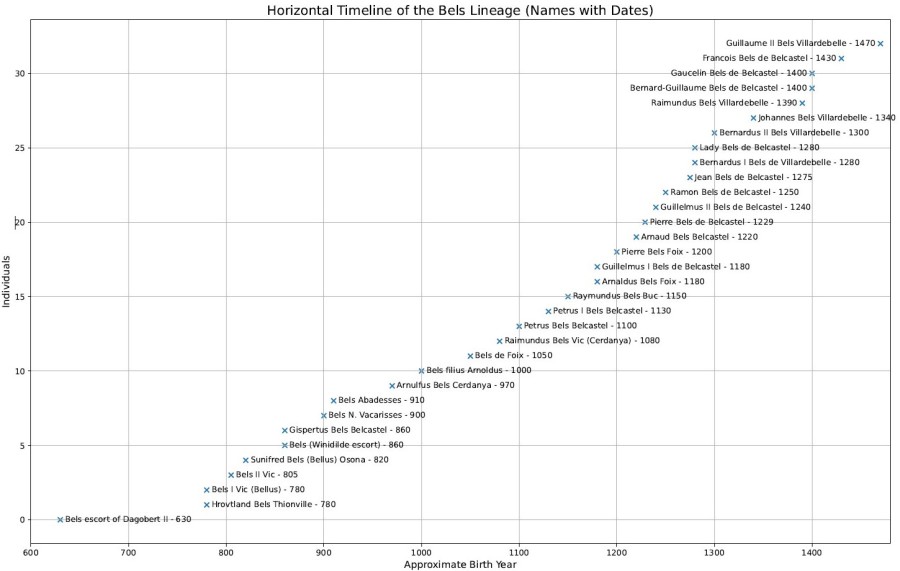
 Druckversion