
THE BELS IN VILLARDEBELLE - BELCASTEL & BUC and BRUCAFEL
VIII. THE BELS IN THE SOUTH OF FRANCE
"…L'Histoire est une Dame à tel point exigeante que l'homme l'évite au lieu de la consulter…"
Frater André Louis Saumier d´Albis (1915 -2004)
“…History is a so high demanding Lady that man avoids her instead of consulting her…”
THE BELS IN
BELCASTEL-&-BUC. BRUCAFEL. VILLARDEBELLE
And incredibly, as it may sound, here is another surprise. Some 32 km northeast of Rennes-le-Château is a very small old village (69 Inhabitants) called Villardebelle.
This toponym is made of two words: “Villar + de Belle”.
By now, we all know that “de Belle” (Flemish) means “de Balliol” (Latin). What the word “Villar” means, I had no clue until I found the word in a dictionary of Medieval Latin. That word means either “Manor” or “Village”.
Is Villardebelle a Manor (small castle) belonging to the Belle or a village called, for a mysterious reason, “de Belle”? Good electronic translations of Villardebelle give unequivocally: “Un village de Belle” (a village or a manor of the Belle). One cannot be more explicit!
In appreciation for 14 years of loyal service to our Dynasty and its Order of Chivalry, Fra. Jürgen Bels, Knight Ordinis Balliolensis, received the High Barony of Villardebelle from his feudal overlord Mgr. Fra. Robert Adelsohn Bels. Fra. Jürgen Bels has, since the 28th of May 2022 in Saarbrücken, the title of High Baron (Baronobis) of Feudal nobility. Fra. Jürgen keeps his Seignorial title of Sire d’Oosthoven, he received after a ceremony of feudal homage performed on 28 May 2008, in the Church of Diepenbeek (Belgium).
Fra. Jürgen’s new charter was handed over by H.E. the countess Caroline Safian Krawiec Brownstone, Knight and Chancellor of North America from Order of St. Stanislas
If the word “de Belle” was used in those times instead of the Latin word “de Balliol”, that may have been the result of a clear intention of its inhabitants, out of Flanders, to mark their settlement for the future. Introducing a Flemish toponym in the south of France, instead of a Latin one that may be interpreted quite differently in the far away future, was for them a kind of insurance that someday linguists and/or historians would discover the hidden message. And that may be: We, in Villardebelle, settled here coming “from Belle” (Flanders).
We encounter exactly the same intention of the Bell (De Bel), from Flanders, who lived in Northumberland, north of England, some 1700 km from Villardebelle! The Bell called their family seat “Bellasis”, what is a contraction of “Bell+assise” or “Bell+seat”. Here, like in Villardebelle, the message may have been: “We, in Bellasis, settled here coming “from Belle” (Flanders).
The locality of Villardebelle (1330 hectares, highest elevation above sea level is 857m and lowest 414m) and/or the manor must have existed at a time the Medieval Latin was still in use. That ranges from the Vth until the XVth century. And that is the case: the church of the village, in Roman Style, was built in the XIIth century. So, the village is at least one thousand years old.
Located west of Villardebelle is another place called Belcastel-et-Buc (from the name of the small River that runs down in the valley). Some 3 km south of this village are the silent and rather mysterious ruins of Belcastel-et-Buc (castle of the Bels) also called “the Castle of Villardebelle” some 12 km away. Picture taken by Ms. Ani Williams of Rennes-les-Bains, on 25th October 2025.
Picture just freed from the morning fog that hung over the mountain in the background. The ruins of the Belcastel-et-Buc (XIth century) rises isolated but majestically on its rocky piton in the Hautes-. Corbières (France), some 30 km north-northeast from Rennes-le-Château. Left the chapel and the cemetery still in use in 2012. View taken from the road D429. Coordinates: 43.02965, 2.35397
According to historians the castle, already mentioned in anno 1082 and later in 1221, under the name “castellum pulchrum” (ce qui, par certains signes apparents, promet d'être bon), was known as the castle of Villardebelle. It was built on a hill about 510 m high in an isolated place north of the Corbières, a wild, hot, and dry mountainous area with the highest elevation culminating at 1231 m (Pic du Bugarach). The absence of round towers means the castle is at least 900 years old.
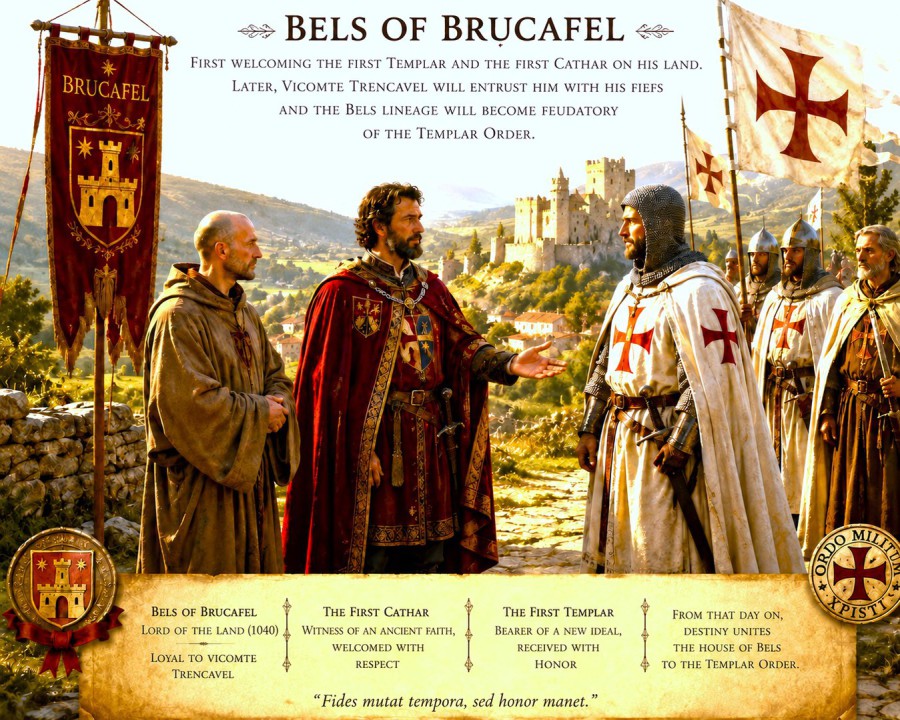
Among the written sources, “the Liber Instrumentorum vicecomitalium”, or “cartulary of the Trencavel family”, contains valuable information concerning the chronology of the fortification. It reports that the Bels lord of Belcastel-et-Buc paid homage to Emmengarde of Carcassonne, who held personal lordship rights. She was the mother of Bernard Aton IV Trencavel (ca.†1129), viscount of Carcassonne and of the Razès, and this act of homage can probably be placed at the end of the 11th century (undated oath).
Bernard was a major figure of the powerful Trencavel viscomital house, which ruled territories including Carcassonne, Albi, Béziers, and the Razès. Emmengarde was probably born around 1025-1035 (most plausible working range), x circa 1065 Raimon Bernard, the first of the Viscountal family who carried the name Trancavel and was active during the late 11th century (approximately 1070-1100).
It is interesting to note that, before bearing the name Trencavel, the Viscounts of Albi belonged to a lineage known under the names Ato or Aton. According to the earliest genealogical sources, the first traces of this family date back to Bernard (Bernart), Viscount of Albi (*abt. 860 - †918).
If this family did indeed rise to the seigneurial aristocracy as a result of the political upheavals associated with the conquest and organisation of the Spanish Marches, as well as the Carolingian campaigns conducted in Septimania and Catalonia, it is likely that its local establishment was already of considerable antiquity. Such an ascent generally presupposes several generations of military loyalty, service rendered to the sovereigns, accumulation of landed wealth, and gradual integration into the regional aristocracy.
Assuming an average of approximately thirty-three years per generation, it may be estimated that Bernard's ancestors were probably established in the region as early as the middle of the eighth century, around 730. This dating nevertheless remains a theoretical reconstruction based on genealogical extrapolation rather than on contemporary documentary evidence.
In this respect, the history of the earliest Trencavel presents certain similarities with that of the Bels. In both cases, the available evidence is compatible with the hypothesis of an origin dating back to the Carolingian period. It is conceivable that their ancestors, like those of other very ancient southern lineages, took part in the military operations conducted in the Spanish Marches during the early Reconquista or in other campaigns of the Carolingian armies.
Be that as it may, the Trencavel appear to represent a lineage considerably older than the houses of Hautpoul and Blanchefort, whose earliest documented attestations are noticeably later. If this hypothesis is correct, it is likely that these very ancient families had known one another for several generations even before they first appeared in medieval charters. Kinship ties, matrimonial alliances, feudal loyalties, and military commitments together formed a particularly dense aristocratic network.
It was within this restricted circle of very ancient families that a substantial part of the political and feudal history of southern Languedoc was written over the course of several centuries. Among them were the houses of Carcassonne, Narbonne, Toulouse, Barcelona, as well as the Trencavel and other leading lineages. All maintained, to varying degrees, relationships of cooperation, rivalry, alliance, or vassalage. They encountered one another on the battlefield, in seigneurial assemblies, through dynastic marriages, and in acts of donation to religious institutions.
Without suggesting that they formed a homogeneous group, it nevertheless appears probable that their principal representatives knew one another personally or, at the very least, were thoroughly familiar with each other's families. Over several centuries, these lineages shaped the history of the Aude, Razès, the Carcassonnais, the Haute-Corbière, the Albigeois, and, more broadly, a large part of southern France.
- Narbonne is the oldest of these four great houses. Following the reconquest of Septimania from the Muslims in 759, Charlemagne installed Frankish counts there in order to organise the southern frontier of his Empire.
- Barcelona became a Frankish County in 801, when Louis the Pious recaptured the city. Its earliest counts formed the nucleus of what would later become medieval Catalonia.
- The comital house of Carcassonne is generally traced back to Bellon, founder of the dynasty known as the Bellonids. From this same family also descended the Counts of Barcelona, which explains the close relationship between the two lineages.
- Toulouse constituted one of the oldest and most powerful counties of the Carolingian Empire. Its earliest counts were appointed directly by the Frankish sovereigns.
Chronologically, the earliest attestations of these great families may be summarised as follows: 759 for the Counts of Narbonne, 778 for the Counts of Toulouse, 790–801 for the houses of Carcassonne and Barcelona, 820 for the earliest known Bels in the region, and around 860 for the earliest documented ancestors of the future Trencavel.
This chronological concentration is very unlikely to be coincidental. It corresponds precisely to the period during which the Carolingians reorganised Septimania and the Spanish Marches, granted honores, benefices, and the first great lordships to their loyal followers, and established the political and feudal structures that would shape southern France for centuries to come. It was within this historical context that the great lineages destined to dominate the history of the region for generations gradually emerged.
The Bels of Belcastel-et-Buc who paid the said homage to Emmengarde may therefore have been her contemporaries and thus belonged to the Bels family that later took over the fief of Brucafel (Carcassonne). One may think in particular of the Bels great-grandparents (*abt. 1040), or of the Bels of Foix (*abt. 1050), or even of members who have not yet appeared in the surviving archives.
In 1182, the viscounts Roger and Raymond Trencavel (his brother) authorized the construction of a castle at a place that had formerly been called Bel Castel in the Razès. This marked the foundation of a new fortification, replacing an earlier structure.
In the 13th century, the Albigensian Crusade disrupted the political situation, and the lands of Belcastel were assigned to Pierre de Voisins, lieutenant of Simon de Montfort. Religious conflict in this territory reappeared in the 16th century.
By the end of the 16th century, the site seems to have been abandoned. In 1668, the lands of Belcastel passed into the hands of François d’Arse. The last lord of Belcastel was the Marquis d’Escouloubre.
It is worth recalling that while Rennes-le-Château lies clearly to the west, at about 6 kilometres, from the Paris Meridian, the celebrated Rose Line, the château of Belcastel-et-Buc stands only 347 metres away from it.
Thus, throughout the entire Rennes-le-Château region, the point lying closest to the Rose Line is precisely Belcastel-et-Buc.
The castle was, together with the castle of Claramunt, on the trade route to Barcelona's, the most important checkpoint in the lower valley of the Llobregat. The bridge over the river is also dated XIIth century BCE.
The dungeon has the typical architecture for Gothic castles built around the year 1000. Walls surrounding the site, are still visible on satellite pictures.
Belcastel-et-Buc is also located in the middle of the Cathars and Templars region. However, and unlike several other nearby castles such as Arques, Termes and the Abbeys of Saint Hilaire and Saint Polycarpe, it seems to have been miraculously and mysteriously spared from the horrible Albigian events, which shook the South of France, starting anno 1209, with the crusade against the Albigians, under Simon de Montfort. Why was this castle spared?
The Middle Age hamlet that surrounded the castle was devastated by a fire and abandoned ever since. The castle and house building stones were used to build the sole house (Villa) of Belcastel-et-Buc down the road west. Left, the much more recent, but almost abandoned, chapel and its graveyard counting a dozen tombs!
* Note: Due to the vagaries of history, the lands, on which the ruins of the castle are located today, were acquired, decades ago, by the family Pages. Correspondence with the owner Madame Pages and with the municipality of Belcastel-et-Buc, through the mayor, Madame Anne Valmigere, has been implemented on 17th Nov. 2019, to buy back these lands. Since Madame Pages passed away, I have been requested to contact one of her sons, Mr François Pages, au Domaine des Candellières, in Belcastel-et-Buc.
The Myterious Funerary Stele in the Belcastel-et-Buc Cemetery.
Interesting to note is the presence of a particularly intriguing upright funerary stele in the very small old castelan cemetery of Belcastel-et-Buc.
The stele belongs to Victor Serie (*1847-†9 March 1874), whose richly ornamented monument and highly unusual inscription have prompted speculation concerning a possible connection with Freemasonry.
At first sight, however, this gravestone does not appear to be specifically Masonic. The visible motifs belong rather to the classical funerary symbolism of the XIXth century:
- The wreath of foliage at the top symbolises remembrance, honour, or the immortality of the soul.
- The two inverted torches on either side represent life extinguished and death.
- The vegetal ornaments evoke mourning and the hope of eternal life.
None of the characteristic Masonic emblems is visible: neither the square and compasses, the letter “G”, the all-seeing eye, the level, the plumb line, nor a Masonic handshake. The two inverted torches on either side should not be mistaken for the two pillars of Solomon’s Temple, Boaz and Jachin.
The gravestone is therefore most likely a Neoclassical funerary monument bearing general funerary symbolism, and its decoration alone does not allow us to establish a Masonic connection.
This nevertheless raises another important question: who was this young man, and why was he commemorated with such an elaborate funerary monument, so unexpected in this isolated cemetery, seemingly lost in the countryside?
At the bottom of the gravestone appears a rather unusual inscription: “Your masters will never forget you.” If the “Masters” mentioned in the epitaph were members of a Masonic lodge (3d degree “Master Mason”), this might explain their willingness to finance such an elaborate monument for a young man who died at only 27 years of age.
But, in that case, what could possibly have motivated his “Masters” to pay him such a marked tribute? Nothing, in the present state of our knowledge, allows us to regard Victor as a Freemason, a Rosicrucian, a seigneurial Knight, that is, a Knight attached to a lordship, and even less as a Knight Templar.
And why surround this gravestone with such mystery, leading us, through its inscription, along a particularly intriguing path which, unfortunately and quite evidently, leads nowhere?
The trail was not erased: it was simply never materialised. No distinctive sign, emblem or additional indication was carved into the stone to reveal the identity of these enigmatic “Masters” or the exact nature of their relationship with Victor Serie. The inscription therefore appears to have been deliberately devised to perpetuate his memory while preserving the anonymity of those who paid him this tribute.
Why do so many mysteries surround such emblematic sites as, just to name a few, Rennes-le-Château, Rennes-les-Bains and Périllos, to which Belcastel-et-Buc now seems to be adding an enigma of its own?
Within the tradition of Chivalric Orders, the title “Master” normally refers to a particular office, such as the “Grand Master” of an Order or the “Master of the House” to which a knight belongs. Since a knight could belong to only one such House at any given time, the plural expression “your Masters” would make little sense in this context.
In addition, knights were commonly identified by recognisable attributes and specific terminology, all of which are absent from this gravestone. There is no sword, shield, armour, helmet, heraldic device, or inscription such as “hic jacet dominus X, miles” (“Here lies Lord X, knight”).
A broadly comparable system existed within certain Rosicrucian Orders. In place of a “Master of the House”, one might find a “Master of the Lodge”, but there was likewise only one presiding Master in each lodge. The plural expression “your Masters” would therefore not naturally suggest that Victor was a Rosicrucian. This consideration alone cannot entirely exclude a connection with some other initiatory society. Moreover, Rosicrucian organisations possessed their own distinctive emblems, most notably the Rose Cross, yet no recognisably Rosicrucian symbol appears on the gravestone.
One point, however, is quite evident: the wording is highly unusual for a family dedication. Nowhere does one find such expressions as “his parents”, “his brothers”, or “his friends”, nor even “his colleagues”, as might have been expected if the monument had been erected by those with whom he worked.
Nevertheless, the word “Masters” is not in itself conclusive. Depending on the historical and professional context, it could refer to employers, teachers, master craftsmen, or other people under whose authority Victor had worked or trained.
In that case, however, the disproportion between his presumed status as a mere servant or labourer and the quality of a monument financed by his employers constitutes a genuine anomaly. A purely professional explanation therefore appears difficult to sustain, as it remains unconvincing.
Despite extensive searches, no other funerary monument bearing the inscription "Your masters will never forget you" has been identified, either among the over 50.000.000 of funerary monuments in France or, to the best of our knowledge, in the other French-speaking countries of Belgium, Luxembourg, and Switzerland.
To date, no other epitaph containing that phrase has ever been traced. The case therefore appears to be unique. Its presence in the tiny and otherwise unremarkable cemetery of Belcastel-et-Buc makes it all the more intriguing.
It is nevertheless unlikely that such links existed between the Bels and these two other families of Belcastel-et-Buc. We recall, indeed, that the last documentary traces of the Bels in this locality date back to the XVth century, with Baron François Bels. There is therefore a hiatus of approximately four centuries between these two periods, which renders any filiation or direct relationship highly conjectural in the absence of new documentary evidence.
By contrast, another aspect of this study deserves particular attention. It lies in the identification of an internal correlation capable of permitting certain historically plausible extrapolations.
If Father Bérenger Saunière, as the numerous elements visible in the Church of Sainte-Marie-Madeleine at Rennes-le-Château appear to attest, deliberately incorporated a coherent body of Masonic and Rosicrucian-inspired symbols, it is reasonable to conclude that he could not have acquired such knowledge without having been in contact with persons initiated into these traditions.
It is highly unlikely that Bérenger Saunière was himself a Freemason. At that time, a Catholic priest could not belong to Freemasonry, as it had been officially condemned by the Church, notably in the papal bull “In eminenti apostolates”, issued by Pope Clement XII in 1738.
If Saunière really used Masonic or esoteric symbols in his church, he must have learned their meaning from people who were familiar with these traditions.
By the end of the XIXth century, the most likely explanation is that he had discreet contacts with such people from the region or with other people familiar with these esoteric traditions. Such contacts would probably have gone unnoticed by his parishioners, who generally paid little attention to where their parish priest acquired his knowledge or found his sources of inspiration.
Because Belcastel-et-Buc and Rennes-le-Château are located only a very short distance from each other, it is also possible that these Freemasons belonged to the same lodge or, at least, were part of the same network of acquaintances Victor had.
In this context, the remarkable monument of Victor Serie (*1847-†1874) in the cemetery of Belcastel-et-Buc becomes especially interesting. It would therefore be premature to dismiss the possibility of a connection between Victor Serie's family, or the members of his lodge, and Bérenger Saunière (*1852-†1917), the parish priest of Rennes-le-Château, even though no known documents currently prove that such a connection existed.
As is well known, Bérenger Saunière was born on 11 April 1852 in Montazels (Aude). After serving for five years in the parish of Alet, he was appointed parish priest of Rennes-le-Château and officially took up his post on 1 June 1885. He was then 33 years old.
Victor Serie, on the other hand, died in 1874, eleven years before Saunière arrived in Rennes-le-Château. If there really was a connection between Victor Serie's circle and that of Bérenger Saunière, it could not have been a personal relationship between the two men. It may instead have involved members of Victor Serie's family, people from his close circle, or, most likely, other Brothers belonging to the same unknown organization who were still active when Saunière was serving as parish priest in Rennes-le-Château.
This observation also allows a reasonable historical hypothesis. For several centuries, the Bels of Belcastel-et-Buc maintained close ties with the lords of Rennes-le-Château. These connections were based on feudal obligations, shared territorial interests, and close neighbourhood relations.
As the previous evidence seems to suggest, at least one member of a family from Belcastel-et-Buc belonged, by the end of the XIXth century, to a mysterious organisation that may have had contacts with the one in which Bérenger Saunière moved. This is precisely what makes this observation so interesting. It raises the possibility that certain local networks of influence, although different in nature from one period to another, may have formed part of a historical continuity going back much further in time.
This continuity may have its roots in the close ties that existed between the Bels of Belcastel-et-Buc and the lords of Rennes-le-Château from the Middle Ages onwards. These relationships were based on feudal obligations, shared territorial interests, and close neighbourhood ties. While this does not prove any direct institutional or personal continuity, the evidence does allow the hypothesis that local networks of influence may have continued to exist over the centuries, changing in form while remaining rooted in the same geographical area and among the same local families.
The noble Bels family held the lordship of Belcastel-et-Buc for almost 3 centuries, roughly from 1150 to 1450. However, their presence in the region is documented much earlier, with Gispertus Bels as early as around 880 and Petrus Bels around 1120. During these 6 centuries of documented history, the Bels lived alongside several successive dynasties that ruled Rennes-le-Château and the Razès.
After the fall of the Western Roman Empire, the Razès became part of the Visigothic Kingdom of Toulouse (Vth-VIIIth centuries). At that time, Rhedae (Rennes-le-Château) was an important regional administrative centre. According to tradition, this was also the period when members of the Bels family came from Flanders, and were present in the region, particularly in the circle of King Dagobert II.
A Brief Historical Overview
In the VIIIth century, after Pepin the Short conquered Septimania, the Razès became part of the Carolingian Empire. The region was then governed by counts appointed by the Frankish king.
From the middle of the IXth century, the Razès came under the control of the House of Carcassonne. Among its best-known rulers were Count Oliba II, Count Acfred I, and, at the beginning of the tenth century, Countess Arsinde. Later, the county passed to the House of Comminges.
During the Xth century, the Razès was gradually united with the County of Carcassonne, strengthening the political unity of the region.
A major turning point came in 1067. When Count Roger III of Carcassonne died without a direct heir, his sister Ermengarde inherited the rights to Carcassonne and the Razès. To strengthen their position against rival claims, she and her husband, Raimond-Bernard Trencavel, transferred these rights on 2 March 1067 to Ramon Berenguer I, Count of Barcelona. From that moment, the Counts of Barcelona became the lawful rulers of Carcassonne and the Razès, at least in legal terms. In practice, however, the Trencavel family continued to exercise real authority over the region for several decades.
It was in this constantly changing political setting that the Bels of Belcastel-et-Buc and Villardebelle, who were well known to both the Trencavel viscounts and the Counts of Barcelona, developed close relationships throughout the Middle Ages with the successive lords of Rennes-le-Château. These ties were based on neighbourhood, feudal obligations, and shared territorial interests. Despite the succession of different ruling dynasties, this remarkable geographical continuity is one of the key elements for understanding how certain local networks of influence may have endured over the centuries.
Around 1082, the Trencavel viscounts regained effective control of Carcassonne, the Razès, and Rennes-le-Château. Bernard Aton IV Trencavel, Viscount of Albi, Nîmes, Béziers, Agde, Carcassonne, and the Razès, exercised authority over these territories on behalf of the Counts of Barcelona, who remained the legal holders of the comital rights.
In 1209, at the beginning of the Albigensian Crusade, the lands of the Trencavel family were confiscated by Simon de Montfort after the capture of Carcassonne and the imprisonment of Raymond-Roger Trencavel. This marked the end of Trencavel political power in Languedoc.
Following the conquest of Languedoc, the Razès was granted to Pierre de Voisins, a companion of Simon de Montfort. Around 1231, the Lords of Voisins became Barons of Rennes, and Rennes-le-Château became the seat of a barony that included several neighbouring parishes and communities, among them Rennes-le-Bézu (Albedun), Rennes-les-Bains, Montazels, Saint-Just, Sainte-Eugénie, Laval-Dieu, and Belfort-sur-Rebenty. The historian Louis Fédié also included Belfort de Voisins, Monterrand, and Moissan, although the exact identification of these places remains uncertain.
It is particularly noteworthy that neither Belcastel-et-Buc nor Villardebelle appears among the lands belonging to this barony. This suggests that these lordships formed a separate feudal entity. They were not part of the Barony of Rennes-le-Château but belonged to a different feudal organisation, most likely an older one that was directly connected to the authority of the Trencavel viscounts.
It is also worth noting that the Bels of Belcastel-et-Buc and Villardebelle appear to have maintained relations with the Hautpoul family from an early period, probably from the XIth century onwards. Since both families belonged to the same feudal sphere under the authority of the Trencavel viscounts, such a close relationship is historically plausible.
History tells us that after Pepin the Short conquered Septimania, the Razès became part of the Carolingian Empire and was placed under the authority of officials appointed by the Frankish king.
The first historically known ruler to govern the Razès was William of Gellone (abt.755-812), a cousin of Charlemagne. As Count of Toulouse, Duke of Aquitaine, and Margrave of Septimania, he was responsible for the administration and defence of this strategically important region at the end of the VIIIth century.
Around 790 or 791, according to the sources, William was succeeded by Bera I, the first Count of Barcelona, who also exercised authority over the Razès. Bera's origin remains a matter of debate. Most historians consider him to have been the son of William of Gellone, while others believe that he belonged to the Visigothic aristocracy that was incorporated into the Carolingian administration after the conquest of Septimania. In either case, this continuity illustrates the Carolingian policy of relying both on loyal followers and on local elites to govern newly conquered territories.
The Bels of Brucafel are first recorded in the first half of the XIth century, at almost the same time as the earliest reliable references to the Hautpoul family.
The family name was formerly written in several Latin and Occitan forms, including Altum Podium, Altapul, Autpol, and Hautpol. It is generally derived from the Latin expression altum podium, meaning "high place," "hilltop," or "fortified site on elevated ground." The name therefore appears to have been a place name before becoming the surname of the family that owned or occupied the fortress.
As for an even earlier origin, some genealogies have attempted to trace the Hautpoul family back to the Carolingian period or even to Visigothic noble lineages. Unlike the Bels, however, whose documented history is supported by an exceptionally strong body of contemporary and independent sources, including cartularies, charters, deeds of donation, and monastic records, allowing the family to be followed from the VIIth century onwards, the earliest origins of the Hautpoul family remain largely hypothetical.
The first securely documented member of the family is the baron Pierre Raimond d'Hautpoul, mentioned at Nîmes in 1084 as a lay nobleman. By 1098, Pierre Raimond and his brother Arnaud already appear as powerful lords able to make important donations and to take part in the First Crusade. Such a position could certainly not have been achieved in a single generation.
The fact that the first surviving with reference to a family, dates from 1084 does not mean that the family originated in 1084. Among the great feudal families, historians generally allow for 2 to 4 earlier generations, roughly 60 to 120 years, whose documents have simply not survived. Several indications suggest that this was also the case for the Hautpoul family.
An old genealogical manuscript of the House of Hautpoul traces the lineage back to Bernard-Raimond d'Hautpoul, who was active around 936 and was therefore probably born around AD 910, together with other ancestors from the Xth century. According to this family tradition, Bernard-Raimond took part in the foundation of the Abbey of Saint-Pons-de-Thomières in 936 and is mentioned again around 960. Source: Gérard Sassier.
Everything suggests that the Hautpoul family already existed in the Xth century, and perhaps even earlier. The real question is therefore not whether the family existed, but where the documentary evidence can be found. As with the Bels, it is possible that earlier references remain hidden in the great southern cartularies, particularly those of Saint-Pons-de-Thomières, Caunes-Minervois, Castres, or Albi, as well as in the archives of the Trencavel viscounts.
Since the present Essay is devoted to the history of the Bels family and its surname variants, it does not aim to provide a detailed study of the House of Hautpoul. The family is mentioned only as a historical point of reference, helping to place the Bels within the network of relationships they maintained with the other great noble families of Languedoc, especially the Hautpoul and the Blanchefort families.
A Brief Summary of Their Documentary Antiquity:
A comparison of these three lineages reveals significant differences in the antiquity of their documentary records.
- The Bels are distinguished by an exceptional documentary continuity extending back to the VIIth century, supported by a substantial body of contemporary and independent sources.
- The Hautpoul are securely attested from the end of the XIth century onwards. Several indications nevertheless suggest that their origins probably date back to the Xth century, although this earlier history remains insufficiently documented.
- The Blanchefort, finally, are securely attested only from the end of the XIth or the beginning of the XIIth century. To date, no contemporary documentary evidence allows their lineage to be traced back to an earlier period.
On the basis of the evidence currently available, the Bels therefore appear to be the oldest of these three lineages from a documentary perspective, followed by the Hautpoul and, finally, the Blanchefort.
The Hautpoul family is securely recorded from the end of the XIth century in the Montagne Noire, near Mazamet. At that time, they appeared as a powerful knightly family, closely associated with the Trencavel viscounts and exercising considerable influence throughout southern Languedoc. It was within this same political sphere, although farther to the south, that the Bels of Brucafel were already established during the first half of the XIth century.
The two families therefore belonged to the same feudal world under the authority of the Trencavel viscounts. In such a setting, contacts between noble families were highly likely. Feudal assemblies, military campaigns, arbitration, marriage alliances, land transactions, and feudal obligations all provided many opportunities to meet and establish lasting relationships.
From the XIIIth century onwards, this close relationship became even more likely. By then, the Bels already held estates at Brucafel, Belcastel-et-Buc, Villardebelle and, through successive acquisitions, in the area around Limoux, while the Hautpoul family gradually extended its influence towards the Aude Valley. Both families were subject, directly or indirectly, to the same feudal authorities and belonged to the same regional noble networks.
Over the centuries, several branches of the Hautpoul family emerged, including the Hautpoul of Félines, Salettes, Seyres, Rennes, and Blanchefort. The branch established at Rennes-le-Château was therefore probably not the original line, but rather a later branch that settled in the Razès, most likely through marriage alliances, inheritance, or the acquisition of lordships.
The real turning point came in 1422, when Pierre-Raymond d'Hautpoul married Blanche de Marquefave. Through this marriage, the Hautpoul family acquired the Barony of Rennes-le-Château, which had previously belonged to the House of Voisins, and became one of the most powerful noble families in the Upper Razès.
From that time onwards, the lands of the Hautpoul became immediate neighbours of the Bels lordships of Belcastel-et-Buc and Villardebelle. Administrative, judicial, feudal, economic, and, where appropriate, marital relations between the two families therefore became particularly likely.
It should be emphasized, however, that Rennes-le-Château and Belcastel-et-Buc (together with Villardebelle) remained legally distinct lordships. The former belonged to the Hautpoul family, while the latter were held by the Bels lineage. This distinction did not prevent regular contacts between the two houses. On the contrary, it reflects the normal relationship between two neighbouring noble families exercising authority over adjoining territories.
If the Hautpoul family really possessed secret knowledge or traditions dating from the XVIth to the XIXth centuries, as many books on the esoteric history of Rennes-le-Château have claimed, it is unlikely that the Bels shared this knowledge. By the end of the XVth century, they had lost their last lordships and were probably no longer part of the noble circles that might have had access to such traditions, even though members of the family continued to live in the region until the present day.
These traditions surrounding the alleged secrets of Rennes-le-Château often involve Abbé Antoine Bigou (*1719-†1794), parish priest of Rennes-le-Château from 1776 to 1791 and confessor to Marie de Nègre d'Ables (*abt.1714-†1781), Lady of Hautpoul and Marchioness of Blanchefort, a woman surrounded by many legends, particularly because of her famous testament.
Abbé Jean Bigou (*1702-†1776), Antoine's brother, maintained close ties with the Hautpoul family and managed many of their affairs for several years. In 1736, he was installed as parish priest of Rennes-le-Château by Étienne Lucet, the parish priest of Rabouillet. After Jean Bigou's death in 1776, he was succeeded by his brother, Abbé Antoine Bigou, who became parish priest of Rennes-le-Château.
For many years, it was widely believed that Abbé Antoine Bigou had taken refuge in Sabadell, near Barcelona, where he supposedly died together with the Bishop of Alet, Mgr de La Cropte de Chanterac. This version was adopted by René Descadeillas and repeated in many books on the history of Rennes-le-Château.
However, the discovery of Bigou's death record has shown that he died at Collioure on 20 March 1794. Historians now agree that, although he may have crossed the border into Spain at some point, Sabadell was not the place where he died or was buried. His death at Collioure is firmly established by the parish registers.
On the other hand, if certain documents or special knowledge relating to Rennes-le-Château date back to a much earlier period, it is conceivable that the noble, chivalric, cultural, and social ties maintained for centuries between these great families may have allowed at least part of this knowledge to be passed on. Over the generations, a few fragments of this intangible heritage, unknown to the general public, may therefore have reached the Bels family.
Be that as it may, no known document concerning the Bels of southern France explicitly refers to any such knowledge. Unless... we recall the place name Les Baillessats, traditionally interpreted as meaning "The Bailles know." What, then, did the Bailles—or the Bels—know?
Did this place name preserve the memory of a particular tradition that has now disappeared? Did it refer to an event or a body of knowledge whose meaning has since been lost? Was there a connection with Rennes-le-Château or perhaps with Perillos? At the present state of research, no definite answer can be given.
Another mystery remains at Les Baillessats. Why was the enigmatic date "1465" carved into a stone and then deliberately concealed beneath the foundations of an old house located about 3.6 kilometres north of Cubières-sur-Cinoble, the door to the majestic Galamus Gorges? As shown earlier, this date coincides with the disappearance of the last documented Bels lords of Belcastel-et-Buc, the last known baron being François Bels (born around 1430).
Could it be that François Bels, then about thirty-five years old, left Belcastel-et-Buc for good and settled at Les Baillessats? No known document currently allows such a conclusion. We are entering the realm of historical hypothesis, where caution is essential. Nevertheless, the convergence of this date, this unusual place name, the secrecy around it, and the simultaneous disappearance of the Bels from the local documentary record is striking enough to deserve attention.
Did the date 1465 simply mark the end of an era, or commemorate a family or seigneurial event that someone wished to preserve from oblivion? If so, why then was the inscribed stone deliberately hidden beneath the foundations of a house instead of being left in plain sight? For now, these questions remain unanswered, and no satisfactory explanation can yet be offered.
Back to Belcastel-et-Buck
Fact is that the church Marie-Madeleine of Rennes-le-Chateau (RLC) is full of Templar, Masonic and Rosicrucian signs. Strange enough to allow us to ask some pertinent questions about this priest! What is sure is that Bérenger Saunière is the tree that hides the forest!
I know rather well the region and I can tell you that, except for Belcastel-et-Buc and for Villerouge-Termenès, some 40 km of Belcastel-et-Buc, no one castle has been spared from the destructive craziness of the Church crusaders. An important crusader detachment came from Carcassonne, followed the Aude River valley, and headed for Limoux.
There they turned east towards the Corbières Mountains marching on the nowadays called D129 and D40 (Departmental) roads. From the D129, abreast of the village Belcastel-et-Buc, it was totally impossible not to see the small castle of Belcastel-et-Buc for it is perched high on a mountaintop, as the crop flies less than 700 m from the road and very well visible against the light.
That year, 1209, Simon de Montfort seized the castle of Bertrand de Blanquefort (1109-1169) and gave it, as its surrounding lands, to his comrade in arms Pierre de Voisins. The lands included Rennes-le-Château, where De Voisins found a permanent residence in what is today the Château Hautpoul. However, not a single mention has ever been found in documents, being they old or modern, as far as the Belcastel-et-Buc is concerned.
We know that the bishopric of Alet-les-Bains received the castle of Bertrand de Blanquefort, and that Lord Bertrand swore allegiance to the Viscount Bernard Aton of Alet-les-Bains. Since the castle of the Viscount is practical at an equal distance between Belcastel-et-Buc (19 km) than the Blanchefort´s Castle (15 km), there is no explanation why there is only the mention of the Blanchefort castle and not a single word about the Belcastel-et-Buc! The lords of Belcastel-et-Buc did not swear allegiance to the Viscount otherwise, the fact should have been recorded. Why were they exempt from this usually unavoidable feudal obligation?
Archaeological research would help us to have a good overview of the castle, because nowadays one is only walking over stones of collapsed walls and next to walls that may collapse at every moment. The site is very dangerous and absolutely not a safe place to picnic or to hang around.
«…Le Donjon. Dans la salle principale ou plutôt le bâtiment le plus imposant, je suis en admiration devant l'équilibre des pierres. J'ai l'impression que la ruine ne veut pas mourir et s'accroche au ciel...». Dixit: Le chevalier Dauphinois, publié dans: Châteaux en Languedoc : 11-30-34-48.
“...The Dungeon (also called the Keep). In the main room or rather the most imposing building, I am lost in admiration in front of the equilibrium of stones. I have the impression that the ruin will not die and clings to the sky...”.
The castle seems to have had a particular history, most probably a Dynastic one that may explain why the Belle Dynasty properties and estates remained untouched by the religious events.
The dungeon of the castle may have been, at least 30-35m height. The main building had several floors. This proposition can be deducted by the height of the dungeon and by the construction holes still visible in the walls of the main building.
Something interesting about this castle is the total absence of a defensive system. It was, of course, perched high on a hill, but unlike other early medieval castles, in Belcastel-et-Buc there are no traces of battlements, arrow slits or machicolations. Its curtain walls are surprisingly thin and the size as the multitude of windows, are by no means to ensure an adequate protection to the inhabitants in case of attack.
In the Middle Ages, it was mandatory to keep the horses inside the walls of the castle. I do not know if Belcastel-et-Buc had some stables or not. I am searching for a plan or a drawing from the castle that could tell me more about it.
There is no trace left of neither a well nor wells that would have given some autonomy to the inhabitants in case of a siege. Wells were, of course, dug inside the castle but also in the keep itself. This would enable the besieged to hold longer in the case of falling curtain walls under the enemy siege.
On the site, the debris, several meters thick, are far too important to locate a well. The danger of falling stones and even collapsing walls is far much too real. It would be virtually suicidal to begin excavating the site without having previously secured it by consolidating works.
Question: What was then the real purpose of this castle? Why building a castle that has no defensive capacities, other than the natural protection of its location that limited and rendered the access to the castle rather difficult, and its “thin” walls?
Were they “castellani” (inhabitants) not afraid to be attacked? And if not, what made them so sure?
As said, the castle’s first mention was 1082, what means that it must have existed there for a longer time. Half a century seems a good working hypothesis what brings us back to anno 1030. Going further back in time is very risky because we know that the very early medieval castles, built with stones and rocks, started around that period.
So is anno 1030 extremely close to anno 1014 when the Baron and Knight Bels (prob. Arnulfius Bels de Cerdanya) appeared, undersigning the document of Vacarisses, for the Count Ramon (972-1017) x in 1001, Lady Ermessen de Carcassonne. In those times, Vacarisses together with the Razes region, that included Rennes-le-Château, Villardebelle, Belcastel-et-Buc and Baillessats, were the estates of the Counts of Barcelona.
As the knight Bels was a baron (baronobis) attached, like his heirs and ancestors, to the court of the aforementioned counts, it is not unfounded to suppose that other members of his family also settled in Baillessats, Villardebelle and that some of them were the builders of Belcastel-et-Buc.
The castle, built on a rocky hook high above the brook “le Buc”, could be better defended than the high plateau of Villardebelle. But as seen earlier, the castle had probably no defence capabilities. Any castle building was either designed to control, defend and/or to protect inhabitants. Belcastel-et-Buc was, at least in its early years, an isolated castle with only a few inhabitants around it, with no strategic roads to control and/or to protect. Only centuries later, from the XIVth century onward, did a small locality develop itself at his feet. But by then, its inhabitants had already abandoned the castle.
Is it evident that, although Belcastel-et-Buc is referred as being the castle of Villardebelle, it may have had not very much to do with this village. The castle could never protect the inhabitants of Villardebelle, at the very most the Lord of the castle, in case of danger. The distance between the two locations, some 12 km, was just next door, but still much too substantial in case of an emergency retreat.
Anno 1082 is also relatively close to 1130. It is the year that Bertrand de Blanquefort asked the Knights Templars to start exploiting a gold mine near his castle and some other not far away. In fact, he ordered important underground constructions made by German miners. A big cover-up operation either to dig up, among others, the treasure of the Visigoths which was gathered during the sack of Rome in August, anno 410, by the Visigoth leader Alaric Ist, the Goth, or from the Merovingians. Or was the operation to create new secret underground galleries and chambers? In that case, the German miners were no longer there to dig up something... but most probably to dig something in (sic) !
Where did the miners dig? Was it in the biggest mine of the Corbières (4 stories deep into the mountain) called “Mine Belle Isis”, in the village of Bouisse? Again, we encounter the patronymic “Belle” ! Pure chance one may retort! What then about the fact that this mine is not located some hundred kilometers away from the ruins of Belcastel-et-Buc but only 13 km from it and only 8 km from the village of Villardebelle? Bouisse is the village next door from Villardebelle!
Or were they working in the old mining complex of Camp-sur-l´Agly near the Mount Bugarach, some 20 km from Bertrand de Blanquefort´s castle? Or in caves from the area? If yes, then we are going to lose ourselves into conjectures because there are dozens of caves in the direct vicinity.
Just to quote three of them. One cave in the Bugarach Mountain, the «Bufo Fret», has a big hall some 50m long and 20m high and the length of its galleries reaches almost 6 km. The “Bufo Fret” and the «Font de Dotz» are the two biggest cavities out of 50 that criss-cross the Bugarach Mountain.
The third big cave in the Bugarach is the “Grotte Cathérale” (picture from the Spéléo Club de l´Aude). Another cave, at the Col de St-Louis has, as of today, no less than 20 km of explored galleries! These caves are situated respectively 12 km and 16 km from Bertrand’s castle. Sufficient places to hide several treasures!
The last inhabitants of the Belcastel-et-Buc abandoned it sometimes during the XIVth century. According to historians, the ruins have been inhabited and totally abandoned ever since. Did the last inhabitants belong to the Bels-Belle Lineage or Dynasty?
The small locality that later developed itself, at the feet of the ruins of the castle, burned out totally decennia ago. Most of the stones were used to create the magnificent villa and estates (some 150ha) distant less than 1.000m from the ruins.
The Knight Jim Elton Bell (Ordinis Balliolensis), an excellent historian, quickly reacted after the publication of this article, by his correspondence dated 18 July 2011:
“... How nice to hear about your new South France findings and possible connections to the Flemish Bels. I admire your ability to piece together new tidbits of data, compare to previously known facts and declare the possibilities. That is the only way to weave possibilities into new history, i.e. even others may pick up on your work and help you prove these as later proven facts.
I have too many associated researcher friends who simply refuse to venture out unless they work with absolute proven facts; hence the reason that few of them ever really discover or contribute anything new... Anyway, your hypothesis is exciting and challenging, and I commend you for continuing the good work that will become so important to our beloved Order...”. Warmest Regards, Brother Jim.
There are four more Belcastel localities in France. All are in the vicinity of Albi! These locations are not necessarily linked to the “Belle” family as Belcastel-et-Buc does.
Question: Belle (Beyle, Bayle, etc.) in Flanders and the others in Languedoc are some 1000 km apart. What was our Lineage doing that far south?
It is known that the Cathars encouraged the establishment of a class of skilled craftsmen. Workshops specialized in the manufacture of textiles and by-products were developed. Moreover, who were the best textile “skilled craftsmen” in those times, but the Flemish?
Ypres was a drapery industry power of the first importance in Middle Age Europe. And it is precisely with this trade that the Bels and Belle were excelling. The astonishing financial fortune they gathered through the centuries came mostly out of the trade and business made with textile.
One of the several mentions about this fact, the records (1250-54-67) of Salomon Belle (†1272) fs. of Jourdain Belle, state: "The gathered notes on Salomon Belle, from Ypres, prove us his wealth and his strength".
It would therefore not be a real surprise if someone would propound the business or commercial hypothesis as a motive behind the settlement of people from our lineages down amidst the Cathars, in south-western France.
In fact, there are some precedents to this sort of skilled artisans’ settlements. Remember the Bels in Limburg (Belgium) dealing with textile in a region that had absolutely nothing to do with it. See “ca. 1492” and in the French part of this Essay under: “Les Belles, Bellis, Bellens sont des Bels”.
There is, however, one stumbling block to this suggestion: Members from our Lineages seem to have settled down in the south of France long before the Cathars! The first reference about the Cathars comes from a letter of the Prior Ebwin von Steinfeld, dated 1145 and addressed to Bernard de Clairvaux. This does not mean that there were no Cathars in the region before this date. But they may have been so few and so insignificant, that they could hardly have been the driving force behind these hypothetical settlements.
The Catharism arose when a priest called Bogomil preached a dualistic form of belief in Bulgaria around 930 CE. The religion itself was born in Persia and was the product of a certain Mani. Paradoxically, the feared contamination ran the opposite direction of the routes taken by the crusades whose intentions were to counteract the “Islamic” contamination (sic).
This infiltration was dangerous for the Roman Catholic Church because, as written by Tim Wallace-Murphy: “…The Gospel of Love, otherwise known as The Secret Gospel of John, taught the simple message that Jesus came to reveal and not to redeem. In this sense, the first identifiable parent of the Cathar faith can be found within the First church in Jerusalem led by James de Just, the brother of Jesus...”.
During my next study trip, I will take more time to visit the village of Villardebelle and try to find out if there has ever been a Manor at this location (as it was the case in Ambels) or if the toponym refers only to the village!
As seen before, Nicole and Alain Bels from Albi told me that the word “Sats” is related to the verb “to know”.
The meaning of the word “Les Baillessats” is thus: “Les Bailles savent” or “The Bailles know”.
- What were the Bailles supposed to know?
- Where did they get the information?
- Why was there such a need to inform the future generations about their “knowledge”?
Due to the extremely short distance (some 30 km) between “Les Baillessats” and “Rennes-le-Château” and its procession of mysteries whose secrets were kept for more than a thousand years, we may speculate if our Lineage knew something about what was going on in Redae, in Rennes-le-Château, with the Merovingian, with the Cathars, with the Templars or with all of them together because they all were interconnected.
All the places our lineages settled in France, and which were named after them, are in the Cathars and Templars region: Albi, Ambels, Ambialet but also, as we will see subsequently Bales, Bayle, Les Bayles, Baillessats, Les Baihards, Montbel, Les Bels, Ambels. They are all located amid the Cathars country such as: Albi, le Bézu, the Château de Blanchefort, the fortress of Peyrepertuse, Rennes-le-Château, the fortress of Montségur, etc.
Our links with the Templar Order, whether on the continent or in England and Scotland, etc., are also firmly established. In addition, our lineage is also linked to some of the most important lineages of the south of France and of the north of Spain such as the one of the Counts of Barcelona, later Kings of Navarre, the Counts of Toulouse and the Counts of Razès, only to quote them!
The small valley south of the elevation (hill) of Rennes-le-Château, in which runs the stream “de Couleurs”, is called “La vallée des Bals” or “The Valley of the Bals”. The chance of finding outside Flanders a toponym linked to our Dynasty or lineage, such as “Bals” - “Bels” - “Bayle”, etc., may be roughly the same as to get the Jackpot on the Lotto (1 upon 100.000.000)! But are we really speaking here of pure mathematical chance, a product of a Cartesian spirit, or from a voluntary intention we still have to discover the reason?
We know that the patronymic “Bals”, together with “Baels” and “Balles”, is a Flemish variant of the name “Bels”. Except for very few occurrences of “Bals” in the south of France, there is no such place in whole continental Europe. It is as if we would encounter, in France, places called after other typical Flemish patronymics such as Beyens, Borrekens, Caloen, Coppens, Festraets, Kerkhove, Mertens, Terlinden, Vantieghem, Verhaeghe, Verwilghen, Vandernoot, etc., and want them to be of French origin!
Apropos, there is a “Vandernoot” married with Castera, buried in a big family vault, in the cemetery of Massat (four kilometers from Les Bels). This “Vandernoot”, is definitively a Flemish person.
This is also true for places encountered, in northern France, such as: Dunkerque (Duinkerke), Coudequerke (Koudekerke), Morbecque (Moerbeke), Steenbecque (Steenbeek), Haverskerque (Haveskerke), Steenwerck (Steenwerk), Steenvoorde (Steenvoord), Oudezeele (Oudezele), Godewaersvelde (Godsvelde or Godewaarsvelde). Even the more exotic Auderuicq comes from the Flemish Ouderwijk.
Nobody, in the northwestern part of France (Nord - Picardie), will ever doubt on the Flemish origin of these toponyms because this part of France is known to have been usurped from Flanders. In these two French departments, people still speak Flemish, as a second language.
We encounter the same phenomenon in the north-eastern part of France (Lorraine - Alsace). In these regions, most encountered toponyms, are of German origin: Windstein, Drachenbronn (Drachenbrunnen), Surburg (Sauerburg), Steinmauern, Fleckenstein, Wintershouse (Wintershausen), Lichtenberg, Baerentall (Bärentall), etc. And people also still speak German!
However, the situation would be quite different if we encountered typical Flemish or German names in the south of France! These would be, to say the least, quite out of place! Like “a hair in the soup”! How should historians react if they encountered, down there, villages called “Baerentall” or “Steinmauern”? Would they want them to be of French origin?
It is precisely what happens with the Flemish patronymics Bels - Bayles! Of course, there is still the possibility that the word “Bals” is taken, in the south of France, in its Provencal acceptation of the term:
“…Bals (Les) - En Provencal, “baou” signifie “rochers”. D´après Amedée Thierry, ce mot aurait une origine ligurienne. A Villebazy, les Bals forment des escarpements, près de Crausse, ils ont donné leur nom à une Metairie…”: In this case the “La valée des Bals” may designate “the valley of the rocks” ! Source: Bedos Amédée Antonin.
Bénédicte et Jean-Jacques Fénie, have not reported a single of these “Flemish” words in their list of Occitan toponyms in the region of the Languedoc speaking. This region encompasses:
- The Aquitaine, South of the Department of the Dordogne, Velines in Sarlat, The Oriental extemity of the Gironde, the plateau and the “serres” de l´Agenais both sides of the valley of the Lot in the Lot et Garonne.
- The Auvergne, District of Aurillac in the Cantal.
- The Languedoc-Roussillon, Aude, West of the Gard d´Ales to Lunel, the Herault and the high Basin of the Agly in the Oriental Pyrennées.
- The Midi-Pyrennée, l´Ariège east of the line Col de Port - le Fossat, l´Aveyron, la Haute-Garonne West from the line Auterive - Toulouse. The Lot, the Tarn and the Tarn et Garonne east of the big Aquitain river.
If the toponyms Bels and Bayles are neither of French nor of Occitan origin, what are they then? It is evident that they are quite out of place!
In fact, there are only three places called “Bels” in France. All three are of Flemish origin and are situated in the south of France. One is designating a small road called “Chemin des Bels” or “Path of the Bels” leading to the locality called “Les Bels”. This locality is some 8 km South from Castres, in the Cathars and Templars region. A very important sign appears right here. The city’s toponym of Castres (43000 inhabitants in 2008) is identical with the one of the Flemish villages called Caestre (1670 Inhabitants in 1999).
As Castres was, in France, in the Templar region, its pendant Caestre happened, by pure chance, to be also in the Templar region but in Flanders. Right in the middle of the first seven Commanderies built in Flanders (around 1128), in the Diocese of Thérouanne. They were in Ypres, Nieuwpoort, Furnes, Caestre, Cassel Steenwerck and Bas-Warneton. Seven others were in the diocese of Tournai: Slijpe, Leffinghe, Steene, Brugge, Ghent, Kortrijk, Pérenchies near Armentières and La Haye in Lomme, next to Lille. Source: E.M Braekman.
Is this not strange to find so many Flemish toponym and patronymics so close to each other, 1000 km away from Flanders. Idem for the blazon of two cities related in Flanders but at first glance totally unrelated in South of France? Left (1) from the city of Tournai (B) and right (2) from Castres (F).
Caestres, in Belgium, belonged to the Balliols of Flanders, who had the well-known Arms with the Pal Vair (3-4-5). The Balliols were also big Lords in Scotland. Why did this Flemish city (6) take the same heraldic elements of the Arms (7) of the Scottish Lords of Barnard Castle, 650 km away, when the Balliols of Flanders, their own Lords (10 km away) had their own?
Did a subtle heraldist want us to realize that the Scottish Balliols, conspiratorially pretended by the French to be of Normandy, were in the past, the Flemish Lords of Balliol (Belle) to whom Caestres (Flanders) depended? How else could we explain all these apparent coincidences?
Back to the “Chemin des Bels”.
The name of the road and of the locality is also quite abnormal. The road should be called “Chemin de Bels” instead of “Chemin des Bels” respectively “Path of Bels” instead of “Path of (to) the Bels” ! The first appellation would mean: “Path leading to a place called Bels” which is the primary purpose of a road sign. The second one would mean: “Path leading to the people called the Bels”.
- “The Bronson Road” is quite different indeed from “The Bronson´s Road” or its genitive pendent
- “The road to (of) the Bronson”! The same is true for the toponym of the locality itself “Bels”: It is, after all, nothing else than the patronymic of a Flemish family!
The other pseudo-toponym I found is the one of a small mountain location (alt 900 m) on the slope of the Pyrenean Mountains, some 4 km northeast of Massat (on the Departmental Road Nr 46). It is called “Les Bels” or “The Bels” (15 houses, only a few permanently inhabited). We have here again the same abnormality as described here above. The name of the locality means “a place where live some people called Bels!”. Compare with an English version as example: “I am driving to Bronson” and “I am driving to the Bronson”. This is quite different!
In addition, but side by side and only separated by some 700 m rough terrain, there is another locality (alt 860 m) named after another Flemish patronymic version of “Bels”, the homonym “Les Bayles” (10 houses). See picture next page. We have seen throughout the previous chapters of this Essay, that both patronymics belong to the same family lineages of Flanders.
That Bayles is a typical Flemish name is also proved by the history of the Bayles in England. As seen “in 1617”: “...The first authentic record of the Bayless, or Bayles family was the appearance of a refugee named John Bayles (Bayley or Baylie), (°1617 in the Parish of St. Peters of Mancrofts in Norwich, Norfolk, England) at Colchester, England.”
John Bayles is said to have come from the Low Countries [Flanders] as a Huguenot who migrated from northern France to escape the death, which overtook so many thousands of Huguenots at the massacre of St. Bartholomew on August 24, 1572. Almost twenty years later, John and two other brothers boarded the “Truelove” and sailed to America they reached on June 10, 1635.
And, as we have seen, there is just on the other side of the mountain, north of “Les Bels” and “Les Bayles” another small settlement called “Balès”. It has the same phonetic identity, a toponym synonymous with “Bels”, “Belles”, and “Baels”.
Some historians assert that the proximity of three hamlets bearing surnames that later evolved into place names supports the hypothesis of a shared origin or lineage, or, at the very least, of an orthographic or phonetic variation of a common name. References to "Bels" and "Bayles" appear in the cartularies of Cerdagne, Osona, Foix, and Béziers, as well as in notarial records from the regions of Carcassonne and Narbonne.
Some troubadours occasionally indicate the author(s) of their songs. This is how the following note A. del Monte 26-42, came to appear: “de Bels m'es lo chans et de Lo pair' e.l filh de Bernart de Venzac, et de Ja ogan pel temps florit d’Adhemar lo Negre..” Source: Annales du Midi.
Or in English: “The song is by Bels, and by the father and the son of Bernart de Venzac, and also by Ja Ogan in the flourishing time of Adhemar the Black.”
“de Bels m'es lo chans” means “the song is attributed to ‘Bels’”, either as a name of the author (a senhal, or poetic pseudonym), or as a patronymic.
“de Lo pair' e.l filh de Bernart de Venzac” indicates a complementary attribution, either to other authors, or to alternative versions of the song.
This Bernart de Venzac is in fact Bernart de Ventadorn (*abt.*1135 -*abt.*1195). Since the text tells us that the song “,,, is attributed to Bels as well as to the father and the son of Bernart de Venzac…” this suggests that the father of Bernart de Venzac must have been born around 1100. This therefore gives us an approximate date for the birth of the “Bels poet”, also around 1100.
Their song “Can vei la lauzeta mover…” (When I see the lark move…) became one of the great classics of its time. One could compare it to a “golden record”, a song that stayed at the top of the medieval “hit parade” for many years.
Jongleurs learned it by heart and sang it from one court to another, which allowed the song to remain popular for many decades. Later, when it was written down in medieval manuscripts, its reputation became even stronger. For this reason, this particular song became one of the most famous lyric poems of the Middle Ages and has remained well known up to the present day.
The music and songs of the troubadours were secular and refined, joyful and full of life, thus diametrically opposed to the religious and dogmatic chants composed mainly of imprecations, guilt and repentance, as they were heard in abbeys and churches. It goes without saying that such pagan songs were hardly welcome, especially in the north of France and in Flanders, where the grip of religion was at its tightest.
In the South of France, however, it was paradise: where the sun shines, where lavender perfumes the air, where thyme and blackcurrant soften the senses, where the vine produces the finest grapes and where the goat and sheep cheeses of the mountains magnificently eclipse those made from cow’s milk in the vast damp and misty plains of the North.
“The South is life; the North is rain,” as a troubadour of modern times named Jacques once said: “…With endless mists to come, With a sky so low that a canal seems to have hung itself, And paths of rain as the only good evening…”
Living a nomadic life, the troubadours travelled great distances and met many people. Despite themselves, they became some of the earliest agents of intelligence, often more influential and better informed than merchants.
The circumstances were quite different: merchants certainly met many people in the marketplaces, but none of them had access to the seigneurial courts. The troubadours, on the contrary, were regularly received there and were therefore always welcomed by lords eager to know what was happening among their neighbours.
Finally, for the noble ladies, were they not the ones who introduced notions such as courtly love, moderation, gallantry and generosity? Were they not the ones who helped transform the perception of women, who were now celebrated and respected rather than merely regarded as prey?
Another interesting clue concerning the “Bels poet” is that the centre of the troubadour tradition was located neither in Bordeaux, nor in Lyon, nor in Metz, but in Puivert, which lies only about 50 km southwest of Belcastel-et-Buc.
There is indeed a historical tradition according to which a great festival of troubadours took place at Puivert around 1170, organised by the local lords, the Congost family. This family depended, just like the Bels of the Corbières, the Razès and the Ariège, on the viscounts of Carcassonne of the House of Trencavel. Thus, the circle closes.
The “Bels poet,” having been born around 1100, therefore joins the group of fifteen Bels recorded in the Spanish March and along the Pyrenean axis between the 8th and the 13th century, confirming a continuous presence of the lineage within this geographical and cultural space.
This interpretation is corroborated by the attested presence of the name “de Bels” in several Occitan and Catalan medieval documents, notably in charters, cartularies (such as those of Cerdagne, Osona, or Foix), as well as in various genealogical annotations. It is further supported by references found in the Annales du Midi, which underscore the persistence of such names in regional literary and poetic corpora.
It is therefore not unlikely that this name, rooted in the local aristocracy or in minor noble lineages, found its way into local or regional songs of southern France, possibly even employed by troubadours themselves, whether as authors or as fictional poetic personae.
Bernart de Venzac (also Ventadom), an Occitan troubadour, likely originating from Venzac in the Rouergue region, then part of the County of Rodez. He lived during the period preceding the Albigensian Crusade, a time marked by increasing religious tension in southern France.
His poetry is distinguished by its sharp, satirical tone, often aimed at the nobility and clergy, as well as by its profound moral reflections. Bernart openly denounced the corruption of the Church and the moral decay of the aristocracy and elite. While his father and the Bels (poet) concentrate more on the music and textes of the “Amour courtois”.
There is no evidence that Bernart adhered to Cathar beliefs, and none of his surviving poems mention the Albigensian Crusade (1209-1229). However, his aversion to the Roman Catholic Church was evident and must have been known to the inquisitors. The silence about him suggests that he may have ceased composing, or possibly died, shortly after the outbreak of the conflict, around July 1210. However, it is also plausible that this absence is simply due to the loss of manuscripts. Personally, I suspect that Bernart may have been among the early victims of the Inquisition.
I wrote a CM (Magisterial Communication Nr 490a), dated 29 February 2016, to a Dynast directly concerned: Mr Françis Bels (°1 Oct 1950), mayor of Roquefère and member of the Departmental Council of the Aude (France) whose father is: Roger Bels!
"... Mister mayor, I am the author of an Essay (written in English), on the right track of completion, on the history of the Bels and other homonymous patronymics, distributed in Western Europe. I allow myself to come to you for the following reasons:
The Bels are members of a very old family. Their first tracks take shape at about the year 286. In the Merovingian times, they become "obvious" and eventually “official” due to their publications in official acts such as:
- The Treaty of Verdun (Thionville) in 843.
- The judicial hearing held at Vacarisses, Catalonia, in 1014 to resolve a claim brought by the vicarius of Olesa de Montserrat. Guillem de Muntanyola, later known as Guillem de Montcada, appears among the participants in his capacity as a comital official.
My research started in Flanders (Belgium), brought me, among others, in the south of France.
Mister Bels, being of passage in June 2016, in the “Cité” (name given to the ancient part of the City of Carcassonne), it would especially be very pleasant and very instructive to me, to be able to meet you there. Do you glimpse the possibility of such a meeting? Looking forward to the real pleasure to read you and/or to meet you, deign to receive, Mister Bels, mayor of Roquefère, my respectful greetings ".
The Email apparently stranded somewhere on the western slope of the Mount Kailash (Tibet), because I never received an answer! However, on 21 July 2016, I finally made contact. Having Mr Françis Bels personally on the line, I could explain to him what I was looking for. Mr Françis informed me that he would use his long-standing good connections to find out some information pertaining to my research and send me anything that might be of some interest. He himself has no idea how the “Les Bels “and “Les Bayles” toponyms could be explained in the south of France. He will investigate.
On June 17, 2016, wanting to gather some information upon the origin of these names, the year of their first appearance in old documents as well as the number of inhabitants by locality, I drove to the Pyrenean Mountain range to meet Madame Marie-Christine Soula, the mayor of Boussenac, the locality on which the "Les Bels" and the "Les Bayles" hamlets depend administratively. Their respectively coordinates are: 42.907626, 1.367095 and 42.904640, 1.354809
Since these localities are literally lost in time and space, on the other slope of a mountain, I had the very unpleasant and tedious time to zigzag up the road (D618) to the mountain pass, called “Col de Port” (Alt.1.249m), to then zigzagging it down to these places. I was lucky, the weather conditions being good, the pass road was open!
Lady Emmanuelle’s father is Pierre Bels, as is her grandfather’s name. The Lady has absolutely no clue where her ancestors originated from. Further research is in the process.
That Miss Emmanuelle Bels is living, or came back to the area, less than 15 km from the medieval locality of “Les Bels”, is unbelievable. If we compare the chances we would have to find anywhere, outside Flanders, a Miss “Vanmuysen” (Flemish name) living 15 km from a locality called after the Flemish name of “Vanmuysen”, which is next to another locality bearing the Flemish synonym “Van Muijsen”, we would quickly realise that the odds are close to zero!
Meeting with Madame Soula, in her mayor´s office (picture right), she told me she had no idea where these toponyms originated from but added that their consonance is definitively not French or from the regional speaking.
As she could not answer my question on the date or time of the toponym´s first apparition, she advised me to contact some historians specialised in this matter. The town hall of Boussenac is not in the Boussenac locality but some 3 km east from it, somewhere on the Départementale D618, south of the “Les Bels” locality, at 42.903831,1.368948
En route to the “Col de Port” there is a locality called “Saurat”, it counts some 580 inhabitants. There lives the dynast Miss Emmanuelle Bels. This, unfortunately, I only found out after my return from my trip to the Pyrenées!
There is yet another truly striking coincidence. Within the triangle formed by Belcastel-et-Buc, Villardebelle, and Terroles, there once existed a locality, belonging administratively to the latter village, called “Les Bels.” It depended upon the seigneurial terriers of the domains of Belcastel-et-Buc, and was situated approximately 6 km from Villardebelle, 11 km from Belcastel-et-Buc, and 14 km from Rennes-le-Château, at the very heart of the Belcastel-et-Buc , Villardebelle, Fenouillet , Quéribus corridor.
This “Les Bels” of the Aude is distinct from the one in Ariège previously discussed, and it remains untraceable today. I read this information somewhere, though I no longer recall where. It is, in truth, becoming quite the “Hals-Eimer” mystery!
Nevertheless, there is an intriguing locality called “Fels” to the north of Terroles. This word “Fels,” which is not of French origin, could it perhaps be a phonetic variant of “Bels,” as is so often the case? The mutation of B into F is real and well attested in the mountain Occitan linguistic zones (Aude, Upper Ariège, Fenouillèdes).
Moreover, whatever its precise toponymic form, this place was a direct dependency of the seigneury of the Bels of Belcastel-et-Buc. It lies precisely in the strategic zone of the passage between Belcastel-et-Buc and Quéribus. This place called “Fels” does not appear to be there by accident. In any case, I continue my research to relocate the primary source of this information.
When my maternal grandfather, Charles-Alphonse Valcke died, March 28, 1974, an announcement of death was printed and distributed. On this announcement, although printed in a Flemish village, by Flemish personal used to deal with Flemish names, the typical spelling error happened once again. The couple Robert Gérard Bels x Suzanne Valcke, my parents, was named “Beyls-Valcke” instead of “Bels-Valcke” ! The same happened in 2025, in Rennes-le-Château on my Parking ID. The Municipality wrote “Belz” instead of “Bels”.
Our Dynast Willy Bels wrote me: “…for your information. In the Ypres´s loan registers one Jonkvrouw, wife of Rycquart (Ryckewaert) Van der Gracht, appears under the following names, sometimes as Marie Belle, then Marie Belles and also as Marie Bels. It should be noted that each time it is the same lady. About the spelling of the name, there was little or no concern at the time…”. Source: Willy Bels, out of Leenregister van de Zaal van Ieper (1514-1515) Johan Beun anno 2001.
If such mistakes could happen in modern times and in a country where more than 99% of the people are literate, then we better understand why so many patronymics variants appeared in the Middle Ages. In those times, the spelling of a name being only phonetic, the name Bels became indistinctly Beils, Beyls, Bells, Belles, Bellis, Belis, Bailes, Bailles, Bails, Bayls, Baillies, etc. Simply because they all sounded exactly the same!
from Bels to Bayles is phonetically plausible, particularly in certain dialectal variants of Languedoc or Rouergue, where the open "e" diphthongizes. This phenomenon did not happen only in Flanders.
Note that the phonetic change from "Bels" to "Bayles" is feasible, especially in specific dialects of Languedoc or Rouergue, where the open "e" sound undergoes diphthongization. This linguistic shift is not exclusive to Flanders.
Therefore, among other particularity of this very hard to study language, French students have so many problems with the spelling. As an example, the sound of the word “vair” can be written, in French, in different ways and will mean every time something else: vers = toward(s), vers = line (poetry), vert = green, verre = glass, vereux = corrupt, ver = worm, vair = vair (slipper), vair = fur (heraldry) and pronounced a little bit too hard will become Fer = iron, Faire = to do !
If somebody tells us, he is living in a place that sounds like “Vair”, how are we going to write it down? If I tell you my name, which sounds like “Bails”, how are you going to write it down?
If the correct spelling was already a big problem in Flanders, there where these synonyms originated from, then we can realise how big the spelling confusing must have been in a place like the South of France? In addition to that, writing down these names, in their correct spellings, must have been a challenge in those times when only a very small fraction of the population was literate.
Outside the monks, the clergy, the Leudes and later the Vassi officers (Lawman, Office holders, Magistrates, etc.), nobody could read nor write. The literacy rate in England, in the XIIIth century, has been evaluated as low as 6% and this percentage did not change significantly until about the beginning of the XVth century.
On the other hand, due to the great use of reading and writing by the urban bourgeoisie, followed much later by the gentry and nobility, Flanders and northern Italy had, as for culture, arts and science developments, the highest rate of literacy in Europe.
If Flemish people have problems spelling those names, what for an insurmountable task it may have been represented for French people, known for their kind of “genetic” resistance to learn foreign languages, and once learned, to master them!
Here at the foothills of the Pyrenées, in extremely isolated areas, Flemish patronymics were given to neighbour localities, moreover, in the Cathars and Templars terrains, at least some 1.000 km away from Flanders! Is this not another coincidence?
And it still goes on. Twelve kilometers south of Castelnau Durban and some 6,5 km as the crow flies north of “Les Bels” is another locality (13 houses) named after another Flemish patronymic variant and homonym for Bels, called “Bales”.
All these above-mentioned places are in the hottest part of the Cathars country and are never further away than 34 km, linear distance, from their famous fortress of Montségur!
The village of “Carla-le-Comte” does not exist anymore. It has been renamed “Carla-Bayle” in the honour of our dynast Pierre Bayle. It is located 25 km west of the city of Pamiers, in the Comté de Foix. Pierre Bayle (1647-1706), the famous philosopher, writer and forerunner of the Encyclopaedists and an advocate of the principle of the toleration of divergent beliefs, was born in Carla-le-Comte.
He was one of the most important professors of history and philosophy of the last centuries. Of Cathar blood, he has not forgotten the inquisition that struck his family four centuries earlier. So, as soon as the opportunity arose, he broke with the Roman Catholic Church and cautiously opted for the nascent Protestantism. In 1681, he took refuge in the Netherlands where he held the chair of a professor of history and philosophy at the illustrious Rotterdam school.
Other small villages called “Bayle” are in the region: one counting some 20 houses is located some 10 km West of Pamiers, one counting 27 houses is located some 15 km southeast of Pamiers and one hamlet counting nine houses is located some 14 km east of Pamiers. All are less than 20 km as the crow flies from the Cathars fortress of Montségur. “Cazals des Bayles” counting 28 houses, is located some 43 km west of the ruins of our castle remnants in Belcastel-et-Buc!
There are a few other “Les Bayles” in France, such as the one in the Ardèche at coordinates: 44.726638, 4.656277 The medieval hamlet of Boussan is also called “Les Bayles”. With only a few houses, it is located at coordinates: 43.239831, 0.891592
I have no idea how these places got their names and haven't paid much attention to them, being too far from the Epicentre of the Bels at the foothills of the Pyerenees. But it is highly probable that the “Bayls” of Flanders also settled there.
As mentioned before, by studying the area between Boussenac and Massat in more detail, I spotted another hamlet on the other side of the mountain, also named after one of our Flanders lineages. It's called “Balès”, one of the “Bels” phonetic variants in Belgian’s Limbourg Flanders.
If one starts from “Les Bels” or “Les Bayles”, already at some 950 m altitude and climb the mountain’s south slope to the top at 1440 m high, one arrives on its northern slope, where one will find down below, at an altitude of some 840 m, the small place called “Balès”, counting just a few houses. Note that the distance between “Les Bels” and “Les Bayles” and “Balès” is exactly 6 km, as the crow flies over the top of the mountain. Coordinates are: 42.961886, 1.350287
And then there's the mountain pass known as "Port de Balès", at an altitude of 1755 m, in a landscape of magnificent desolation. What does this passage have to do with the "Balès»?
And there is even more: To the north of the two historically attested sites of the Lords Bels of Belcastel-et-Buc and Villardebelle lies a hamlet known as “Les Bels” (version 2) or “Les Bels II”. It is located to the east of Viviers-lès-Montagnes, approximately 86 km north of the aforementioned sites, and lies along the axis leading toward the “Bels of Ambels”, on the heights of Ambialet, situated only 56 km from the hamlet of “Les Bels II”.
This little road, called “Chemin des Bels” is no stranger to mystery. It surrounds the very old place of "Les Bels II”, that has no church, no chapel and counts only some 125 inhabitants in 2024. Coordinates: 43.555012, 2.205990
The "Chemin des Bels" is the continuation of 'Chemin des Fontaines'. It takes then a fork-shaped extension and becomes the "Chemin de la Pierre plantée" and then, after leaving the locality to the east, the “chemin” climbs to the left and becomes the "Chemin du secret" who lead - nowhere!
So is the “Les Bels II”, as are some other Bels lineages called places, also linked to a secret and a coded sentence. The chemin “de la Pierre plantée” means “a planted stone”. This has no logic meaning. You can plant a tree, but not a stone! What, then, does this phrase mean and why is the path that follows it, called the “secret path”?
In order to understand these mysteries, we need to go back a long way in time and ask ourselves the question: what could there possibly be in these places, or what did the inhabitants of these places know that could have motivated or necessitated the depositing of such messages, and for whom were they intended?
We can continue asking such questions: What means the carved “1465” message on the stone hidden in the wall of a house belonging to “Les Bailesatz”, which also means “The Bailes know". What do they know, or what did they know?
What is the significance of adding the word “Buc” to the place name of Belcastel? Is it to remind future generations that the people who settled there had a connection with the forester Lyderic le Buc, who lived during the reign of Dagobert I, the ancestor of the initial Count of Flanders?
If seems, the “Buc” would attest the Flanders connection of the inhabitants of Belcastel. In the process, it would also show that Flanders is the origin of other Flemish toponyms and names found in specific areas of south-west France. Areas where the Cathars and Templars were at home.
A fundamental aspect of the names of places and people is something I would like to emphasize without going overboard. It is essential to understand this phenomenon in order to elucidate the presence of these atypical names in this particular region of Southern France.
There is quite evidently nothing surprising about encountering the names of “Martin” or “Dubois”, in France. But if we encounter strange names that appear out of nowhere and that are totally out of place, then questions must be posed.
There is no need to have done Harvard or Oxford to quickly realize that names, such as “Müller” and “Schneider”, are German. That “Rossi” and “Romano” are Italian, that “García” and "Rodriguez" are Spanish, that "Brown" and "Williams" are English, that “Ivanov" and "Smirnov" are Russian, are totally exotic to the Hexagone. The list of names totally foreign to the language of the countries in which they appear is inexhaustible.
Many Flemish names were Frenchized after the annexation of part of Flanders by France in the 17th Century. The «Vandevelde» became «de la Pasture». «Zoeterstede» became «Le Doulieu». «Rijsel-Lille». «Belle-Bailleul», and «Boonen-Boulognes». Linguists and Polyglots will almost instantly make the links, others will not.
Some other names have retained their Flemish origins but have been slightly Frenchized: «Duinkerke (meaning - the church in the dunes) is now Dunkerque». «Ekelsbeke (Ekel stream) - Esquelbecq», «Valensijn - Valenciennes» and «Torkonje - Tourcoing», etc.
“I'm a simple Vivierois who loves his village, is interested in it, and marvels at the past of what our ancestors built and which we are struggling to maintain! The hamlet of Les Bels has existed for a very long time, and in the old days was inhabited mainly by farmers who worked the land around it, some ten families”. Source: Email dated 12 Sept 2024 - 21:28 GMT.
It was agreed that any new information would be passed on to me.
Since our family names have nothing to do with the French language, I turned to the vocabulary of the medieval lingua franca, Occitan. The word “Bels” is found there as a masculine noun meaning “the pipe, the conduit” or, according to M. Montagné, the tree in the expression “Lou Bels”. All of which gives no meaning to the villages encountered.
Other words such as “Bayles” and “Bales” don't exist. Buc meant either a “beehive”’, “brachium sine manu” (an arm without a hand), “mountain peak” or “thorny undergrowth”.
These meanings cannot be attributed to Lyderic le Buc, from Flanders. There are no “mountain peaks” in the vast, flat plains of Flanders, and even fewer “thorn trees”, specific to the south of France, and Lyderic didn't have “an arm without a hand”. As for the "beehive" my goodness! But then, you'd have to be really short of ideas to include such an object in your surname.
As you've already realized throughout this Essay, I don't seek or create mysteries where there are none. I only observe, surprise myself (sic) and simply mention the facts. These facts are the ones that present themselves as “strange” - “questioning” - “defying all logic” and often or even surrounded by “secrets”.
It's up to us to take an inquisitive look at them, because it's certain that behind all these “coincidences”, lie messages destined for future generations. It is up to us, to unravel their mysteries.
As we can see, all these places named after Flemish surnames are relatively centralized and not far apart. The longest distance measured for the establishment of the Bels in the south of France is to the north, Ambels, the Lordship of Frater Heiko Bels, and to the south, Ax-les-Thermes, where our dynasts Sybille and Pons Bailes were burned by the holy Roman Catholic Church during its murderous crusade against the Cathars. That's 140 km straight line.
There is, however, an exception for the Bels held for their duties at the court of the Counts of Barcelona (later the royal court of Aragon). The distance between Ax-les-Thermes and CastelbelI i el Vilar is 150 km.
A few other localities, hamlets or small villages of the same name can be found in France but, being not in the immediate region I am dealing, I do not spend much time describing them! Were all these localities and hamlets, with patronymic variants, named by their occupants who settled there at the time of the Merovingians, the Carolingians, the Count of Barcelona, the crusade against the Cathars, the Templars adventures and of the Rennes-le-Château events? Or did someone else called the localities after the families who settled there, as for the case of Carla-Bayle?
The definition of a locality (Lieu-dit in French) is: “A place which, in the countryside, bears a name reminding a topographic or historic peculiarity and often constitutes a gap from a municipality”. Source: Larousse Dictionnaire de Français. (2015).
For any observer who went to these remote and isolated places, it is clear that their topographic or historical peculiarities equal the absolute zero! There is then only one option left: These places were not called after these criteria but after the patronymic of an important lineage who lived there!
In Spanish, the letter “a” from “Bales” sounds like “a” in “Alpha”. If the place was named “Belles”, the letter “e” would have sounded like “e” in “Echo”. On the other hand, spelling the word “Baills” will have it sounding differently and exactly the same as Bels, Belles, Baels in Flanders and Bayles, Bailles, the word we encountered in the south of France, in the composition “Les Baille-sats” - “The Baille know”.
Why be so precise in trying to describe the phonetic characteristic of this word? What was the intention behind it? What was the underlying message that can only be decrypted by linguists and other gifted researchers? We can draw here a parallel with the words “Bels” and “van Belle” in Flanders and its identical grammatical rules (two aspects of applying the Genitive form of ancient German). A parallel proved with the aid of heraldry (identical blazon). Here also, only specialists could discover the link.
Is this not another incredible coincidence? As said earlier in my Essay, I do not try to make facts to suit my theory but my theory to fit “strange facts” and “unusual coincidences”!
How must I face them? What an attitude should I take? I have only three options: Writing about them, forgetting all about them or applying the ”Conspiracy of Silence”. The latest was already well applied in the Middle Ages, as we can read hereunder the text of Mr Comies (XVth century), the first philosophic historian:
Tout regarder, et faindre riens de veoir ; Watch everything but pretends to see nothing.
Tout escouter, monstrant riens ne sçavoir ; Listen everything, show knowing nothing.
Mot ne sonner des cas qu´on sçait et voit ; Say no word from cases one knows and sees.
What is underlying all these “coincidences” I keep encountering the more I deepen the research for my Essay?
Why can we not find our Lineage settlements anywhere else in Europe? For example: Bailleul in Poland instead of in Flanders and Normandy - Ambels in Austria - Vacarisses in Hungary - Baillessats in the Netherlands - Villardebelle in Denmark - Belle in the Czech Republic - L’Orme in Portugal - Flemingland in Italy - the Bales Valley in Germany - Castellbell in Ukraine - Belcastel-et-Buc in Finland - Bellasis in Switzerland - Bayle in Romania - Bels in Bulgaria, etc.?
On the contrary, all these patronymic toponyms are exactly situated at historical locations where we, together with Templars, Benedictine Monks, and other key figures of the time, were active for centuries, if not more than a millennium. This is absolutely not a curious coincidence!
What is the statistical meaning of all these places called after Flemish names? I am not a mathematician and will never be able to find it out. However, normative logic gives already an answer.
If one takes the specific names appearing in France and focus on their occurrences individually, we may have the impression that there is nothing special or unusual going on there. However, the correct way to analyse the problem is to look at all the names together.
Quoting Prof. Andrey Feuerverger of the Dept. of Mathematics and Statistics at the University of Toronto (Canada):
“...If we were on a crowded street in ancient Jerusalem and called out the name Jesus, 45% of the man would probably answer. If we call Mary, 25% of the women would probably respond. They were both common names! But, if we would call out for a Jesus with a father called Joseph, a mother named Mary and a brother called Jose, the odds that such an individual will respond are quite low. From a statistical point of view, we do not look at the incidence of individuals names, we look at how the factors combine with each other. So sure, a father by the name Joseph is not a rare name, a son by the name of Joshua is not a rare name, but if you combine those two together, it is rarer...”.
This is exactly how we must proceed with the occurrences, in France, of the places called: “Les Bels - Les Bayles - Bailes - Belle, etc.”.
There were in France, as of January 2016, some 35.885 municipalities distributed in 101 French departments. No one single “Bels” or variant could be found! Source: I.N.S.E.E.
Considering that each municipality administrates several villages, hamlets and localities, we may end for the whole Hexagon (France) to an approximate number of 205.000 toponyms. Yet, in the multitude, we only encounter seven hits: 2 for “Les Bels” - 2 for “Bels” and 3 for “Les Bayles”. Seven hits upon 205.000 indicate us not only that these words are extremely rare in France (some 0,003%) but also that they do not originate from that country!
There are also composite words including the patronymics such as Bailles-sats, Baille-stavy, Am-bels, Villar-debelle, Castelbel i el Vilar, etc.
Looking for these places on a map, we quickly realise that their distributions are not at all at random, as it should statistically be the case. Instead, we find them all confined in southern France and predominantly in what used to be the ancient Cathars and Templars region.
The case of “Les Bels” and “Les Bayles”, is quite unique. Here we have two localities called after Flemish patronymics, which are separated by only 700 m distance!
Another Flemish substantive, used in France, as toponym, is “Les Baihards”. As we have seen it, it is also located in the Cathars´ and Templars´ region!
It gets even more interesting. At coordinates 42.88975, 1.39890, some 2 km in a bee line (10 km by road, around the mountain), south-southeast of Boutenac (the village on which the two hamlets of “Les Bels” and “Bayles” depend), there's a hamlet called “Liers”.
This seemingly innocuous toponym has more than one trick up its sleeve.
- The toponym “Liers” exists only twice in the world. Once in France and once in Belgium (Juprelle).
- This “Liers” is a phonetic variant, synonymous with “Leers”.
- This French “Liers” is in the same area as “Les Bels”, “Les Bayles” and “Balès”. It is respectively only 2 km and 9 km away in a straight line.
- There is only one “Leers” in the world, in Belgium and France (sic).
- There's a village called “Leers” on the Belgian-France border. This village was Flemish before it was annexed by France.
- The two “Leers” are thus one and the same village, split in two after the annexation of part of Flanders by France. To appease inhabitants’ sensitivities, it was decided to keep the same toponym for both villages. The part of the village located in France is called “Leers France” or simply “Leers”. The part of the village in the Flanders of yesteryear is called “Leers-Nord” or, nowadays, “Estaimpuis”, due to its merger with this Belgian commune.
- Since the establishment of the Bels-Belle in the South of France, was at least 1000 years prior to the annexation of the “Leers” in Flanders, by France, the village's toponym "Leers" is therefore Flemish.
- As in the case of “Belcastel et Buc”, the stream that flows at the foot of the village of “Liers” has also been named after the village. It is called “Ruisseau de Liers”.
As fate would have it, here comes a new and very surprising element of the puzzle.
I was born in 1946, in the village of “Leers-Nord”. Carrying the surname “Bels” and being born in “Leers-Nord” means that, if I were to move to the village of “Les Bels”, in the South of France, I would never live more than 2 km as the crow flies from the village that bears the name “Leers”, where I was born, but some 900 km straight line, from south of Flanders (sic)!
The “Belcastel et Buc”, “Villardebelle” and “Castellbell i el Vilar” cases are therefore not isolated, and the recurrence of similarities eliminates any desire to categorize them as the mere product of chance.
One last word concerning these Flemish localities near Boussenac. On January 2017, I contacted the Dynaste, Willy Bels, from Leopoldsburg (Limburg. Belgium), I had lost sight of for almost 20 years. Willy is, as were his ancestors, attached to the Bels of Flanders through the big branch of the Bels from Limburg (see blazon 2k).
I was really surprised to learn that Willy knew about these “Les Bels” and “Les Bayles” localities and that he even went to these spots, decades ago! Prior to his trip and to learn more about these two Flemish named localities, he wrote to the mayor requesting some information, to never receive a reply!
Nonetheless, despite Willy's unique encounter situated at approximately 1000 kilometers from Flanders, which presented a challenge comparable to mine, he did not think to disclose this information to me. He should have known far better because he was aware of my extensive historical research. C’est la vie !
Willy transmitted me, mid of the 1980´s, some genealogical data on the branch of Brustem. He participated, together with his uncle Romain Bels, to a conference I hold jointly with Fra. Ignace Bailleul, our Knight from Roeselare, sometime in the early 1990´s, in the Flemish city of Kortrijk. The conference gathered Dynasts from several patronymics such as Bels, de Bels, Belle, Vanbelle, Bailleul, etc.
It is, however, possible that Willy spoke to me about these places, and that I simply forgot all of it. I would not be surprised if this was the case. Whatever, Willy Bels went, driven by historical curiosity, to another place called “Belz”.
This is a small town in the Morbihan department, in Brittany (N.W. France). Here also, as for “Les Bels” in South of France, we find less than a 20 km distance from this place, some Belz Families.
Roland Belz, for example, is living in Pluneret, west of Vannes (France) and only 20 km away from the village “Belz”, called after his patronymic.
The presence of the Bels and Bayles of the South of France could be traced, as we have seen, through the happenings at the Merovingian’s Court, Carolingian’s Court, Counts of Barcelona’s Court, and through the history of the Cathars and Templars. However, what brought the Bels Lineage to this remote western part of France, of Morbihan, far away from the classical theatre of operations I just enumerated, cannot be explained, and constitute a new mystery.
The construction of an initial castel of Belcastel-et-Buc may have gone very back in time, since it is known that members of our lineages had already settled in the region for decades, even centuries.
And, an interesting point in the case of Belcastel-et-Buc is that its owners seem to have had the curious habit, as we have already encountered several times throughout this Essay, of giving Flemish-origin names to the places where they settled: Bailhards, Bels, Bayles, Baillesats, Ambels, etc. This pattern appears not only in the south of France, but also in other regions of Europe where they established themselves: Balliol, Beltz, Belz, Bell, Castelbel I el Villar, and so on.
So many places where their presence appear either attested by the sources, or as the logical and almost normative consequence of the same movement of filiation and settlement.
According to tradition, the first mention of the name Belcastel-et-Buc appears around 844, which suggests an early Carolingian or post-Carolingian occupation. However, the physical construction of the small castle would rather date from the 11th century, at the time of the feudalization of the Razès, when numerous castra, hilltop castles serving as military control posts, arose throughout the region.
During the Albigensian Crusade (early 13th century), Belcastel is mentioned less frequently than Castelpor or Niort, yet it is certain that the site was seized and entrusted by Simon de Montfort to one of his lieutenants, Pierre de Voisins, in 1221. At that time, the name was simply established as Belcastel.
Like many small castra of the Razès, Belcastel-et-Buc served to control a secondary valley and to connect several more important seigneuries, Niort, Puylaurens, Puivert. Its importance was overshadowed by that of its powerful neighbors, yet its history remains closely linked to the network of fortifications in Languedoc during the age of the Cathars and the Crusades.
In the year 1132, documents mention works of modification or expansion at the castle. Later, around 1150-1160, we encounter Pierre de Belcastel, lord of the site, connected by marriage to the house of Aniort, one of the leading families in the region.
This information is of particular importance. It is indeed acknowledged that the d’Hautpoul were the heirs of the d’Aniort. The Aniort, however, were related to the Bels, following the marriage mentioned above. It is therefore plausible that the latter were aware of certain facts or traditions, transmitted through the family narrative and very probably also preserved in sensitive documents relating to the history of the Razès, as well as that of the Hautes-Corbières and the department of Aude.
It is likewise important to emphasize the ties that united the Aniort family with another prominent noble house of the period: the Blanchefort. Ramon d’Aniort, indeed, married Alix de Blanchefort, thereby strengthening the bonds between these lineages. Pierre III de Voisins, Lord of Rennes, who held the entirety of the Razès on behalf of the Crown, and who had become widowed, subsequently married Jordane d’Aniort, a cousin of Ramon.
From these alliances there emerges a broad network of kinship linking at least five major noble families of the region: the de Voisins, the Aniort, the Hautpoul, the Blanchefort, and the Bels. For the sake of completeness, it should also be noted that Ramon had a younger brother named Udaut.
In this regard, it is interesting to recall that “…the Hautpoul possessed in their archives papers that were not family documents…”. These documents appeared to be of such importance that “…in 1870 the notary with whom the family archives had been deposited refused to communicate them to Pierre d’Hautpoul, on the grounds that he could not part with documents of such importance without committing a serious imprudence...” Source: Jean Markale.
As shown earlier, this Pierre should not be understood as a different line of Belcastel lords; rather, he forms part of our own dynastic continuity. His name appears in contemporary charters in the form Petrus Bels, indicating that this Pierre de Belcastel was, in fact, Pierre Bels. Thus, the individual traditionally referred to as the lord responsible for the mid-12ᵗʰ-century restoration and enlargement of the castle is best identified as: Petrus Bels de Belcastel (Pierre Bels, lord of Belcastel).
This attribution is supported by chronological coherence and the genealogical consistency established earlier in our analysis.
Here is a timeline chart presenting several notable members of the Bels lineage in southern France and northern Spain, corresponding to the individuals discussed in Chapter I, Subsection e, entitled “Historical listing from anno 820”.
This timeline is not exhaustive. It focuses on the principal documented lineages directly related to the Bels of Belcastel and Villardebelle axis. Accordingly, it does not include the Bels branches historically established in: Baillessats (Cubières-sur-Cinoble), Les Bayles (Boussenac), Les Bels (Boussenac), Ambels (Ambialet), Albi, and other associated villages and hamlets.
Those parallel branches will be presented and analyzed separately in the respective regional and seigneurial sub-chapters.
- Please note that the toponymes “de Buc” and “Belcastel” on the graph means Belcastel-et-Buc.
- The Bels “de Vacarrisses” is probably the same as the Bels Arnulfus “de Cerdania”, the “Homme de loi” (Man of the Law) wo defended the Count of Barcelona in a Trial against the vicarius of Olesa, in 1014.
This chronological chart highlights the remarkable continuity of the name Bels between the Carolingian Marca Hispanica (Osona and Cerdanya) and the regions of Fenouillèdes, Foix, Belcastel-et-Buc, and Villardebelle, from the VIIIth to the XVth century. It shows first an original establishment around Vic and Ripoll, in the context of the Frankish reconquest of northern Catalonia, followed by a gradual movement toward Cerdanya and the neighboring territories of Quéribus, Fenolhet, and Rhedae (Rennes-le-Château).
From the IXth century onward, and quite possibly already by the late VIIIth, certain branches settled permanently at Belcastel and Buc, as well as at Villardebelle, where a significant seigneurial reorganization took place in the XIVth century. Other lineages, meanwhile, passed through the valleys of Foix and Ax-les-Thermes, following the feudal and military routes characteristic of Pyrenean networks.
Thus, the chronology reveals not a family limited to a single locality, but rather a marcher lineage, mobile, strategic, and deeply rooted within the broader territorial dynamics of the medieval South.
So, the primary value of the timeline lies in its ability to demonstrate long-term continuity of the name across more than eight centuries. While it does not in itself establish direct genealogical relationships between all individuals listed, it reveals a coherent pattern of regional presence, mobility, and eventual stabilization.
In historical terms, this pattern is consistent with the evolution of numerous medieval knightly lineages, whose early members appear sporadically in frontier zones before the family becomes firmly established within a particular seigneurial territory.
Thus, the chronological distribution of the name Bels suggests the trajectory of a lineage that may have originated within the military environment of the Carolingian world, later participated in the development of the Catalan frontier, and eventually became integrated into the local aristocratic structures of the Razès and neighboring regions.
Further names are, in all probability, also preserved in the “compoix” land-registry records, which constitute one of the principal documentary sources for the region. The “compoix” were local cadastral registers, detailing landholdings, taxes, and proprietors. These records frequently provide valuable genealogical information concerning seigneurial lineages.
As we approach the summary chart of the Bels identified in the south of France, it is appropriate to mention several recent discoveries.
3 a. TEMPLAR CARTULARY AND OTHER OLD DOCUMENTS
The Cartulary of the Templars of Douzens (47 km north-east of Belcastel-et-Buc), page 124, testsify that, on 18 July 1167, “the Militia grants to Guilhem and Pierre Bels … an honour that had belonged to their grandparents,” at Brucafel :
« Anno incarnationis Domini MCLXVII, XV kalendas augusti “
“… Nos fratres Militiae Templi concedimus et confirmamus Guillelmo et Petro Bels illud honorem qui fuit avi et aviae eorum in loco qui dicitur Brucafel, cum omnibus pertinentiis suis, sicut tenuerunt et possederunt antecessores eorum. Hoc autem facimus pro amore Dei et pro bono pacis, ut ipsi et successores eorum teneant et possideant dictum honorem sine calumnia. Facta carta apud Douzens, anno et die supradictis… ».
“In the year of the Lord’s Incarnation 1167, on the 15th day before the Kalends of August (18 July).”
“... We, the brothers of the Militia of the Temple, grant and confirm to Guillelmus (Guilhem) and Peter Bels that honour which belonged to their grandfather and grandmother, in the place called Brucafel, with all its appurtenances, just as their ancestors held and possessed it. This we do for the love of God and for the good of peace, so that they and their successors may hold and possess the said honour without dispute or challenge. The charter was made at Douzens, in the year and on the day aforesaid…”
There are even more details in the following charter:
“...Anno millesimo. C.LXVII. Incarnationis dominice, .III. feria, .XV. kalendas augusti, rege Lod[ovico] regnante, civitati que dicitur Carcassona Trencavello proconsule dominante.
Nos scilicet Petrus de Sancto Johanne et Bernardus de Rocafort et Bernardus Cappellanus atque Isarnus, fratres et servi militie Templi Jherosolimitani, cognoscimus vobis Gillelmo Bels et Petro Bels quia dudum Bels avus vester et Rangis avia vestra, qui fuerunt, adquisierunt a vicecomitissa Carcassone et a Petro Arnaldi et Gillelmo Mironis, bajulis illius, honorem in terminio de Burcafols ad Novenum, sicut in altera carta adquisitionis prescripte notatum habetis; qui honor nunc gratia Dei omnipotentis est militie propedicte et servorum ejusdem militie. Ergo ilium honorem modo per nos et per omnes successores nostros bona fide laudamus et donamus vobis prescriptis, videlicet Guillelmo Bels et Petro Bels et uxoribus ac..:”.
“ In the year 1167 of the Incarnation of the Lord, on the third day of the week, fifteen days before the Kalends of August, under the reign of King Louis and under the authority of the proconsul Trencavel in the city called Carcassonne.
We, Pierre de Saint-Jean, Bernard de Roquefort, Bernard the Chaplain, and Isarn, brothers and servants of the militia of the Temple of Jerusalem, declare to Guillaume Bels and Peter Bels that their grandfather Bels and their grandmother Rangis had formerly purchased an estate (called an “honour” in the medieval text) situated at Brucafel, near Novenum. This purchase was made from the Viscountess of Carcassonne and by her representatives, Pierre Arnaldi and Guillaume Miron, as is explained in another, older charter. This estate now belongs to the Order of the Temple, yet the Templars officially recognize the rights of Guillaume Bels and Pierre Bels over this property. Therefore, we formally acknowledge this estate and, in good faith, restore and confirm it to Guillaume Bels and Pierre Bels, together with their wives…. “.
The Templars further declare that this recognition shall remain valid in the future, both for themselves and for their successors, even if :
«…Si quidem in illo honore vineas ad proficuum vestrum tenere non potueritis, terram ad bene laborandum teneatis, unde octavum sextarium vel garbam fideliter fratribus militie prefate donetis. Dare autem vel vend ere sive impignorare aliquid illius honoris si volueritis, cum consilio illorum fratrum fatiendi licenciam habeatis, que consilium juste secundum usaticum Carcassone dabitur vobis…».
“… And indeed, if upon that estate you are unable to maintain vineyards profitably, then you may hold the land for proper cultivation, from which you shall faithfully give to the brothers of the aforesaid militia one eighth of the grain measure or one sheaf of the harvest. Moreover, if you should wish to give, sell, or pledge any part of that estate, you shall have permission to do so with the counsel of those brothers; and such counsel shall be granted to you justly according to the customary law of Carcassonne…”.
These references appear in seigneurial and Templar acts of the XIIth century. It fits within the same great southern corridor, Aude, Carcassès, and Languedoc, which directly touches upon the Razès-Albigeois sphere. The Militia in question is that of the Temple.
In the Middle Ages, Brucafel (Domus Templi de Burcafolis) was a village, or rural domain situated 5 km north of the lower town of Carcassonne. It must have been omewhere between the villages of Villemoustaussou, Villegailhenc and Conques-sur-Orbiel. In the region of the Carcassès (Aude, Languedoc). The toponym appears frequently in thirteenth-century cartularies and in various sources, notably because it constituted a dependency of the Templar commandery of Douzens.
The Templars had established there, around 1133, an establishment called Saint-Jean. After the suppression of the Order of the Temple in 1312, these possessions passed to the Order of Saint John of Jerusalem. The medieval village has since disappeared; the name survives only as a toponym or archaeological site in the vicinity of Carcassonne.
We have thus identified Bels who, in 1167, their age estimated at about 40 years, and therefore probably born abt.1130, as well as their grandparents (* abt. 1080), maintained evidently particular links with the Templars. Something significant must indeed have occurred around 1125-1130 for the Militia of the Temple still to remember it a century later, by honouring the descendants of these “grandparents”.
I do not yet know the precise nature of this event. One thing, however, is certain: the year 1167 falls under the mastership of Mgr. Fra. Bertrand de Blanquefort, 6th Grand Master of the Order of the Temple… as if by coincidence.
The facts mentioned, “an honour that had belonged to their grandparents”, must therefore necessarily have taken place under the mastership of none other than the first Grand Master of the Militia of the Temple, Mgr. Hugues de Payns (1118-1136).
In this Essay, and before the discovery I have just described, I had wondered why no member of our lineage appeared among the 9 founding knights who went before the King of Jerusalem to request authorization to create the Militia of the Temple. I wrote in substance in Chapter XII:
“… As mentioned earlier, in 1096 Hugues de Payens travelled for several months from Flanders to the Holy Land together with Godfrey of Bouillon and knights from the Bels, Belle, and Balliol families. Later, in Jerusalem, Hugues de Payens and several other knights approached Baldwin II of Jerusalem to ask for permission to create what would become the Order of the Knights Templar.
One question, however, remains unanswered: why was not a single knight from our lineage among those who accompanied Hugues de Payens to the king?
Historians have never provided a clear explanation. This is particularly surprising because the kings of Jerusalem at that time were closely connected to the House of Boulogne. Godfrey of Bouillon ruled first as Protector of the Holy Sepulchre, followed by his brother Baldwin I of Jerusalem, and later by their cousin Baldwin II of Jerusalem.
Our lineage had long-standing ties with these families in Flanders. Because of these close family and political connections, knights from our lineage would seem to have been among the most suitable people to approach the king for such an important request. Yet none of them appear in the delegation. This absence is therefore puzzling, especially since obtaining royal authorization was not a simple matter at the time, as several military orders were already active in Jerusalem…”.
Could the recent discovery of “an honour that had belonged to their grandparents” perhaps shed some light on this darker corner of our history? Might it represent, on the part of the Militia, a gesture of gratitude toward the Bels, their grandparents, or perhaps even their great-grandparents (*abt. 1040), for having interceded on their behalf with the King of Jerusalem, or perhaps simply for having voluntarily refrained from joining the petitioning knights who would later become the founders of the Militia? These observations may be regarded as working hypotheses; it remains to be determined whether they may apply in the present case.
Be that as it may, this fact remains more than surprising. It sometimes happens that a distinction is awarded in recognition of the actions of a parent. I personally received one, granted posthumously in honor of my mother, in tribute to her involvement in the Resistance, both in Belgium and in France during the Second World War. However, the granting of such recognition for grandparents remains extremely rare, if not virtually unknown.
Was the 51st Grand Master, Fernando Campelo Pinto Pereira de Sousa Fontes, who, in 1986, agreed discretely to support and sponsor the creation of our Order, an act unprecedented in the entire modern history of the Temple, already aware of ancient documents such as those preserved in the Cartulary of Douzens, and of the unique relationship that has existed for nearly a millennium between the Bels lineage and the Templar Order?
Was this exceptional bond preserved within the secret archives of the Templar Order, accessible only to the Grand Masters and transmitted from one Grand Master to his successor throughout the centuries?
Certain particularly attentive observers may nevertheless have raised such questions when witnessing some of the subtle yet perceptible signs that occasionally emerged during the interactions between Monsignor Dom Fernando and Monsignor Fra. Robert Adelsohn Bels.
Might this be interpreted as a modern expression of recognition toward a dynasty or a lineage that stood alongside the Temple from its earliest moments, in Jerusalem, in Flanders, in France, and later in Scotland?
What, then, might lie hidden behind the thick curtains of the history of the Temple that could explain these few, yet striking, anomalies in its long course?
Was the 51st Grand Master, Fernando Campelo Pinto Pereira de Sousa Fontes, who, in 1986, agreed discretely to support and sponsor the creation of our Order, an act unprecedented in the entire modern history of the Temple, already aware of ancient documents such as those preserved in the Cartulary of Douzens, and of the unique relationship that has existed for nearly a millennium between the Bels lineage and the Templar Order?
Was this exceptional bond preserved within the secret archives of the Templar Order, accessible only to the Grand Masters and transmitted from one Grand Master to his successor throughout the centuries?
Certain particularly attentive observers may nevertheless have raised such questions when witnessing some of the subtle yet perceptible signs that occasionally emerged during the interactions between Monsignor Dom Fernando and Monsignor Fra. Robert Adelsohn Bels.
On the picture at the end of this text, we have : From left to right: H.E. Heinrich Katzenstein, Grand Chancellor of the OSTHM; Monsignore Dr. Yvo Verbeek; Mgr. Fra. Robert Adelsohn Bels; Fra. Jean-Claude Debels; Mgr. Fra. Dom Fernando Campelo Pinto Pereira de Sousa Fontes, Grand Master of the OSMTH; and Dona Maria de Glória Figueiredo, spouse of Monsignore. OSTHM Investiture at La Converserie, Tenneville. Saint-Hubert, Belgium, on 17 June 1995.
Might this be interpreted as a modern expression of recognition toward a dynasty or a lineage that stood alongside the Temple from its earliest moments, in Jerusalem, in Flanders, in France, and later in Scotland?
What, then, might lie hidden behind the thick curtains of the history of the Temple that could explain these few, yet striking, anomalies in its long course?
Now we come to another interpretation of the Latin text. The wording in the document "honorem qui fuit avi et aviae eorum” means that the Templars recognized a “hereditary right” predating the fra. Guillelmus and fra. Pierre Bels. In medieval diplomacy this usually implies one of three situations:
- Earlier donations or alliance. The grandparents may have either donated land to the Templars, supported their establishment locally or allowed them to settle on their territory.
- Joint possession. The land could have been held partly by the Bels family, partly by the Templar commandery or the subject of a restoration of rights. Sometimes descendants recovered a possession that had been temporarily administered by the Order.
- Chronological coherence with the early Templars. The reconstructed chronology is interesting because it overlaps with the very early decades of the Order.
The Great-grandparents Generation (*abt.1040) coincides to the pre-Crusade feudal world.
The Grandparents generation (*abt.1075) coincides to the First Crusade
The Parents generation (*abt.1100) coincides to the early crusading nobility
Fra. Guillelmus & Fra. Pierre (*abt.1130) were adults in 1167 charter.
Fra, Domicius (*abt 1130) were adults in a 1163 charter
Fra. Romi (Raymond) (*abt 1130) was adult in a 1163 charter
The grandparents’ generation corresponds precisely to the era when the Templar Order was founded around 1118.
- The Templar Order may have preserved the memory of an earlier family. Medieval military Orders frequently maintained a lasting institutional memory of their benefactors and early supporters. If the grandparents of the Bels family had contributed to the establishment of a Templar presence, provided land, protected the Order locally, or, as we have hypothetically suggested earlier, had in some manner played a role in the circumstances surrounding the creation of the Order in Jerusalem, it would not be surprising that their descendants later received a formal confirmation of the ancestral honor (understood here in its feudal sense as a hereditary seigneurial holding).
In the 11th-12th century Languedoc and Catalonia, the Latin term “honor” did not simply mean “honour” in the modern sense. It had a technical feudal meaning generally referred to a seigneurial holding, a fief or territorial unit often including lands, rights, revenues, and jurisdiction
So, when the charter says: “illum honorem qui fuit avi et aviae eorum in loco qui dicitur Brucafel”, it essentially means: “that seigneurial holding (or fief) which belonged to their grandfather and grandmother at the place called Brucafel.”
This wording suggests that the grandparents of Guilhem and Pierre Bels held a seigneurial tenure at Brucafel, that the property was recognized as hereditary within the family or that the Templars are confirming or restoring this tenure. This, in turn, indicates that the Bels ancestors held an established feudal possession there. Instead of translating “honorem” simply as “honour”, a more accurate rendering would be:
“… We grant and confirm to Guillelmus and Pierre Bels the seigneurial holding (honor) which belonged to their grandfather and grandmother...”.
We do not know exactly what happened and how to interpred correctly the original text. One thing, however, seems certain: the Bels family must already have had an important connection with the Templar Order in those distant times. Otherwise, it would be extremely difficult to explain why the Grand Master of the Order, Mgr. Bertrand de Blanchefort, autorised the commander of the Commandery of Saint-Jean, at Brucafel, to carry out the recognition described above.
ANOTHER CARTULARY CHARTER 120 [119], dated 18 July 1167, records that :
« … La milice consède à Guilhem et Pierre Bels, moyennant une acapte de 6 de Melgueil, un « honneur » ayant appartenu à leurs grands-parents mais devenu sa propriété, en vue d'y planter une vigne. Ils seront tenus de payer au Temple la moitié des droits, des acaptes et foracaptes qu'ils recevront pour cette vigne, plus un denier de cens annuel par arpent de vigne. La garde du vignoble sera à leur charge ainsi que le transport à Brucafel de la part qui reviendra au Temple. Au cas où le rapport de la vigne serait insuffisant, elle serait mise en labour et soumise à une prestation d'un huitième des fruits… ».
“… The Militia grants to Guilhem and Pierre Bels, in return for an acapte of six deniers of Melgueil, an “honour” which had belonged to their grandparents but had become its property, in order that they may plant a vineyard there. They shall be required to pay to the Temple one half of the rights, acaptes and foracaptes that they will receive for this vineyard, together with an annual census of one denier per arpent of vineyard. The guarding of the vineyard shall be their responsibility, as well as the transport to Brucafel of the share that will belong to the Temple. Should the yield of the vineyard prove insufficient, it shall be put under cultivation and made subject to a levy of one eighth of the fruits…”.
Here is the proof that the said ‘honour’ indeed belonged to the grandparents of the two beneficiaries, and that it was only much later that the Order of the Temple became its owner, through the donations made by the three viscounts, sons of the Viscountess Cécile of Provence (see next page).
As we have seen, Brucafel (Saint-Jean-de-Brucafel) lies some 5 km from the city of Carcassonne, approximately 25 km from the Bels known at Fanjeaux and about 34 km from the Bels of Belcastel-et-Buc. One may therefore ask whether the Pierre Bels mentioned in the cartulary of 1167 might correspond to the Pierre Bels of Belcastel-et-Buc (*abt.1130). If so, he would have been about 37 years old at the time of the act, which would perfectly fit the profile of a knight appearing in such a charter.
But who then was Guillelmus Bels (*abt.1125) ? Since the two men appear together in the document, this suggests that they were either brothers, co-heirs, or members of the same family holding the fief jointly. Guillelmus may well have been the elder and Pierre the younger, as the order in which names appear in medieval charters often reflects seniority.
It is plausible that Guillelmus also came from Belcastel-et-Buc. Indeed, within the Belcastel lineage we later encounter a Guillelmus Bels (*abt.1180) and another Guillelmus (*abt. 1240). The Guillelmus mentioned in the cartulary could therefore represent an earlier member of the same line, perhaps born around 1125 at Belcastel-et-Buc. These indications strongly suggest members of a single and continuous family lineage. As the saying goes, surnames, like apples, rarely fall far from the tree.
Besides Guillelmus Bels and Petrus Bels, the charter also mentions a Pons Bels, accompanied by his nepotes, as well as a certain Domicius Bels.
“… And in the landholding (or tenancy) held by Pons Bels together with his nephews (or descendants) at Comba Simir, one quarter of the tasque. And in the tenancy held by Domicius Bels and Raimond Savarig at Valle Frigida, one third of the tasque…”
"... et in ipsa terra quam tenent Poncius Bels homo et suis nepotibus in Comba Simir quartam partem de tascha. In ipso tamen quod tenet Rocius Guaribi super casal medietatem de tascha. Et in campo Raiopodi sive Villam hoc quod habeo vel inde habebo. Et in ipsa tenentia quam tenent Domicius Bels homo et Raimundus Savarig ad Valle Frigida tertiam partem de tascha ..."
Original text :
⁊ in p̃a tm̃ ꝙ̃ tenẽt põciꝰ bels hom ⁊ suis ne potibꝰ in cõba simir quartã partẽ d taschã. in ip̃o tm̃ ꝙ̃ tenoo Ro̾ciꝰ guaribi suꝑ casal medietatẽ d̾ toschã⁊i in cãpo raio podi s uiliam hoc qͦs habo uł hĩe ab̾o. ⁊ in ip̃a tẽnꝙ̃ tenẽt Dõciꝰ bels hom ⁊ x. sauarigad ualle frigida ĩciõ partẽ đ inscha ⁊ Source : f78-f
There is also further information concerning the lands of certain members of the Bels family:
“... And this vineyard adjoins, on one side, the vineyard of the infant (or lord) Mor de Boc; to the south, the road leading to Saint Mary's monastery; and the land of Bernard de Villaldicino; to the north, the vineyard of Romii (Raymond) Bels and his nepotes...”
« .. et ipsa vinea affron(tat) de altera in vinea infantis Mor(de)boc. Ab meridie in via directione monasterii Sanctae Mariae. Et in terra Bernardi de Villaldicino. Aquilone in vinea Romii (ou Raimundi) Bels et nepotum eius… ».
Original text:
&. ip̃a unĩa affr̃ d alt̾ inuĩa infñ Mor d boc. Amĩe in uia. dc̃cio mim̃ sc̃e marie ⁊ n tm̃ bnardi d uillaldicino. aqͥł in uiña Rõmi bels ⁊ nepotũ eiꝰ. Source : data.biblissima.fr/entity/Q422037. Passage: f111-f
In any case, this passage from the Cartulary of Douzens, whatever its precise interpretation, clearly shows that our lineage maintained exceptionally close relations with the Order of the Temple from the very beginning of its existence.
Plausible conclusion.
The reference in the charter of 18 July 1167 to the grandparents of Guilhem and Pierre Bels has an important chronological implication. Medieval charters frequently preserved the memory of earlier holders of a fief when hereditary rights were confirmed to descendants. If one applies the commonly observed generational interval of approximately 30 to 40 years, the wording of the document allows a reasonable reconstruction of the approximate chronology of the lineage connected to the Brucafel honor.
As detailed earlier, if Guilhem and Pierre Bels were active adults around 1167, they may plausibly have been born abt. 1125-1130. Their father would then belong to a generation born abt. 1090-1100, while the grandparents mentioned in the charter would most likely have been born abt. 1060-1070. This chronological sequence corresponds remarkably well with the feudal context of the region, since the decades around 1075 represent a period during which many minor seigneurial holdings in the Carcassonne area were consolidated or transmitted through matrimonial alliances among local knightly families.
Such a reconstruction therefore suggests that the honor of Brucafel entered the Bels lineage toward the end of the eleventh century, possibly through a marriage alliance with a family already holding property in that locality. The overlordship of the fief may well have belonged to the comital house of the Trencavel, which exercised authority over the Carcassonne region at that time.
There is whowever another mention of a Bels linked to wineyards in the same region of Brucafel :
“... Jherosolimitani unam vineam nostram in honore Bernardi de Caneto ad ipsam Celatam in terminio Sancti Vincentii Carcassone; et ipsa vinea affronta de altano in vinea infantum Mor de Boc, a meridie in via, de cercio in terra Sancte Marie et in terra Bernardi de Villadicuto, de aquilone in vinea Pontii Bels et nepotum ejus...”
“…of Jerusalem, one of our vineyards located within the estate of Bernard de Canet, at the place called La Celata, in the territory of Saint-Vincent of Carcassonne. This vineyard bordered, on the upper side, the vineyard belonging to the children of Mor de Boc; on the southern side, the road; on the western side, the lands of Sainte-Marie and of Bernard de Villadicut; and on the northern side, the vineyard of Pons Bels and his nephews…”
Below is an example page from the Cartulary of Douzens. This deed of donation “Facta carta huius donationis…” dates from the year 1041 (“mense decembris anno dominicae incarnationis Mº Cº XLº Iº”) and was established approximately one year after the presumed emergence of the Bels of Brucafel.
It mentions the names of individuals belonging to families whom the Bels of that period must necessarily have known or interacted with. These include: Petrus de Roveria (Rovira), Berengario de Rovira, Raimundus de Sancto Martino, Guillelmus Catalanus, and Petrus Sacher.
It is interesting to find in this document given names that would still remain familiar in the region in 1167, such as Guilhelm (Guillelmus) Bels and Pierre (Petrus) Bels. I am currently searching for the original documents relating to the Bels.
To understand the historical context of this transmission, it is essential to recall that the Order of the Temple did not yet exist at the time when the Brucafel honor most probably entered the Bels lineage. The Order was created in Jerusalem around the year 1118.
Our main source for this event is the twelfth-century chronicler William of Tyre. According to his account, nine knights, led by fra. Hugues de Payens and fra. Geoffroy de Saint-Omer (lineage of Flanders) presented themselves to Baldwin II of Jerusalem (lineage of Flanders) and offered to protect the pilgrims traveling to the Holy Land.
Most historians place this event around the years 1118-1119. The year 1118 is also the one retained by Ordre Souverain et Militaire du Temple de Jérusalem, in the booklet published in March 2026, on the occasion of the 712th anniversary of the death of Jacques de Molay.
This means that by the time the Templar Order established its authority in the area, toward the middle of the twelfth century, the Bels descendants already possessed hereditary rights to the property. The act recorded in the Cartulary of Douzens in 1167 may therefore represent a formal recognition by the Order of the Temple of a possession that had already belonged to the Bels family for at least two generations.
If the Bels “grandparents” mentioned in the charter obtained the fief at about 25-30 years of age, this would mean that they already held it some 20 to 25 years before the Templar Order was created, and perhaps as much as 35 years before the Order became firmly established in the region, around 1132, and began to play an active role in local land and feudal affairs.
Another document specifies the following:
“… On the day of the Kalends of April in the year 1132, the three brothers and viscounts, Roger of Béziers, Raymond Trencavel and Bernard Aton, with the assent and counsel of their mother, the Viscountess Cécile of Provence, granted to the Order of the Temple a mas situated at the foot of the walls of Carcassonne together with its inhabitants.
On the third day before the Ides of April in the year 1133, Bernard of Canet, Aymeric of Barbaira and several other lords donated to the Order of the Temple the town of Douzens and its territory…Source : Commanderie de Douzens…”. Wikipedia.
So was the Fief or Seigneurie of the Bels “…that was situated at the foot of the walls of Carcassonne together with its inhabitants…”, granted to the Order of the Temple. From that moment on, our overlords were not longer the vicomtes of Trencavel, but the Order of the Temple.
From that time onward, the Bels retained a hereditary grant together with the enjoyment of the feudal rights attached to it.
Alongside the Bels, there appears to have been another lord who likewise saw certain of his rights and domains situated at Brucafel, together with a parcel of land located in the suburbs of Carcassonne “beneath the Toulouse Gate”, transferred, in 1132, to the Templars. This was Messire Roger de Villery. Source: Cartulaire de Douzens. Templiers.net
In 1132, Lord Roger de Villery appears as the holder of rights at Brucafel. As for the brothers Guillaume and Pierre Bels, the charter of 1167 establishes that their grandparents (born circa 1040) already possessed an honour in the same locality around 1080.
The Bels and Villery lineages are therefore both attested at Brucafel between the late XIth and early XIIth centuries. It is thus plausible that these two families exercised feudal rights simultaneously over this extensive territory situated in the region of Carcassonne for a period of at least 50 years.
This situation may suggest the existence of a form of co-lordship (co-seigneury) that is only sparsely documented by the surviving sources, unless further evidence should one day emerge from compoix records, cartularies, or other medieval archives that have remained unexplored.
According to the information presently available, the Lordship of Brucafel extended continuously from Carcassonne to Saint-Jean-de-Brucafel and beyond. It is entirely plausible that it comprised scattered possessions within a radius of 10 to 15 kilometres around Carcassonne, which would have made it a significant lordship within the Carcassès during the eleventh and twelfth centuries.
For the sceptics or the lovers of statistics, it should be noted that the probability that “Villery” and “Willery” are merely two orthographic variants of the same surname is extremely high.
This wording constitutes an ad hoc euphemism intended to remain acceptable within an academic context, as it avoids the assertion of a percentage that cannot be demonstrated with strict statistical rigor. Nevertheless, if one were to express a personal estimate based upon medieval onomastic practices, it would most likely exceed 90%.
As the spelling of surnames had not yet been standardized during the Middle Ages, such interchangeability was by no means exceptional and did not necessarily indicate the existence of distinct families. It resulted primarily from the absence of standardized orthography, each scribe recording names according to local usage, his own training, or the pronunciation he perceived.
The various forms assumed by the original Flemish surname “Bels” are particularly revealing in this respect. Over the centuries, they assumed an extraordinarily wide range of spellings, at times to the point of appearing almost arbitrary: Belz, Belez, Belx, Beles, Belles, Belis, Bellis, Baels, Beltz, Bils, and so forth, as we have already observed repeatedly throughout the preceding chapters.
Much depended upon the regions in which these surnames were used: Flanders, England, Scotland, Aude, Languedoc, Catalonia, Razès, Hautes Corbières, Limburg, the Netherlands, Germany, Poland, and elsewhere.
In medieval documents, the letters “V” and “W” were frequently interchangeable depending upon the region and the period. One commonly encounters variants such as: Villery / Willery, Valter / Walter, Vautier / Wautier, and Villers / Willers.
Other letters were likewise frequently interchangeable in medieval records: T and D in Arnaut/Arnaud - C and K in Karolus/Carolus - I and J in Iohannes/Johannes - U and V in Ubertus/Vbertus - S and Z in Bels/Belz - P and B in Jacob/Jacop - F and Ph in Stephanus/Stefanus, etc.
We have already observed the rather unique ties that connected the 50th (Antonio) and 51st (Fernando) Grand Masters of the Order of the Temple to the Bels lineage (Valerius). An equally extraordinary relationship also existed between the 52nd Grand Master of the Temple, Mgr. Fra. Gérard Edmond Willery, and Mgr. Fra. Robert Adelsohn Bels, Grand Master of the Ordo Balliolensis.
Two representatives of the “Bels” and “Willery” lineages, once co-seigneurs of Brucafel, reunited 9 centuries later. Photograph taken in Paris on 24 November 2018, the day of the election of Mgr. Fra. Gérard Willery to the 52nd Grand Mastership of the Order of the Temple.
Was it merely coincidence that two lords associated with Brucafel, the “de Bels” and the “de Villery”, maintained special relations with the “Order of the Temple” from the very beginnings of its establishment in the region of Carcassonne during the Middle Ages, and that, nearly 900 hundred years later, members of both lineages should once again be found reunited, and maintaining unique relationships with the Order of the Temple?
In casu, Mgr. Fra. Gérard Edmond Willery, as the 52nd Grand Master of that Order, and Mgr. Fra. Robert Adelsohn Bels, as the sole official representative of a foreign Order formally recognized by the 51st Grand Master as a Sister Order within that prestigious institution, while fully preserving its sovereignty and independence, unlike the situation that prevailed in 1167 when the Bels became enfeoffed to the Templar Order, moreover shared personal ties extending far beyond the merely diplomatic and chivalric framework.
The few metaphysical introductory lines of Chapter XII would therefore now appear to possess their full legitimacy:
The Knight does not enter Chivalry. He has never left it.
He simply rejoins his Brothers of the past.
It is beyond time that his work continues,
fueled by an eternal flame that burns within him,
and of which he is even unaware.
Happy and meaningful are the reunions in Chivalry.
This is our true family, our raison d’être.
(Recommendations to the Knight, 2019).
When the various elements of the case are considered together, it therefore becomes increasingly likely that the connection of the Bels lineage with the honor of Brucafel dates back to a period preceding not only the establishment of the Order of the Temple in the region, but even its creation.
And this aspect of the question does not end there. We have already mentioned the Cathars on several occasions and we shall return to them again. It is nevertheless important that the reader bear in mind that what is true for the Order of the Temple and the Templars is also, to a large extent, true for the Cathars.
Without entering here into a detailed analysis of the matter, it is nonetheless necessary to recall an essential point. The patronym Bels, as well as several of its anthroponymic variants, indeed appears in regions where the Templars and the Cathars were active.
Such an observation could easily lead to an erroneous interpretation. It might indeed suggest that members of the Bels lineage were living in territories belonging to the Templars or marked by Cathar influence. Yet a careful examination of the historical context leads us to reverse this perspective.
This nuance, apparently minor, in reality takes on an almost Babylonian dimension inasmuch as it profoundly alters the reading of the facts. It reminds us that the presence of the Bels lineage in these regions predates that of the institutions or religious movements that later became famous there. In other words,
The Bels were not established in the lands of the Templars or the Cathars.
The reality is exactly the reverse.
It was they who came to establish themselves in regions
where the Bels lineage had already been present for centuries.
The Templars, for example, did not appear in the region until after the creation of their Order, founded in the Holy Land at the beginning of the XIIth century and officially recognized in 1129 at the Council of Troyes. Their implantation in the south of France only truly developed from the years 1130-1140 onwards, when the first houses and commanderies were established in Languedoc and Catalonia. A Templar presence is attested in Narbonne around 1130, and the commandery of Douzens was founded in 1141 near Carcassonne.
As for Catharism, it was a dualist religious movement that developed in Western Europe during the twelfth century. Historians see in this doctrine the influence of the Bogomils of the Balkans, who appeared in Bulgaria in the Xth century and whose ideas would gradually have reached Western Europe. In the south of France, Catharism gained particular importance at the end of the XIIth and the beginning of the XIIIth century, especially in the region of Albi, from which the name “Albigensians” derives.
Thus, far from being mere witnesses to these religious or military movements, the Bels appear as belonging to an older seigneurial and territorial reality within which the Templars and the Cathars later came to inscribe themselves.
The clocks of history thus having been reset, let us now resume the thread of our analysis.
STILL ANOTHER OLD DOCUMENT
Other members of the Bels family also appear in sources from southern France. An act dated 12 June 1235 records the following:
“Berangère, daughter of Guillaume Février of Bages, in Narbonne, and her husband Pierre Bels donate a piece of land to the hospital of the Pré de Six…, the act having been drawn up before Arnaud Guilabert, public notary in Narbonne.” Source: La Revue des Bibliothèques.
From this document we can also estimate the approximate year of birth of this Pierre Bels. Since the donation act dates from 1235, Pierre was likely abt. 35-40 years old at the time. From this we may reasonably infer a birth date within the time range 1190-1200. For reference, Narbonne lies only about 78 km east from Belcastel-et-Buc.
The OCR transcription of the Cartulary of the Abbey of Prouille records the entries “Ramundus Bels et Arnaldus Bels, fratres …” and again “R. et Arnaldus Bels, fratres …”, clearly identifying them as brothers. They appear as tenants or rent-payers within a long list connected with the jurisdictions of Fanjeaux and neighbouring localities. The document is introduced under the date 13 January 1320.
The text concerns feudal dues and obligations relating to Fanjeaux and surrounding settlements. Fanjeaux lies approximately 38 km north-west of Belcastel-et-Buc. If we assume that Ramundus and Arnaldus Bels were active adults at the time of the record, their approximate year of birth may reasonably be placed around 1280, following the usual generational estimation of about 40 years.
Within the same Prouille dossier, around 1320, the name “Gualhardi Bels” appears as a land boundary reference (confront), while “Gualbardus Bels” is recorded as a debtor for a parcel of land at Serram-Curtam. These occurrences suggest that we are not dealing with isolated individuals but rather with a small local familial cluster, including Ramundus, Arnaldus, and Gualhardus Bels. Applying the same chronological reasoning, the birth of this Gualhardus Bels may also tentatively be placed around 1280.
Around 1348, a certain Lord Jean Bels (*abt. 1310), a merchant of Fanjeaux, an active commercial centre situated between Toulouse, Carcassonne and the Razès, appears in the records. His testament reveals a remarkable devotion to the great pilgrimage sanctuaries of the Iberian Peninsula. He requested that a pilgrim travelling to Santiago de Compostela should carry, in his name, 4 livres tournois to the Apostle, and he likewise donated 4 livres tournois to the Hospital of Montserrat.
According to the observations of the historian Humbert Jacomet, Jean Bels was among the very few testators from the Toulousain region to make a direct donation to Santiago de Compostela, whereas the majority of the faithful favoured Marian sanctuaries such as Montserrat or Montgauch.
Given the geographical proximity to the ancient centres of the Bels family in the Razès and the Hautes Corbières, this merchant belonged to the same family group as the Bels previously attested at Belcastel-et-Buc, Villardebelle and Brucafel, and there is absolutely no doubt that he was related to the aforementioned Bels of Fanjeaux.
«… On peut aussi racheter son vœu ou faire un legs à une église de pèlerinage. Jean Bels, marchand de Fanjeaux, souhaite qu’un pèlerin de la ville porte pour lui 4 livres tournois à Saint-Jacques de Galice. Il lègue également 4 livres tournois à l’hôpital de Montserrat… » . Source: Presse Universitaire de Perpignan.
This was a very substantial sum for the period. Four livres tournois already represented several months of labour for an ordinary working man. Depending on the method of calculation employed, its modern purchasing power may be estimated at approximately 9.000 euros.
« Jean Bels (*vers 1310), marchand, lègue également des sommes relativement importantes à Roncevaux et à Saint-Jacques. ». Source : Humbert Jacomet.
« Si l'on laisse de côté les comtesses et que l'on fasse nos propres « comptes » … This play of words cannot be translated into English. So, I restarted simply with what follows :
If we make our own "calculations", we find that Jean Bels' pious expenditure alone amounts to 16 livres tournois. Such a sum represented a fortune for the period and could correspond today to some 36.000 euros in purchasing power. One certainly had to possess considerable resources to devote the equivalent of such an amount to works of devotion and the salvation of the soul.
Jean Bels is said to have donated 10 Toulouse-sous to the Hospital of Roncesvalles, one of the principal hospices serving pilgrims crossing the Pyrenees. While the exact modern equivalent is impossible to determine, this donation may reasonably be regarded as representing several thousand euros in purchasing power.
The document identifies Jean Bels simply as a "merchant". While the precise nature of his commercial activities remains unknown, the scale of his pious donations suggests that he was a man of some wealth and social standing within the community of Fanjeaux.
Jean Bels undoubtedly belonged to a wealthy merchant family of the region. My research in the Departmental Archives of Aude has uncovered several particularly interesting references:
"Arnaud Bels was a merchant of Fanjeaux, active at least between 1324 and 1346. He purchased or received rights and feudal rents in Prouille, Laurac, Laurabuc, Alzonne, Brézilhac, and Villesiscle. He was the son of the late Raymond Bels, a merchant of Fanjeaux."
A Raymond Bels, merchant of Fanjeaux, is recorded in 1337 and 1338. ”… in 1337 he acquired a piece of land in Laurac, and in 1338 he was the creditor of a debt connected with the purchase of a riding horse (roncin). He may be the same Raymond Bels mentioned as the father of Arnaud Bels…”. The available documents do not allow us to confirm this with certainty.
These records already reveal at least four members of the Bels family engaged in successful commercial activities, important enough to leave traces in the archives. But what kind of trade were they involved in? The sources currently available do not yet provide a definite answer.
Another major difficulty faces the researcher: how can one keep track of all these identical surnames found in neighboring localities, often during the same periods, from the foothills of the Pyrenees to the slopes of the Montagne Noire? How can we determine with certainty who is who in this true jungle of family names?
The task is made even more difficult because medieval documents usually provide very little identifying information. The same first names appear again and again from one generation to the next, while notaries and scribes often recorded only a name, a place of origin, or an occupation. It is therefore not unusual to find several Pierre Bels, Raymond Bels, Arnaud Bels, or Jean Bels living in neighboring villages, often only a few kilometers apart.
How, then, can we distinguish between these individuals, establish their family relationships, and reconstruct the different branches of the family? Are we dealing with separate lineages that happened to share the same surname, or with members of one and the same family that had been established for many generations throughout the Lauragais, the Razès, the Aude, the Corbières, and the surrounding regions?
In reality, the multiplication of Bels references within a relatively small geographical area may be less an obstacle than a valuable clue. Far from reflecting a mere coincidence of identical surnames, it reveals the existence of a broad family network whose various branches spread throughout the Lauragais, the Razès, and the Corbières over the centuries, while retaining a common surname and, at times, shared economic or landed interests.
Another question must also be asked. If these Bels of Fanjeaux had become merchants, had they therefore ceased to be lords? Did they still retain fiefs, seigneurial rights, or a privileged position within the local hierarchy, like the Bels of Brucafel and others? Or had they gradually abandoned the landed nobility in order to join the emerging patriciate of the great merchant families, as happened in the prosperous cities of Flanders?
The example of Ypres is particularly illuminating. In this powerful cloth-producing and financial city, the Belle and van Belle families, and to a much lesser extent the Bels, some of whose branches appear to have gradually moved toward southern France, ranked among the most influential lineages for several centuries. Although they no longer necessarily claimed noble titles, they had acquired such economic and political power that they had little reason to envy their knightly ancestors. Wealth, credit, commercial networks, and access to urban magistracies constituted a new form of power, often more effective than the possession of a castle or a lordship.
History provides many similar examples. Yesterday as today, influence did not depend solely upon birth, titles, or noble ancestry. In the modern world, a number of businessmen and entrepreneurs, despite having no royal or princely origins, have accumulated fortunes that would make many kings and princes of the past appear modest by comparison. Their power rests not upon hereditary privileges, but upon their control of commerce, finance, technology, and global economic networks. In much the same way, the great merchant families of medieval Ypres, Bruges, or Florence gradually replaced feudal power with financial power, while preserving a position of influence within society.
A natural question therefore arises: did the Bels of Fanjeaux, the Razès, and the Corbières undergo a similar evolution? In other words, did they gradually abandon the lesser landed nobility in order to join the exclusive circle of merchant and patrician families whose wealth, credits, properties, and social connections provided them with an authority sometimes greater than that of the old local lords?
The moral of both the story and History itself may therefore be this:
Yesterday as today, power did not reside solely in crowns, castles, or noble titles. During the Middle Ages, certain merchants of Ypres, Bruges, and Florence already possessed financial resources capable of influencing princes, bishops, and rulers. In our own time, billionaires command fortunes that would eclipse those of many kings of the past and even some contemporary sovereigns. The forms of power have changed, but the underlying phenomenon remains the same: economic power can sometimes rival, and even surpass, political and noble power.
Whether in a medieval castle, a Flemish counting house, a Renaissance banking family, or a modern multinational corporation, wealth has often been one of the principal foundations of influence. Titles may command respect, but financial power has repeatedly demonstrated its ability to shape societies, direct policies, and leave a lasting mark on history.
The sanctuaries benefiting from donations are not necessarily those most frequented by the inhabitants of the Toulousain. Indeed, although most pilgrims travelled to Santiago de Compostela, only Jean Bels, Bernard Dusan and the Viscountess of Lautrec made an explicit bequest there. All the other testators were essentially interested in Marian sanctuaries. At the head of the list were Our Lady of Montserrat and Our Lady of Montgauch.
Perhaps donations were made only to churches whose representatives periodically came to solicit the believers through collections or preaching. Such a network does not appear to have existed for Santiago de Compostela, which could explain why Jean Bels requested that his offering be delivered by a pilgrim travelling there. The latter thus became a sort of spiritual procurator charged with carrying out, in the name of the donor, an act of devotion which the latter could no longer, or no longer wished to, perform himself. For all that, he had evidently kept both feet firmly on the ground.
A Raymond Bels further appears in a list associated with the Inquisition at Narbonne. If this Raymond is indeed recorded in inquisitorial registers dating roughly between 1270 and 1320, several possibilities must be considered: he may have been questioned as a witness, suspected of having had contact with Cathars, mentioned as a relative or neighbour of an accused person, or simply cited in the course of a deposition.
Unfortunately, these “compoix”, if they ever existed for Belcastel-et-Buc, have doubtless been sleeping for centuries in the darkest corners of the archives of certain great cities. Their decipherment would require a rare and patient expertise.
Which professor today would still take the time to devote himself to such a task? Perhaps a passionate student, in the course of a doctoral thesis in history, might one day dare to take up the challenge.
On the 25th day of October, in the Year of Grace 2025, I journeyed to Belcastel-et-Buc, accompanied by Dame Ani Williams of Rennes-les-Bains, faithful companion and collaborator of Fra. Henry Lincoln, Honorary Knight of our Order.
After her renowned work Guardians of the Dragon Path, she has undertaken the writing of a new volume, wherein shall be related the ancient remembrance of our noble site. Moved by the spirit of place, she desired to deepen the understanding of its origins, its ancestral customs, and the traditions transmitted by the people of the valleys and mountains of the Corbières.
La Serpent
But matters do not end with our spontaneous, unforeseen joint visit to the site of Belcastel-et-Buc.
A few weeks after my return, in the course of an informal conversation with Madame Ani, there emerged a piece of information that seemed, at first glance, quite ordinary, yet whose implications, once restored to their topographical, feudal and prosopographical context, proved to be considerable: an ancient marriage had reportedly united a lady from the territory known as “La Serpent” with a lord of Belcastel-et-Buc.
This information concerning the marriage cold be dismissed as a mere local anecdote. Once situated within its territorial, feudal, and dynastic framework, it becomes a piece of evidence of primary importance for understanding the seigneurial lineages of the Razès at the close of the Middle Ages. As will be shown below, the information concerning this marriage proved to be accurate.
The territory known as “La Serpent”, designated in medieval sources as Castrum de Serpente, belongs to the typology of Languedocian micro-fortresses of the 11th-13th centuries. Located 12 kms from Rennes-le-Château and less than 25 kms from Belcastel-et-Buc, distance travelled along the old routes linking Limoux and Saint-Polycarpe, this castrum naturally fell within the sphere of influence of Belcastel.
Its structure, apparently based on a rudimentary defensive complex (gate-tower, small castral enclosure, limited bailey), corresponds closely to those second-rank rural establishments studied by H. Débax, C. Lauranson-Rosaz, and A. Chenevez. Such sites, whose implantation is centripetal and territorially anchored, rarely functioned independently; they are almost always articulated, functionally, matrimonially, or vassalically, with a superior seigneurial centre. Within this regional configuration, Belcastel-et-Buc occupies precisely that higher pole.
From a castral standpoint, the documentary record consistently presents Belcastel-et-Buc as a dominant seigneurial node, while La Serpent appears as a secondary castrum centred on a seigneurial tower or minimal defensive outwork. This asymmetry between the two sites provides the natural backdrop for a matrimonial alliance oriented toward the superior lineage.
Indeed, Belcastel-et-Buc emerges as a well-established and singular seigneurial centre, continuously controlled by one lineage: the house of Bels. Throughout the central Middle Ages, no charter, act of homage, inquisitorial record, or feudal survey reveals any competing family.
In the Limoux - Saint-Polycarpe - Bouriège - Rennes-le-Château area, no other seigneury bore the name “Belcastel,” nor was any noble lineage sufficiently rooted for an individual to be designated “of Belcastel” without belonging to the Bels. The domain thus appears, in the current state of the corpus, as a lineage space of strongly unified identity.
Consequently, even in the absence of an explicit surname, the toponym “of Belcastel” functions as a powerful dynastic marker. In medieval practice, such a designation was reserved for the head of a lineage, a cadet, or a natural branch of the same family, not for an outsider.
Within this framework, the marriage of Gaillarde du Vivier, lady of La Serpent and La Tour en Fenouillèdes, to François Bels of Belcastel, becomes a decisive socio-seigneurial indicator.
Gaillarde belonged to a landed lineage and held a strategically positioned seigneury. A lady of this rank could not have been married to a commoner or to a man lacking a transmissible fief. Her husband necessarily had to be a recognised lord, holder of a castle, acknowledged by the Lévis-Mirepoix, and originating from a lineage stable enough to assure patrimonial continuity.
In the entire Belcastel-et-Buc and Villardebelle area, only the Bels satisfy all these conditions. Moreover, the asymmetry between a micro-castrum and a dominant châtellenie renders such an alliance entirely consistent with the matrimonial practices of feudal families of “middle extraction” (in the sense defined by Poly and Bournazel), for whom marriage served simultaneously as an instrument of territorial stabilisation, social consolidation, and castral reinforcement.
This fact alone places the probability that Gaillarde’s husband belonged to this lineage in the range of 80-85 %, even in the absence of the name.
Further confirmation comes from the feudal homages of the fifteenth century (1432 and 1441) rendered by Bernard-Guillaume Bels “of Belcastel” and Gaucelin Bels “of Belcastel”. These lords held precisely the same fiefs, within the same geographical perimeter, and in the generation immediately following Gaillarde’s marriage.
Even if every mention of the surname “Bels” were removed from the documentation, the structural coincidence would remain: the holders of the fiefs in the fifteenth century necessarily belonged to the same lineage as Gaillarde’s husband in the fourteenth century. Seigneurial continuity thus proceeds without interruption through the heirs of the lineage already dominant at Belcastel-et-Buc at the time of the marriage. This continuity raises the probability of identification to 90 %.
A counterfactual approach, namely, the deliberate removal of the surname Bels from the dossier, offers a valuable test of the robustness of the interpretation.
Even under such neutralisation, the entire interpretative framework remains unchanged: Belcastel-et-Buc is, throughout the medieval record, a castle historically associated with a single lineage; La Serpent is a neighbouring micro-castrum naturally dependent on this superior centre; the marriage in question is a local and coherent alliance; there is a total absence of any competing seigneurial family in the region; and the dynastic continuity of the fifteenth century fits perfectly into this same lineage trajectory.
Indeed, the Bels lineage appears as the only seigneurial group to have exercised a stable and continuous châtelain authority over Belcastel-et-Buc during the central Middle Ages. No charter, act of homage, inquisitorial report, feudal survey, or fragment of recognition attests to the existence of a rival house. In the present state of the documentary corpus, the domain emerges as a lineage space endowed with a strongly unified identity.
Quote :
It is important to emphasize the remarkable stability of the Bels family’s establishment within their seigneurial lands. At Belcastel-et-Buc, their presence is attested from 860, with Lord Gilpertus Bels, to 1430, with François Bels; at Villardebelle, it extends from 1280, with Bernardus Bels, to 1470, with Guillaume Bels.
An important aspect of this territorial continuity lies in the matrimonial alliances contracted with several medieval noble houses of the region, among them:
- Guillaume II Bels de Villardebelle married the (a) daughter of Alzeu de Massabrac, thus linking the Bels directly to the seigneurial sphere of Massabrac and its associated territorial and patrimonial interests.
- Sybille Baille (Bayle) married Arnaud Sicre (senior) at Ax-les-Thermes, attesting to a connection between the Baille/Bayle milieu and notable local families of the high Ariège.
- Petrus (Pierre) Bels de Belcastel entered a matrimonial alliance with the house of Aniort (medieval form) or Niort de Sault; the name of the spouse remains unknown, but the alliance itself is explicitly attested.
- François Bels de Belcastel-et-Buc married Gaillarde du Vivier, Lady of La Serpent and La Tour-en-Fenouillèdes, thereby connecting the Bels to a noble lineage holding strategic sites on the Fenouillèdes frontier.
- A Lady N… Bels de Belcastel-et-Buc married Ramon I de Périllos (Perella), linking the Bels to the powerful Perillos/Perella family, whose influence extended across Roussillon and the eastern Pyrenean sphere.
- A lady of Brucafel (Carcassonne) married a knight of the Bels lineage, probably from Belcastel-et-Buc; however, the surviving act of 1167 does not name that knight, so his identity cannot yet be established with certainty.
- Lady Berangère, daughter of Guillaume Février of Bages, in Narbonne, married Pierre Bels. They donate a piece of land to the hospital of the Pré de Six…, the act having been drawn up before Arnaud Guilabert, public notary in Narbonne.
About the possible alliance between the Bels family and the houses of Hautpoul or Blanchefor : Within the framework of the feudal networks of the Fenouillèdes and Corbières, regional narrative tradition suggests that the Bels of Belcastel-et-Buc and Villardebelle may have been linked by marriage to either the house of Hautpoul or that of Blanchefort. Although no surviving charter or notarized act has yet confirmed such an alliance, the hypothesis remains historically plausible and merits careful consideration.
The house of Hautpoul was one of the most prominent knightly lineages of southern Languedoc, with documented influence extending across the Aude, the Fenouillèdes, and adjacent territories. Its historical connections include Rennes-le-Château, Blanchefort, Roquefeuil, and several strongholds within the Corbières. This geographical and feudal proximity places the Hautpoul network within the same territorial sphere as Belcastel-et-Buc, Villardebelle, Aniort, Périllos, and Ax-les-Thermes, all locations associated with alliances or documented activity of the Bels lineage.
Situated in the immediate vicinity of Rennes-le-Château, the lordship of Blanchefort occupied a strategic position at the heart of the Razès. Its castle, dominating the valley of the Sals, watched over the natural routes of circulation linking the surrounding plateaus to the passes of the Corbières. It lies only 10 km as the crow flies (22 km by road) from the castle of Belcastel-et-Buc, a distance that underlines the territorial proximity and the defensive interdependence of these strongholds.
Within the feudal landscape of the Razès, Blanchefort formed part of a dense network of castles intended to control the valleys, secure communications, and assert seigneurial authority. This geographical proximity suggests constant interactions, military, economic, and matrimonial, between the lineages established in the region. Neighboring lordships, such as those of the families of Hautpoul and of Niort, likewise contributed to this feudal balance, while the superior authority of the Trencavel structured the political and defensive organization of the territory.
In this context, the Bels of Belcastel-et-Buc fully belong within this seigneurial mosaic, where alliances and local solidarities shaped the balance of power and regional stability.
Blanchefort, moreover, should not be understood solely as a toponym. The seigneury and later marquisate of Blanchefort became integrated into the patrimonial sphere of the Hautpoul through dynastic alliances. Consequently, references in regional tradition to a connection between the Bels and Blanchefort may reflect either a direct alliance with a local Blanchefort lineage, or an indirect association mediated through the Hautpoul family.
The absence of explicit documentary confirmation does not invalidate the possibility of such a marriage alliance. Several historical factors may explain the lack of surviving evidence:
- the destruction or dispersal of archives during the Albigensian Crusade and subsequent conflicts.
- the loss of feudal records during later periods of upheaval, including the French Revolution.
- the incomplete preservation of cartularies and testamentary documents.
- the frequent omission, in later genealogical compilations, of alliances involving cadet branches or daughters whose dowries did not carry major territorial transfers.
In the feudal society of the region, matrimonial alliances were essential instruments of territorial cohesion and military solidarity. The documented alliances of the Bels with the houses of Aniort, Périllos, Massabrac, and Sicre demonstrate their integration into the regional aristocratic network. Within this context, an alliance with Hautpoul, one of the dominant noble houses of the area, would be entirely consistent with prevailing patterns of noble strategy.
Three historical scenarios may be considered:
- Direct alliance: a marriage between a daughter of the Bels and a member of the Hautpoul lineage (or vice versa).
- Indirect alliance: kinship established through intermediary families linked to both houses.
- Territorial association: later tradition associating the Bels with Blanchefort through Hautpoul patrimonial connections.
At present, the hypothesis must be regarded as a plausible but unverified tradition. Continued archival research, particularly within the cartularies of Alet, Saint-Polycarpe, and regional feudal records, may yet yield clarifying evidence.
Until such documentation emerges, the tradition remains historically credible within the known feudal geography and alliance patterns of the medieval Fenouillèdes.
Unquote.
This seigneurial asymmetry between a dominant château (Belcastel-et-Buc) and a dependent micro-castrum (La Serpent) naturally explains, as we have seen earlier, a matrimonial alliance oriented toward the stronger lineage, an entirely typical phenomenon in the strategies of advancement, consolidation, and territorial anchoring pursued by the lesser and middle-ranking rural nobility.
It is therefore perfectly logical that a lady from a small castral site, inherently reliant upon the influence of neighbouring powers, should have allied herself with a family established in a fortified, well-rooted castle and already recognised by the regional overlordship.
Such a marriage aligns seamlessly with the matrimonial patterns documented among feudal families of “middle extraction” (in the classification of Poly and Bournazel), for whom marriage served simultaneously as an instrument of territorial stabilisation, social consolidation, and reinforcement of castral authority.
Within this broader structural logic, the hypothetical involvement of another, unknown lineage would require positing the existence of a seigneurial house that exercised dominion over Belcastel-et-Buc and subsequently disappeared without leaving the slightest documentary trace, an eventuality that, according to rigorous historical method, must be regarded as virtually impossible.
The conclusion is therefore historically unavoidable: the “lord of Belcastel-et-Buc” who married the lady of La Serpent was, with near certainty, a member of the Bels lineage. Even when stripped of the surname, the structural analysis, topography, castral hierarchy, matrimonial logic, feudal practice, and dynastic continuity, leads inexorably to the same outcome. In the terms of historical criticism, it would be statistically, structurally, and dynastically implausible for this individual to have belonged to any lineage other than the Bels.
We know that Belcastel-et-Buc remained in the hands of the Bels well into the XVth century, with no rupture in the lineage. I will now attempt to identify François Bels de Belcastel-et-Buc (*1430 - †after 1475), who married Gaillarde du Vivier, lady of La Serpent and La Tour en Fenouillèdes.
Gaillarde was the daughter of Lord N. du Vivier (ca. 1380 - †before 1445), the last male of his line, who transmitted his patrimony to the Gaillarde family, and of a noblewoman from the Fenouillèdes. This was a milieu of micro-nobility active in the mid-fifteenth century. The marriage must have produced at least one male heir, born roughly between 1455 and 1470.
The two other lords of Belcastel-et-Buc mentioned in the confirmations of feudal homages were Lord Bernard-Guillaume “of Belcastel” and Gaucelin “of Belcastel”. Both confirmed these homages in 1432 and 1441, and may already have been adults at that time, probably born around 1400. If so, François Bels may have been the son of one of them.
Bernard-Guillaume and Gaucelin were very likely the sons (or nephews) of Raimundus Bels of Villardebelle (1390) and resumed lordship of the main seigneury at Belcastel after a brief period at Villardebelle.
We indeed have a Bernardus Bels de Villardebelle, born circa 1280, and a Bernardus, born around 1300. We also have Guillelmus Bels de Belcastel, born circa 1180, and Guillelmus Bels de Belcastel, born around 1240, as well as Guillaume Bels de Villardebelle. Thus, parental links appear to be established.
Comparing the economic strength of the lordships referenced above helps clarify the strategic significance of these alliances.
An annual seigneurial income of approximately 80 to 110 Livres tournois placed the lords of Belcastel-et-Buc and of Villardebelle (same family) in a position of relative comfort. It was sufficient to maintain horses, arms, and a household, without reaching, as noted, the opulence of the great feudal houses.
Ultimately, the Bels appear to have attained a financial strength comparable to that of the lords of Blanchefort that reached from 120 to 250 Livres tournois yearly: Like them, the lords Bels were probably able to maintain between 3 and 6 knights, 15 to 30 men-at-arms, and a militia of 60 to 120 men mobilizable in times of necessity. Only the Niort family (400 to 900 Livres tournois) surpassed them by far in financial power.
For the Bels of Belcastel-et-Buc (BCB) and Villardebelle, an income of 80 to 100 livres tournois could represent, depending on the period, the realistic equivalent of approximately €80,000 to €110,000 seigneurial income per year, in modern terms. For the lords of Blanchefort, the equivalent income may be estimated at roughly €100,000 to €200,000 per year, while that of the Niort de Sault family could range from about €300,000 to €800,000 annually.
Taken together, these lordships constituted an interconnected defensive and economic network, which helps explain the military, economic, and matrimonial interactions between the lineages.
As we have seen earlier, when comparing the remains of the Château de Blanchefort and those of the Château de Belcastel-et-Buc, one quickly notices a visible difference in size and location.
The castle of Blanchefort is built on a rocky spur that widely dominates the valley of the Sals. Its position is impressive and highly visible. The fortified area can be estimated at between 1,500 and 2,500m². A small “house” compared to our Barnard Castle site in the County of Durham (England). It has, as seen today, and all four wards included, a size of 20,000 to 25,000 m².
This relatively large surface of the Blanchefort castel, combined with its elevated position, shows that it was a fortress designed to control a broad area. From this point, the natural routes of communication and the access to the surrounding plateaus could be monitored. Blanchefort therefore appears as a stronghold of regional importance, integrated into the defensive system of the Razès.
The castle of Belcastel-et-Buc, by comparison, is more modest. Its enclosure can be estimated at between 800 and 1,200 m². It too was built in a strategic location, but without the same spectacular sense of dominance. Its function seems to have been primarily local: to protect the seigneurial domain, oversee the agricultural lands, and defend a more limited territory.
If one considers only the size of the walls, Blanchefort therefore appears more important. Yet, as we have already demonstrated in our earlier comparison (see abt. page 340), when examining the thickness of the walls of the castle of Belcastel-et-Buc and those of Barnard Castle on the border of Scotland, such architectural measurements alone cannot determine the real standing of a fortress.
Indeed, wall thickness, surface area, or topographical dominance are visible indicators of strength, but they do not necessarily measure political influence, economic capacity, or dynastic weight. Medieval power was rarely expressed in stone alone. It was structured through land revenues, marital alliances, vassalic bonds, and integration within a defensive and territorial network.
To judge a castle solely by its dimensions risks misunderstanding the nature of feudal authority. A fortress may be modest in scale and yet belong to a lineage whose influence extends far beyond its walls. Conversely, an imposing structure may reflect strategic necessity more than dynastic prominence.
Thus, the comparison between Blanchefort and Belcastel-et-Buc castles illustrates a broader principle that underlies this study: material scale does not automatically equate to historical importance. In the feudal world, power was relational before it was monumental.
In short, Blanchefort seems to have played the role of a dominant fortress in the region. Belcastel-et-Buc, although smaller, was not without importance. It formed part of a coherent whole in which each castle had its function. Its smaller size simply corresponds to a role adapted to its territory.
By way of example, and shifting completely in scale, moving from a local lordship to a regional princely power, the Viscount Trencavel (11th-13th centuries), to whom Carcassonne, Béziers, Albi, Nîmes, Agde, and the Razès were subject, received revenues that may be estimated at between 3 and 10 million euros annually in present-day value. His authority extended over a large part of Languedoc.
The Count of Toulouse, for his part, possessed a power comparable to that of a small kingdom and enjoyed seigneurial revenues that may reasonably be estimated, depending on the period, at between 20 and 60 million euros per year.
However, if the marriage of Pierre Bels of Belcastel-et-Buc to a lady of the House of Niort/Aniort could be proved, it would have been a particularly advantageous alliance. Through the inheritance of lands, pastures, mills, and the rights and dues attached to them, such a union could have significantly increased the annual income of the Bels family.
The following source caused great confusion in my mind regarding the events that took place between the two Houses: the Bels of Belcastel and the Niort family.
“About 1152, Pierre de Belcastel (Bels) had rights not only over the fief of Castelpor, located near the River Rebenty, opposite the village of Marsa, but also over the ‘eagle’s nest’ of A-Niort itself. The ruins of the Château de Castelpor lie between Marsa and Joucou, on the heights of the right bank of the Rébenty, near the hamlet of Taffine, in the commune of Marsa. The name Castelpor comes from Castrum Porti, meaning ‘castle of the passage’. This castle, of Visigothic origin, was granted as a fief to the Counts of Razès around 845…” . Source: Augustine-Marguerite-Simone, Baroness Cornut de La Fontaine de Coincy.
The castle of Aniort stood on a rocky spur overlooking Niort-de-Sault, in the Pays de Sault. It was the main “eagle’s nest” of the powerful Niort, or Aniort, family during the eleventh and twelfth centuries. The Niort family kept the fortress until 1255, despite the confiscation of their lands by the king. The castle was later largely destroyed during the Wars of Religion, particularly in 1573. Only ruins remain today.
Today, Belcastel-et-Buc lies about 56 kilometres from Castelpor, near Taffine. However, it must be remembered that, for centuries, the passage along the River Aude through the Pierre-Lys Gorges was considered almost impossible to cross. Travellers therefore had to take another and much longer route.
The lords of Niort, or Aniort, held rights over the castles of Aniort and Castelpor, the latter being located near the hamlet of Taffine, in the commune of Marsa. A certain Pierre, mentioned as a lord around 1100, is described as “Pierre, son of Imperia”. His family name is unknown. There were, after all, as many men named Pierre in the region as there were donkeys named Martin!
What do we know about this Pierre? He appears in a surviving feudal oath published in the Histoire générale de Languedoc, Volume V, column 364. The document is dated to around 1100. The text begins: “Ego Petrus filius Imperia non decipiam te Bernardum…”, meaning: “I, Pierre, son of Imperia, will not deceive you, Bernard…”
This Pierre therefore promises Bernard Aton IV Trencavel, son of Ermengarde, that he will neither take the castles of Aniort and Castelpor from him nor cause him to lose them. This oath shows that Pierre exercised certain rights, a guardianship, or some form of feudal authority over these two places, possibly through marriage. It should also be remembered that the Bels of Belcastel-et-Buc were themselves vassals of the Trencavel family. The two lineages therefore served the same Trencavel family, although in different places.
In summary
The alliance between the lordship of Belcastel and the Niort/Aniort family appears at the latest in the document of 1 July 1152. This document mentions Pierre de Belcastel alongside Raimond d’Aniort, Bernard d’Alion, Othon d’Aniort, and Guillaume d’Aniort, in a feudal context concerning the castles of Aniort and Castelpor. Pierre de Belcastel probably belonged to the noble lineage of Belcastel-et-Buc, identified as the Bels family.
This connection could be explained by a marriage that took place in the previous generation, perhaps between Raimond de Niort and Almodis, around 1110-1130. According to this theory, Almodis may have passed on to the House of Niort certain rights that she held over Belcastel, possibly through inheritance as the daughter or heiress of a lord of that place. In return, a descendant of the Belcastel lineage may have acquired or exercised certain rights over the Aniort possessions, especially Aniort and Castelpor.
We may therefore be looking at a two-way transfer of rights between the two Houses, which would be consistent with the effects of a marriage alliance. The presence of Pierre de Belcastel alongside the Aniort family in 1152 is therefore a serious indication in support of this theory.
However, this reconstruction remains hypothetical. No surviving marriage document confirms the union of Raimond de Niort and Almodis, gives the parentage of Almodis, or proves that she belonged to the Bels family. The sources also do not reveal the exact legal origin of the rights exercised by Pierre de Belcastel over Aniort and Castelpor. Finally, he cannot be identified with certainty as Petrus filius Imperia, who is mentioned in a feudal oath dating from around 1100.
Conclusion
Baroness Cornut de La Fontaine de Coincy directly identifies “Pierre de Belcastel” as a member of the Bels family. However, this identification seems to be a later genealogical interpretation rather than the exact wording of the medieval document. The original content of the charter must therefore be carefully examined in order to distinguish established facts from later interpretations.
Ultimately, the complexity of this question arises from the presence of several men named Pierre, probably belonging to two different generations, the uncertain origin of their feudal rights, and the theory of a marriage alliance that is not confirmed by any known document. Nevertheless, the available evidence agrees sufficiently to form a serious body of clues in favour of an alliance between the Houses of Bels and Niort. However, the decisive document that would turn this plausible reconstruction into a historically proven family connection has yet to be found.
To these revenues were added those derived from lands and other incomes acquired through the marriage of the gentlewoman Gaillarde du Vivier, Lady of La Serpent and La Tour-en-Fenouillèdes. The same occurred through the marriage of the daughter of Alzeu de Massabrac, as well as through that of the gentlewoman N… Bels of Belcastel-et-Buc to Ramon I of Périllos (Perella).
According to the sources, this house, though very ancient (around the year 1020 a knight named Perillos served as counsellor at the court of the Counts of Barcelona, alongside the judge Pons Bofill and the knight Arnulfus Bels of Cerdanya), was not as wealthy as that of the Bels of BCB.
Other revenues may also be added to the income of the Bels of Belcastel-et-Buc. These likely derived from the marriage of a Lady N. of Brucafel with a lord of the Bels lineage, most probably from Belcastel-et-Buc. The Cartulary of Douzens, which we examined earlier, mentions the “grandparents” of the two knights Guilhemus and Pierre Bels, who appear as co-holders of the same honor.
The detail of the “grandparents” provides an important clue regarding the origin of the lordship. It strongly suggests that the possession probably did not originally belong to the Bels themselves but rather entered the Bels lineage through a marriage alliance with the family that previously held Brucafel. The wording of the charter thus appears to preserve the memory of a matrimonial transmission of the fief, as well as the situation of joint inheritance by two brothers, three generations after the original holders.
The Continuity of the Bels of Vic, Osona, Vacarisses, Cerdanya, Belcastel-et-Buc, Villardebelle, etc., from the 7th to the 15th Century.
Since the dawn of the early Middle Ages, the Bels lineage unfolds, recognizable by the permanence of its name, the strength of its anthroponymic cycles, and the remarkable constancy of its presence throughout the Pyrenean sphere, from Rennes-le-Château, Vic and Osona to the valleys of the Fenouillèdes.
Already around the year 676, a Bels knight appears in the Dagobert II escort to RLC. About one hundred years later, in 780, the Bels I of Vic appears, whose name, transmitted to Bels II (805), inaugurates a family tradition that would never again be broken.
In Osona, Sunifred Bels (820), followed by N. Bels, escorting Winidilde (860), testify to the early implantation of the lineage in Catalan lands.
However, from the 9th century onward, under Carolingian authority, a region was constituted as the County of Osona, one of the core territorial units closely associated with the rising power of the Counts of Barcelona within the Marca Hispanica. The toponym Osona represents a linguistic evolution of the earlier form Ausona.
In Roman antiquity, around the 1st century BCE, one of the principal settlements of the region was “Ausa”, later Latinised as “Ausona”, and functioned as an administrative center of the “civitas Ausona”. The site, corresponding to the modern city of Vic, preserves significant Roman remains, most notably a temple traditionally attributed to Jupiter, which still stands today.
Following the collapse of Roman authority, the name “Ausona” continued in use throughout the Visigothic period and into the early Carolingian era, as attested in early medieval charters and ecclesiastical documents (in pago Ausonensi, episcopus Ausonensis). It was only progressively, from the 9th - 10th centuries onward, that the vernacular form “Osona” came to prevail.
I have speculated on the “how” of the arrival of the Bels and their implantation in this region so far removed from Flanders. I had formulated several working hypotheses, including those described in this sub-paragraph.
I must now consider the possibility of an implantation of the Bels even earlier than that of King Dagobert II. This idea came to me upon realizing that the first Bels of Catalonia were recorded in Osona and in Vic. The earliest trace goes back to a knight Bels (Bellus I of Vic, see diagram a few pages above), who is said to have been born there around the year 780.
Now, King Dagobert II lived only for a short time in the Razès, at Rennes-le-Château; he had no direct connection with Catalonia located on the other side of the Pyrenees.
Two elements are particularly intriguing:
The knight “Bels” appears under the form “Bellus.” This is an ancient Latin Roman form of the name “Bels.” After the departure of the Romans, the linguistic inertia of Latinised or Romanised forms transformed “Bels” into “Bellus.” Subsequently, the surnames “Bels” regained their original form with the arrival of new bearers of the name in Catalonia and in the Razès. “Bellus” would thus constitute a Romanised form of “Bels,” characteristic of individuals established in this former Roman administrative center.
Knowing this, it is noteworthy to observe that it is precisely in such an administrative center, at “Ausa,” “Ausona,” then “Osona” and “Vic”, that we find the earliest traces of the Bels in the south of France. As in Flanders, they appear to have been connected to structures of authority or to Roman institutions; there is but a short step to see in this a logical continuity. Their appearance in Osona and in Vic cannot therefore be considered accidental.
The guiding thread of the implantation of the Bels in Osona and in Vic does not therefore necessarily pass through the hypotheses linking them to the escorts of Dagobert II, of his daughter or his son, nor to troop movements toward the Spanish March, nor even to the matrimonial alliances between the Counts of Barcelona and the Counts of Flanders, as described hereunder. It is probably much earlier than these events.
Might the Bels, as elements of the Roman administrative apparatus, have accompanied the movement of certain Roman institutions toward the south? This being said, let us know continue with a more classical approach :
Phase 1. The Frankish World (7th - 8th century).
The earliest references occur within the Austrasian and Carolingian spheres, corresponding to the core of the Frankish military world.
Bels N. (escort Dagobert II) Flanders *abt. 630
Bels N. (escort fa..& fs.Sigisbert IV). Flanders *abt. 630
Bels Hrvotland Flanders in Dudenhofen *abt. 780
Phase 2. The Spanish March (8th-10th century)
This corresponds to Carolingian Catalonia, organized after the campaigns of Charlemagne. Frankish knightly families were installed there to secure and administer the frontier territories. References in Catalonia are:
Bels I de Vic (Bellus) *abt. 780
Bels II de Vic *abt. 805
Sunifred Bels of Osona *abt. 820
Bels (escort of Winidilde) *abt. 860
Bels of Vacarisses *abt. 900
Bels of Sant Joan de les Abadesses *abt. 910
Arnulfus Bels of Cerdanya *abt. 970
These names appear in the documentary sphere of Vic, Osona, and the surrounding counties.
Phase 3. The Pyrenean Axis (10th-12th century)
This phase corresponds to the Pyrenean corridor, following historic routes linking Catalonia with Languedoc. Names attested along this axis are :
Bels (Bellus) N. *abt. 915
Bels (Bellus) Homo *abt. 945
Bels (Bellus) Raingarde *abt 950
Bels filius Arnoldus *abt. 1000
Bels of Foix *abt. 1050
Raymundus Bels of Vic / Cerdanya *abt. 1080
Bels (Poet) *abt. 1100
Transitional generation
Bels Great-Grandparents of Brucafel *abt. 1040
Bels Grandparents of Brucafel *abt. 1080
These two entries fit perfectly here, because they belong chronologically to the migration period between Catalonia and Languedoc. Also included in this phase are :
Arnaldus Bels of Foix *abt. 1180
Pierre Bels of Foix *abt. 1200
This phase corresponds to what may be described as the Pyrenean corridor, following the historic routes that connected Catalonia with Languedoc throughout the Middle Ages. These mountain passages formed a natural axis of circulation for merchants, pilgrims, soldiers, and noble families moving between the Iberian Peninsula and the regions north of the Pyrenees.
It is also interesting to note that, at the very heart of this ancient route linking Catalonia and Cerdanya with the County of Foix, several place names occur whose sound is reminiscent of the surname Bels and/or its traditional variants.
West of Ax-les-Thermes lies the Plateau de Beille (1,939 m), while to the south-east rises the Pic de Beys (2,532 m). At the present state of knowledge, nothing allows us to state that these names are etymologically related to the surname Bels. However, one may reasonably ask which other family of names they could belong to. Their concentration in this particular region, which formed one of the main natural corridors between Catalonia and the County of Foix, and which the Bels of Catalonia are known to have followed on several occasions during their northward expansion, certainly deserves closer attention.
Taken in isolation, this coincidence cannot be regarded as historical proof. However, when considered together with a broader body of evidence—the early presence of the Bels in Catalonia, the gradual expansion of their settlements towards the County of Foix, and later into the Razès, the Hautes Corbières and the Carcassès, it fully justifies further investigation.
Only a systematic study of the oldest medieval forms of these place names will make it possible to determine whether they belong to the same linguistic family or whether they are simply the result of phonetic coincidence. If the latter explanation should ultimately prove correct, one would have to conclude that chance has been remarkably effective in obscuring the picture by scattering, along this ancient route of communication, place names displaying striking similarities to surnames of Flemish origin, similarities that could easily mislead even the most careful researcher.
Another important corridor existed in the western Pyrenees, notably through the legendary Pass of Roncevaux, long associated with medieval travel and tradition. Within this wider geographical zone, which also maintained connections with Osona and Vic, we encounter additional traces of the name Bels, sometimes appearing in the Latinized form Bellus in contemporary charters.
They are attested in the following charter dated 986. The father of Bellus Homo and Raingarde (both bearing the name Bellus/Bels) was most probably born around 915. Bellus Homo may have been born around 950, and Raingarde around 955. Her husband was Count Arnaud “Mancer” of Angoulême (c. 940 - † 4 March 990). Arnaud was the illegitimate son of Guillaume II “Taillefer”, Count of Angoulême. Raingarde’s son, Guillaume IV of Angoulême, was born around 980.
“… Arnaldus…comes Engolismensis" abdicated in 988 in favour of his son Guillaume, took the monastic habit at "ecclesia Buxensi sancti Amancii" and entered the monastery of "sancti Eparchii" [Saint-Cybard] where he was buried "IV Non Mar" next to his father [520].
Maried firstly Raingarde, sister of Bellus (Bels) Homo, daughter of Bellus N...
"Willelmus Engolismensium comes" founded the priory of Vindelle with the consent of "coniuge mea Girberge atque filiis…meis vivis Helduini seu Gauzfredi" for the souls of "progenitoris mei seu genetrice mea Hernaldi atque Raingardi" by undated charter which also names "[filii sui] defuncti Harnaldi atque Willelmi" [521]. "Willelmus comes" restored the monastery of Saint-Amant-de-Boixe to the cathedral of Angoulême by charter dated 988 after 4 Mar, naming "genitoris mei Arnaldi et Bellus Homo clericus avunculus meus" [522].
Guillaume [IV] d'Angoulême ([978] - 6 Apr 1028, bur Angoulême Saint-Cybard records that "Willelmum filium suum" succeeded "Arnaldus" in Angoulême [529]. He succeeded on the abdication of his father in 988 as Comte d'Angoulême. "Willelmus comes" restored the monastery of Saint-Amant-de-Boixe to the cathedral of Angoulême by charter dated 988 after 4 Mar, naming "genitoris mei Arnaldi et Bellus Homo clericus avunculus meus" [530]. Source : Comtes d’Angoulême. The Chronicle of Adémar de Chabannes. Chpt 3. References in [..].
Phase 4, The Languedoc Expansion (12th-13th century)
Here appear the Brucafel/Narbonne/Lauragais references, which geographically sit between Foix and the Razès.
Brucafel generation (Templar charter context). 1167 Douzens charter.
Guilhem Bels of Brucafel *abt. 1125
Pierre Bels of Brucafel *abt. 1130
Pontius Bels of Brucafel *abt. 1130
Domicius Bels of Brucafel region *abt. 1130
Romi (Raymond) Bels of Brucafel region *abt. 1130
Narbonne branch
Pierre Bels of Narbonne *abt. 1200, x Berangère de Bages
Lauragais / Inquisition region
Raymond Bels of Narbonne *abt. 1270
Ramundus Bels of Fanjeaux / Prouille *abt. 1280
Arnaldus Bels of Fanjeaux / Prouille *abt. 1280
Gualbardus Bels of Fanjeaux / Prouille *abt. 1280
Jean Bels of Fanjeaux *abt. 1310
These references fall into the same regional network around Fanjeaux, Prouille, Narbonne
Phase 5. The Razès Stabilization (11th -15th century)
A stable territorial center appears at Belcastel-et-Buc.
Gispertus Bels of Belcastel-et-Buc *abt. 860
Petrus Bels of Belcastel-et-Buc *abt.1100
Petrus Bels of Belcastel-et-Buc *abt.1130
Raymundus Bels of Belcastel-et-Buc *abt.1150
Guillelmus I Bels of Belcastel-et-Buc *abt.1180
Arnaud Bels of Belcastel-et-Buc *abt.1220
Pierre Bels of Belcastel-et-Buc *abt.1229
Guillelmus II Bels of Belcastel-et-Buc *abt.1240
Ramon Bels of Belcastel-et-Buc *abt.1250
Jean Bels of Belcastel-et-Buc *abt.1275
Lady Bels of Belcastel-et-Buc *abt.1280
Bernard-Guillaume Bels of Belcastel-B *abt.1400
Gaucelin Bels of Belcastel-et-Buc *abt.1405
François Bels of Belcastel-et-Buc *abt.1430
Phase 6. The Villardebelle shift (14th-15th century)
Bernardus II Bels of Villardebelle *abt.1300
Johannes Bels of Villardebelle *abt.1340
Raimundus Bels of Villardebelle *abt.1390
Guillaume II Bels of Villardebelle *abt.1470
The chronology then suggests a probable shift of the seigneurial center toward Villardebelle. This evolution suggests a relocation or reorientation of the family’s principal seat, possibly linked to the profound political transformations that affected the region during the aftermath of the Albigensian Crusade and the reorganization of feudal lordships in Languedoc.
Such shifts were common among regional noble families, whose centers of power often moved in response to changing political circumstances, inheritance patterns, or strategic considerations.
The figure of Gispertus Bels, attested at Belcastel-et-Buc around 860, marks the first emergence of the name at the heart of what would become the family’s seigneurial domain. In the 10th and 11th centuries, the mentions of Bels of Vacarisses (900) and Arnulfus Bels of Cerdanya (970) confirm the solidity and antiquity of the Pyrenean branch, which gradually organised itself around two poles: the high Catalan counties and the region of Belcastel, lying at the frontier between the Razès and the Fenouillèdes.
It is from the 11th century onward that the lineage takes on a fully recognisable form. Petrus Bels, lord of Belcastel in 1100, inaugurates a succession which, from Petrus (1130) to Raymundus of Buc (1150), from Guillelmus (1180) to Arnaud (1220), and subsequently Pierre (1229), Guillelmus (1240), Ramon (1250), and Jean (1275), constitutes one of the most coherent feudal chains in the entire region.
The regular transmission of lands and given names, the continuity without visible rupture, reflects a well-structured house, almost certainly endowed with high local status and ancient alliances.
In parallel, a cadet branch established itself at Villardebelle. Beginning with Bernardus I (1280), followed by Bernardus II (1300), Johannes (1340), and Raimundus (1390), this second centre never truly diverged from that of Belcastel: the two lines echo one another, mirror each other, and, in all probability, reinforced one another. Nothing suggests a rupture of blood; everything points to the classic dispersion of cadets a few kilometres from the main seat.
It is in the wake of these generations that, around 1400-1430, three essential figures emerge for understanding the later medieval phase of the lineage: Bernard-Guillaume Bels of Belcastel, Gaucelin Bels of Belcastel, and François Bels of Belcastel. Their appearance, precisely dated and firmly localised, is not fortuitous.
They stand exactly where genealogy would expect them: at the juncture between the last attested representative of Villardebelle, Raimundus (1390), and the feudal continuity that would lead, in the 15th century, to Guillaume II of Villardebelle (1470).
Bernard-Guillaume and Gaucelin, contemporaries both attested at Belcastel around 1400, very likely represent the next generation issuing from the cadet branch of Villardebelle, called back to hold, or share, the principal seigneury after the extinction of an elder line or the vacancy of a direct heir. Their given names, blending the legacies of Belcastel (Guillaume) and of Villardebelle (Bernard), confirm this double affiliation.
As for François Bels, dated to 1430, he naturally appears as the son or nephew of one of the two. His presence marks the final consolidation of the lineage, its firm establishment in the 15th century, and the certainty that the two branches, Belcastel and Villardebelle, were never anything other than two faces of the same house, unfolding across the same territory and faithful to the same name.
Knights, men of law (baronobis), nobles and/or Feudal lords bearing the name “Bels,” left other traces, no less significant, in the north of Spain and in the south of France, particularly in the regions of the Spanish March and Languedoc. These references, although isolated, insofar as the exact location of their settlement and their genealogy remain unknown, nevertheless demonstrate that this patronym was already circulating between Catalonia, Cerdanya, the Razès and Carcassonne between the tenth and the twelfth centuries.
In the Catalan language of the period, the patronym “Bels” was often synonymous with “Bell.”. A person named “Bell” appears around 940 in a few charters from the middle of the Xth century. One finds, for example, the formula “Signum Bell qui hanc cartam firmavit” or “Bellus testis,” which simply means: “The mark of Bell, who confirmed this charter.”
This “Bell” appears in a few acts relating to donations or land transactions around Vic. If one combines the “Bell” active around 940 and the “Bels”, active around 950, both at Vic and within the sphere of influence of the County of Osona, one obtains a striking chronological and geographical coherence. The “Bell” must have been a “Bels” knight.
It should also be noted that in the Xth century the region of Vacarisses formed part of a small network of knightly families linked to the Counts of Barcelona. Some descendants of these families bear, in the Catalan charters of the Xth century around Vic, a name phonetically so close to “Bels” that it must be regarded as its phonetic variant, something that no longer surprises us after encountering the many patronymic variants of the name “Bels” throughout this Essay.
The name “Bels” and its few known variants appear almost exclusively within the geographical sphere of aristocratic networks originating in the Carolingian period, and perhaps even in an older substratum of Merovingian origin. This sphere corresponds broadly to the Pyrenean arc and to the feudal corridor linking Barcelona to the Razès. It encompasses, in particular, Catalonia, Cerdanya, the County of Foix, the Razès, and the Carcassonne region.
I present below some of the mentions identified in the major cartularies of the region.
- The formula “Signum Belsi qui hanc cartam firmavit” or “Sign of Bels who confirmed this charter” appears in a charter from Vic, in the County of Osona (abt. 957-960). It is a donation charter drawn up under the episcopate of Bishop Ató of Vic (957-971), during the rule of the Counts of Barcelona, notably Borrell II. The count Borrell II x Ledgarda, fa. of Raymond III of Toulouse. The donation act is preserved in the Cartulary of the Cathedral of Vic (Arxiu i Biblioteca Episcopal de Vic - ABEV). Its diplomatic collections contain several hundred acts dated between 880 and 1000, consisting mainly of donations of land, churches, or mas (farmsteads). Source: Arxiu i Biblioteca Episcopal de Vic (ABEV).
- The formula “Bels filius Arnaldi testis” or “Bels, son of Arnaud, witness” appears in a charter from the County of Cerdanya (XIth century), then ruled by the dynasty of the Counts of Cerdanya, a branch of the Counts of Barcelona. It occurs in a land transaction charter datable to abt.1000-1050. The act was most likely preserved in one of the ecclesiastical cartularies of the region, such as those of Urgell, Ripoll (north of Vic) or Cuixà, which contain numerous acts relating to land transactions in Cerdanya during that period. Source: Cartulary of the Cathedral of Urgell.
- The formula “Signum Bels, qui hanc donationem confirmat” or “The mark of Bels, confirming this donation” appears in a charter of the monastery of Sant Joan de les Abadesses (Xth century). It is a donation charter in which a “Bels” is mentioned as a witness. This type of document often concerns small free landowners (allodial holders) or local knights.
- The formula “Bels filius Bernardi testis…” or “Bels, son of Bernard, acting as witness…” appears in a charter of the County of Foix (XIth-XIIth century). It concerns Pyrenean lands and already attests to the existence of a structured family, identified by filiation (filius Bernardi).
- The formula “Ego Belso vendo…” or “I, Belso, sell…” appears in a charter from the region of Barcelona (XIth century). It is a land sale charter in which a “Bels” appears as the seller. The patronym “Bels,” latinized in the charters, may vary according to the grammatical rules of Latin: in the nominative Belsus, in the genitive Belsi, in the dative Belso, in the accusative Belsum, and in the ablative Belso. One also encounters, more rarely, the genitive form Belsis, which may result from an error or an approximate Latinization by the scribe.
- The formula “Ego Belso dono…” or “ I, Bels, give…” appears in a charter of the monastery of Santa Maria de Ripoll (Xth century). A Bels is mentioned there as a donor.
- The mention of a knight “Bels miles…” or “ Bels knight” appears in certain charters of southern Languedoc (abt.1030-1040), near the area where the lordships of Belcastel-et-Buc and Villardebelle would later be located.
- A knight “Bels” or “Belsi” also appears in the lists of military or knightly witnesses in a cartulary of Carcassonne (XIth-XIIth century).
- Knights acting as witnesses bearing the name “Bels” are mentioned in the cartulary of the Abbey of Lagrasse (XIth century). These cartularies contain numerous references to the local lesser nobility of the Razès and the Corbières and constitute one of the principal sources for the study of the regional aristocracy.
- Knights named “Bels” also appear in the charters of Carcassonne and of the Trencavel (XIth-XIIth century).
ANALYSES AND ATTEMPTS AT IDENTITARIAN CORRESPONDENCES
For the points listed above.
- The witness named “Bels” appearing in a charter from the County of Osona, datable to the years 957-960, could possibly be identified with the knight N. Bels of Vacarisses, born around the year 900. If this identification is correct, he would have signed the act at an age between 50 and 60, which corresponds perfectly to the profile of aristocratic landowners frequently present as witnesses in Catalan charters of the tenth century. The relative geographical proximity of Vacarisses (approximately 67 km from Vic) makes this hypothesis plausible, although it cannot be demonstrated definitively. Journeys of 40 to 70 km were normal for these milites.
It cannot be excluded that the witness named “Bels” in the charter of Vic (957-960) was not the knight N. Bels of Vacarisses himself, born around the year 900, but rather his son. If the latter had been born around 925, he would have been about 30 to 35 years old at the time of the signing of the act, which corresponds to the usual profile of milites appearing as witnesses in Catalan charters of the Xth century. The coexistence of several generations bearing the same name within a family is frequent in medieval documentation and makes this hypothesis entirely plausible.
From the point of view of medieval documentary practices, the father did not hold a monopoly over the signature. In many charters, several members of the same lineage appear among the witnesses. It could therefore happen that a son signed an act in place of his father when the latter was unable to make the journey, for example because of his age, health problems, or other obligations.
- We have here the knight “Bels filius Arnaldi testis…” He is mentioned as the son of Arnaud and signs a document between the years 1000 and 1050. If one attributes to the knight Bels filius Arnaldi an age of about 40 years at the time of the drafting of a document dated between 1000 and 1050, this will imply that his father would have been born around the year 970. Now, precisely at that time, a knight bearing the name Arnulfus appears in Cerdanya, born approximately around 970.
It is known that the forms Arnulfus, Arnoldus, and Arnaldus Bels may, in medieval charters, be confused with or substituted for one another according to the usage of scribes and regional linguistic variants. Moreover, the name Arnaud appears to be relatively frequent in the entourage of the Bels, which could indicate a certain anthroponymic continuity within the same lineage.
Furthermore, a Raymundus Bels is attested in Vic (Cerdanya) around 1080. On the basis of these elements, it is possible, while exercising all the necessary caution, to propose a hypothetical genealogical reconstruction: a first individual named Arnaldus Bels (or Arnulfus), born abt. 970; his probable son, the knight Bels “filius Arnaldi,” active abt.1000-1050; and finally a possible descendant, Raymundus Bels of Vic, born abt.1080. Everything therefore seems to fit together.
Such reconstruction naturally remains hypothetical, but it fits within the geographical and chronological continuity of the known occurrences of the patronym in the region of Vic and Cerdanya.
- The formula “Signum Bels, qui hanc donationem confirmat…” appears in a charter of the monastery of Sant Joan de les Abadesses (Xth century). It is a donation charter in which a certain Bels is mentioned as a witness. This type of document frequently concerns small free landowners (allodial holders) or local knights.
The monastery lies roughly halfway between Vic and Cerdanya. It is therefore possible that the witness was a knight or noble named Bels coming either from Vic (48 km) or from Cerdanya (78 km), provided that the act was signed at the monastery itself. It cannot, however, be excluded that the monastery merely served as the place where the document was preserved.
If one adopts, as a working hypothesis, the signing of the act around the middle of the Xth century, we would be around the year 950. The signatory, probably about 40 years old, would then have been born around the year 910. Now, according to the present state of our knowledge, only one individual corresponds to this chronological profile, it is the knight N. Bels of Vacarisses, already mentioned in point 1 of this analysis. But Vacarisses is already much farther away… about 110 km. Is this conceivable? Some historians say yes !
- We have mentioned above the formula “Bels filius Bernardi testis…”, which appears in a charter of the County of Foix (XIth-XIIth century). It concerns Pyrenean lands and already attests to the existence of a structured family, identified through filiation (filius Bernardi).
The question therefore arises as to the existence of a Bernard Bels in the region of Foix at that time. However, according to the present state of our knowledge, only two individuals bearing this name are attested: two Bernardus Bels of Villardebelle, one born abt.1280 and the other abt.1300, unless they were in fact one and the same person. These dates are nevertheless clearly too late to correspond to the individual mentioned in the charter of the XIth-XIIth centuries.
If one assumes that the “Bels filius Bernardi” mentioned in this charter was an adult at the time of the act, that is to say around 30 or 40 years of age, he could then have been born around 1050 (working hypothesis). His father, the knight Bernardus, would then have been born approximately at the beginning of the XIth century. However, to date, no known source mentions the existence of a Bernardus Bels in the region of Foix during that period, nor even elsewhere in the available documentation. This absence of evidence prevents, for the moment, any certain identification and leaves the question open as to who this witness Bels may have been.
The repetition of the same witnesses in charters of the Xth century reveals the existence of a small regional aristocratic network. If the name Bels appears in this context, it is very likely that it refers to a knight belonging to this local circle around Vacarisses, Vic, and Manresa. In several charters of the Xth century, one sees similar combinations of names appearing, for example: Mir, Sendred, Guillem, Sunyer. These individuals are not necessarily related, but they often belong to the same social milieu and to the same territory.
If one considers the lineage of the Bels as a family, it becomes necessary to acknowledge, without adopting either haughty pretensions or undue modesty, the considerable chronological depth of this name.
In Flanders, the original homeland of the Bels and of its many patronymic variants, the historical perspective that emerges is striking. From the present year, 2026, one may look back through the Merovingian period and even further, toward the late Roman world.
In the regions of Catalonia, Foix, Narbonne, and the Razès, several given names typical of the southern aristocracy appear repeatedly associated with the name Bels over several centuries. Among the most recurrent are Arnaldus, Raimundus, Petrus, and Guillelmus, which also form a group of names very commonly found among the seigneurial families of Languedoc and Catalonia.
As discussed earlier in this Essay, individuals bearing this name appear to have entered the Roman sphere as foederati or vassi, gradually integrating into the administrative and social structures of the Empire.
In a world where literacy remained relatively rare, education provided a decisive advantage. It allowed certain individuals to maintain transgenerational positions as scribes, legal intermediaries, or advisers, thereby becoming, in a sense, literate men “before the term itself had acquired its later meaning” (sic).
The phenomenon to which I referred is well known to historians studying the transition between the Roman Empire and the Merovingian world: the survival of Romanized administrative elites.
As Roman administration gradually disappeared in Gaul during the Vth century, the new Germanic authorities, Franks, Burgundians, and Visigoths, rarely possessed the trained personnel necessary to administer their newly acquired territories. They therefore relied heavily upon former Roman officials, educated Gallo-Roman families, and local scribes and jurists.
These men possessed a mastery of administrative Latin, were familiar with the foundations of Roman law, and above all held, as unfortunately in all periods of history, the crucial competence of managing lands and collecting taxes, the true sinews of every political system.
It must be remembered that in the Western world of the VIth to the VIIIth centuries, fewer than five percent of the population was capable of reading and writing. It was therefore only natural that families producing notaries (notarii), scribes and clerks (scribae), legal advisers (cancellarii), or even judges (judices) enjoyed considerable social advantages. For the purposes of this Essay, I have chosen to group these literate administrative actors under the general designation “Baronobis.”
In light of these vital advantages for any organized society, it is entirely understandable that certain lineages of the past succeeded in maintaining their position for centuries. This is precisely what the historical investigations presented in this Essay tend to reveal: the name Bels appears in very early charters as that of witnesses, later as that of members of local knightly families, and eventually as holders of territorial lordships.
In certain regions of Flanders and northern Gaul, several families of Carolingian scribes rose to the rank of knights during the Xth and XIIth centuries. This corresponds precisely to the period when the first documented Bels begin to appear in the south of France.
There exist several well-documented historical mechanisms explaining the presence of a name of Flemish origin, such as “Bels” and its variants, in Catalonia and in the Razès between the IXth and the XIth centuries.
Such movements were far from exceptional. They reflect the circulation of men-at-arms and clerics between the northern and southern regions of Carolingian Europe. Several aspects deserve particular attention in this regard.
1. Migrations during the Carolingian period
Under the Carolingians (VIIIth-IXth centuries), elites circulated widely throughout the Empire. The rulers relied on Frankish knights, administrators from northern Gaul, and clerics trained in the Rhineland and Flemish regions in order to organize frontier territories. The Marca Hispanica, created to defend the frontier against Al-Andalus, therefore attracted many men originating from the north.
2. The Spanish March (Marca Hispanica)
Between 785 and 801, the Carolingians progressively took control of Girona, Urgell, and Barcelona. These territories became a new military and administrative frontier zone. The counts of Barcelona frequently received Frankish knights, Carolingian administrators, and families coming from northern Gaul. Many ancient Catalan lineages therefore appear to have northern roots.
3. Monastic networks
Another important factor lies in the role of monasteries. Institutions such as Sant Joan de les Abadesses, Ripoll, and Vic were connected to Carolingian networks and welcomed clerics, scribes, and administrators. If an ancestor of the Bels belonged to this literate administrative milieu, he may have appeared in charters as a witness or scribe. This is precisely what can be observed in documents dating from before the year 1000 originating in the County of Barcelona.
4. The movement of knights toward the Pyrenees
During the Xth and XIth centuries, the Pyrenean regions experienced a form of feudal colonization. Numerous knights coming from Burgundy, Aquitaine, and northern Gaul settled in the Razès, Fenouillèdes, the Pays de Sault, and Cerdagne. It is precisely within the regions of Cerdanya, Osona, and Vic that the earliest references to the “Bels” appear, before the family later established itself in places such as Belcastel-et-Buc and Villardebelle.
Apart from the escort allegedly given to Dagobert II during his journey toward Rennes-le-Château, the earliest traces of the Bels in southern regions appear indeed within the Marca Hispanica during the IXth and Xth centuries. Only later do the Bels seem to follow a trajectory leading them back beyond the Pyrenees toward Foix, Fenouillèdes, Belcastel-et-Buc, and Villardebelle and Brucafel.
Further ramifications, beyond the Spanish Marches, seem to emerge during the second medieval expansion that followed the conquest of Valencia by King James I of Aragon in the thirteenth century. The “transplantation” of Catalan-Aragonese settlers into the newly conquered Kingdom of Valencia began around 1238.
It is historically established that large numbers of Catalans, Aragonese, as well as families originating from the frontier regions, followed the troops, and marchants, into this newly reconquered southern part of Spain.
It is precisely within this southern Spanish zone, and particularly along the Aragon-Valencia corridor, that one frequently encounters paronyms such as Bells, Bellés and Belsa. These forms are closely related to the primitive Bels, owing to Romance pluralization and the regional evolution of dialects and accents over the centuries.
This obviously does not constitute formal proof of identity with the medieval Bels lineage of northern Spain and southern France, yet it nevertheless corresponds exactly to the kind of phonetic and orthographic evolution one may legitimately expect over such a long historical period. Some historians of medieval onomastics consider the Aragonese frontier to have been highly conservative linguistically, meaning that ancient family names often survived there in altered forms.
For southern Spain, however, we still lack medieval charters clearly identifying members of our lineage, such as: “Petrus Bels de Navarra” or “Guillelmus Belsa miles Valentiae.” Such documents would provide us, as has already been the case for other Bels from the northern and southern Pyrenean regions, with evidence of an unquestionable continuity linking the Flemish, Catalan, Razès and Hautes-Corbières Bels throughout the reconquered territories of the Iberian Peninsula.
THE RISE OF THE MONTCADA FAMILY
as an Operative Modus for the Bels:
Or a brief example of the mechanisms through which a knightly family
could attain seigneurial status.
The decisive rise of the Montcada family occurred principally during the first half of the 11th century, approximately between 1010 and 1040, provides a useful model for understanding how the Bels may have attained seigneurial status.
- Before 1000: the Montcada probable ancestors served the counts of Barcelona as vicarius or other public officials.
- Around 1014: Guillem was already “vicarius” of Vacarisses and Muntanyola. The judicial document witnessed by Bels belongs to this initial phase.
- Between approximately 1017 and 1025: Guillem x Adelaida, an heiress, thereby acquiring important patrimonial rights.
- Around 1025: Countess Ermessenda probably installed him at the strategically important castle of Montcada.
- In 1032: he is documented for the first time as Guillem de Montcada, taking his name from the castle.
- By his death in 1040: he had assembled a patrimony that was becoming a genuine territorial lordship.
- Approximately 1040-1100: his descendants transformed these holdings more fully into a hereditary feudal and banal lordship.
- By the end of the 11th century: the Montcada seigneurial structure, with castles, castellans, knights, fiefs, rents and judicial rights, was firmly established.
Thus, the Montcada ascent was not a single event but a process extending from approximately 1000 to 1100, with the crucial founding phase under Guillem de Montcada occurring between 1014 and 1040.
This chronology is particularly interesting because of the man named Bels that appeared at Vacarisses in 1014 within an important judicial, episcopal, and aristocratic environment. His presence suggests that he was a person of some social standing, familiar with the workings of this threefold institutional milieu. He must have belonged to a prominent family or, at least, to an intermediate social group from which knightly and seigneurial lineages could emerge. His ability to read, write, or speak several languages cannot, however, be established from his appearance as a witness alone.
The year 1014 stands precisely at the beginning of the documented rise of Guillem de Montcada. Bels was therefore present within the local judicial and aristocratic milieu at the very moment when public offices, military functions, and grants of land were beginning to be transformed into hereditary territorial power.
Although this does not prove that the Bels followed precisely the same path as the Montcadas, it places them within the social and institutional environment in which such an ascent became possible, and, according to the surviving documentary evidence, eventually became a reality. One need only consider the numerous fiefs and seigneuries later held by the Bels, extending from south of the Pyrenees northwards into the region of Albi.
An even closer comparative model may be furnished by Guillem Ramon the Seneschal, who apparently did not inherit a great territorial lordship but accumulated fiefs, castles and influence through service to counts and bishops. His career demonstrates that a comparatively modest member of the military aristocracy could convert offices and grants into a transmissible family patrimony. A similar process, service, enfeoffment, accumulation of revenue-bearing rights and hereditary consolidation, may eventually have led to the Bels honor attested at Brucafel in 1167, but already in their possession as soon as 1040.
Following a careful and thoughtful reading, His excellence the Knight Fra. Herbert Class could not help but confirm the soundness of my assertions by taking himself as an example and committing to paper these few lines, imbued with humour and self-deprecation. Since it takes a certain intelligence to make fun of oneself, these words provide me with some reassurance… Here, then, is his text:
“ A fine text about the Montcada family. But you need not go so far back into the past, just look at me! I could read and write and draw up contracts like a true baron. First, I was a soldier, something of a mercenary, then I became an international civil servant, a Knight of the Order of St Stanislaus, your Knight of Honour, a signatory to the founding charter of the BELS College, and finally, as the crowning achievement of my career, even Honorary Consul to the High-Baronial Head of the Bels Dynasty. Where will it all end?.”
REFLECTIO DE NUMERO «1465»,
POST EXPOSITIONEM CAPITULI PRAECEDENTIS : BAILLESSATS
The small and rather discreet inscription 1465, carved into the foundation stone of a house in Baillessats, raises an interesting question: could it be a clue pointing to a link with the Bels lords of Belcastel-et-Buc?
If it is a date, it fits surprisingly well with what we know of the family. Around the middle of the fifteenth century, two lords of Belcastel, Bernard-Guillaume Bels and Gaucelin Bels, were active in the region. Belcastel-et-Buc lies 49 km from Baillessats, though only 19 km “as the crow flies”.
Both lords were probably born around 1400. About one generation later appears François Bels de Belcastel-et-Buc, born around 1430, who is still mentioned after 1475.
The inscription number/date 1465 carved in Baillessats naturally makes us wonder whether this place might, at some point, have been linked to the Bels family. Perhaps the inscription marks the construction or renovation of a house under their authority, or simply the date when a building was completed. We cannot know for certain, but the coincidence is striking.
It is also worth remembering that place-names ending in “-ats” or “-acum” are characteristic of the 8th-10th centuries and often go back to very ancient settlements, sometimes even before the Carolingian period. Baillessats could therefore have belonged, long ago, to a small local domain connected to a nearby castle.
Cubières-sur-Cinoble, the closest village, is attested as early as 817, and satellite hamlets often belong to the same phase of occupation. In this light, even a later inscription such as 1465 may preserve the memory, direct or indirect, of such a link.
We are therefore led to conclude that Baillessats was very probably inhabited as early as the 8th-10th centuries. The hamlet had almost certainly already existed as a micro-domain by the 11th-12th centuries, precisely when the seigneuries of Fenouillet, Puilaurens, Cubières and others were taking shape. Maybe without a toponym.
But how should we approach the following hypothesis?
We suppose that the Bels of BCB were the last lords of that place belonging to our family. We also know that Messire François Bels of Belcastel-et-Buc (*1430 - † after 1475) married Gaillarde du Vivier, Lady of La Serpent and La Tour en Fenouillèdes. Such a union must have produced at least one male heir, most likely born between 1455 and 1470. The year 1465 falls squarely within this time frame. Could it correspond to the birth date of a N… Bels who later moved from the BCB area to Baillesats?
Naturally, all hypotheses must remain open. Yet they must also satisfy a number of historical and chronological conditions before they can be regarded as plausible. In this case, the proposed interpretation appears to meet those requirements.
This enigmatic engraving on the foundation stone of a house in Baillessats does not, in itself, provide a definitive answer. Nevertheless, when placed within the broader regional context and considered alongside the documented trajectory of the Bels family, the year 1465 acquires a particular significance. It may represent a modest yet meaningful clue that deserves to be taken into serious consideration.
As noted earlier, the date 1465 does not in itself correspond to any event of particular significance in the turbulent history of this region.
It should nevertheless be noted that several small ancient baronies gradually disappeared over the course of that century. These disappearances resulted from the natural transformations of feudal society: matrimonial alliances, the sale of lands, concessions or rewards granted by the sovereign power, but also the simple extinction of certain lineages, which led to the transfer of these lordships into the hands of more powerful houses.
In Languedoc, several great families thus saw their influence grow considerably. Among them was notably the House of Joyeuse, whose power became particularly prominent during the second half of the fifteenth century. During this period, its authority gradually extended over the Razès, the region of Carcassonne, and various parts of the Corbières.
A curious wink of History: in October 2025, I met Mrs. Ani Williams at the Château of the Dukes of Joyeuse (built around 1555) in Couiza, only about four kilometers away, at the foot of the mountain, from Rennes-le-Château. Was this, in some way, a discreet “reunion” after more than five centuries between the de Joyeuse and the Bels?
Within this context of the recomposition of seigneurial balances, it is not implausible that a descendant of the last Lords of Belcastel-et-Buc and Villardebelle, perhaps a scion of Messire François Bels of Belcastel-et-Buc (*1430 - † after 1475) and of Gentedame Gaillarde du Vivier, may have acquired lands in this mountainous part of the country, 3 km from Cubières-sur-Cinoble and the wild Galamus gorges, and settled there.
If such a hypothesis were to prove correct, traces of these land acquisitions might well be found in the compoix of the region. Yet the majority of these documents still lie today in the darkest recesses of various archives, awaiting the patient work of scholarship to rediscover them, decipher them, establish their inventory, and finally, thanks to the support of generous benefactors or patrons, bring them to publication.
Yet, when one considers the broader historical framework, a striking picture begins to emerge. From Bels I (escort) of Rennes-le-Château (abt. 676) and Bels of Vic (780) to François Bels of Belcastel (1430), more than seven centuries of familial presence in the region come into view, even more if the date 1465 is taken into consideration. Such continuity must of course be understood in terms of titles, offices, and functions rather than through uninterrupted genealogical documentation.
This remarkable longevity, supported by onomastic, territorial, and chronological indications of notable coherence, may well represent one of the most striking examples of long-term lineage continuity within the historical landscape of the region.
Comparable examples can be found elsewhere in Europe. In Flanders, for instance, the Belle family of Ypres held the office of magistrate for more than four centuries, in addition to their enduring status as prominent patricians within the urban aristocracy of medieval Flanders.
My investigations have not extended beyond the last Bels of Villardebelle. It remains possible that the family subsequently lost its status as feudal lords and, over time, blended into the wider population. After two or three generations, they become practically indistinguishable from the rest of the population.
The following are the principal Pyrenean passes used between the Carolingian period and the XIth century to connect Catalonia with Languedoc and Gaul. These routes help us understand how men, soldiers, clerics, or administrators, could move between Osona / Barcelona and the regions of the Razès and the Fenouillèdes.
The Col de la Perche (Cerdagne) is one of the major natural passes between Catalonia and the upper valley of the Aude, already used in the early Middle Ages by merchants, pilgrims, and milites.
The Col du Puymorens connects Cerdagne with the region of Ax and the County of Foix. This pass was important for relations between Barcelona and the County of Foix.
The Agly Valley (Fenouillèdes) forms a natural corridor between the Pyrenees and the Razès. This route leads directly toward Belcastel-et-Buc, Villardebelle, Rennes-le-Château, and the Pays de Sault, a strategic plateau between the Pyrenees, the Razès, and the County of Foix. It constituted a zone of feudal colonization during the Xth and XIth centuries, where many knights settled.
The chronological chart presented below concerns exclusively the Bels families recorded in South-Western France and in Catalonia during the Middle Ages. The Bels known in Flanders during the same period, as well as their later movements and settlements in the Netherlands, Germany, and other regions of Europe, are not included in this chart.
This chart must therefore be considered provisional, as ongoing research and future documentary discoveries may lead to further additions or adjustments.
Chronological Record of the 50 Occurrences
of the Name Bels in Catalonia,
The Ariège, the Razès, and the Hautes Corbières. Birth approximation.
abt. 630 Bels N. - escort of Dagobert II Coming from Flanders
abt. 630 Bels N. - escort of Sigisbert IV Coming from Flanders
abt. 780 Bels Hrvotland From Flanders (Dudenhofen)
abt. 780 Bels I de Vic (Bellus) Vic (Osona)
abt. 805 Bels II de Vic Vic
abt. 820 Bels Sunifred Osona
abt. 860 Bels - escort of Winidilde Coming from Flanders, Catalonia
abt. 860 Bels Gispertus Belcastel-et-Buc
abt. 900 Bels Vacarisses
abt. 910 Bels Sant Joan de les Abadesses
abt. 915 Bels (Bellus) N. Catalonia
abt. 945 Bels (Bellus) Homo Catalonia
abt. 950 Bels (Bellus) Raingarde Catalonia
abt. 970 Bels Arnulfus Cerdanya
abt. 1000 Bels filius Arnoldus Cerdanya region
abt. 1040 Bels-great-grandparents of Brucafel knights Brucafel / Carcassès
abt. 1050 Bels N. Foix
abt. 1080 Bels Raymundus Vic / Cerdanya
abt. 1080 Bels - grandparents of Brucafel knights Brucafel / Carcassès
abt. 1100 Bels (Poet) Occitan area
abt. 1100 Bels Petrus Belcastel-et-Buc
abt. 1125 Bels Guilhem Brucafel
abt. 1130 Bels Pierre Brucafel
abt. 1130 Bels Pontius Bels Brucafel region
abt. 1130 Bels Petrus Bels Belcastel-et-Buc
abt. 1150 Bels Raymundus Belcastel-et-Buc
abt. 1180 Bels Arnaldus Foix
abt. 1180 Bels Guillelmus I Belcastel-et-Buc
abt. 1200 Bels Pierre Foix
abt. 1200 Bels Pierre Narbonne
abt. 1220 Bels Arnaud Belcastel-et-Buc
abt. 1229 Bels Pierre Belcastel-et-Buc
abt. 1240 Bels Guillelmus II Belcastel-et-Buc
abt. 1250 Bels Ramon Belcastel-et-Buc
abt. 1270 Bels Raymond Narbonne
abt. 1275 Bels Jean Belcastel-et-Buc
abt. 1280 Bels Ramundus Fanjeaux / Prouille
abt. 1280 Bels Arnaldus Fanjeaux / Prouille
abt. 1280 Bels Gualbardus Fanjeaux / Prouille
abt. 1280 Bels Lady Belcastel-et-Buc
abt. 1300 Bels Bernardus II Villardebelle
abt. 1310 Bels Jean Fanjeaux
abt. 1340 Bels Johannes Villardebelle
abt. 1390 Bels Raimundus Villardebelle
abt. 1400 Bels Bernard-Guillaume Belcastel-et-Buc
abt. 1405 Bels Gaucelin Belcastel-et-Buc
abt. 1430 Bels François Belcastel-et-Buc
abt. 1470 Bels Guillaume II Villardebelle
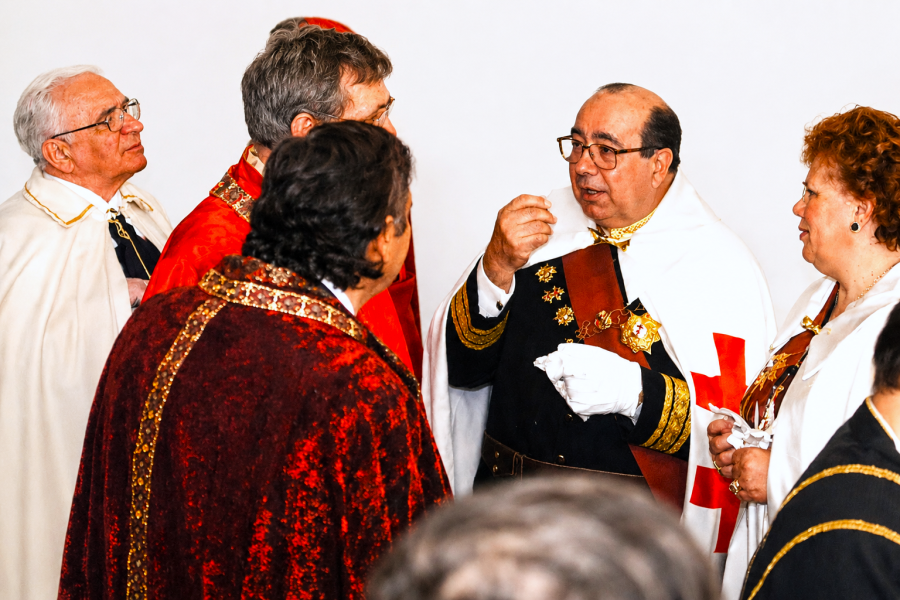
From left to right: H.E. Heinrich Katzenstein, Grand Chancellor of the OSMTH; Monsignore Dr. Yvo Verbeek; Mgr. Fra. Robert Adelsohn Bels; H.E. Fra. Jean-Claude Debels; Mgr. Fra. Dom Fernando Campelo Pinto Pereira de Sousa Fontes, 51st Grand Master of the OSMTH; and Dona Maria de Glória Figueiredo, spouse of Monsignore. OSTHM Investiture at La Converserie, Tenneville. Saint-Hubert, Belgium, on 17 June 1995.
3.e. COMPARATIVE ANALYSIS OF THE THREE MAJOR COUNTIES AND VISCOUNTIES THAT PLAYED A PIVOTAL ROLE IN THE MILLENNIAL HISTORY OF THE BELS FAMILY
THE COUNTS OF FLANDERS - THE COUNTS OF BARCELONA -
THE VICOUNTS TRENCAVEL AND THE COUNTS OF CARCASSONNE
It is worth recalling, at this stage of the discussion, that the Counts of Carcassonne originally ruled the County of Carcassonne. This comital line became extinct in the male line with the death of Roger III of Carcassonne in 1067. His sister, Ermengarde of Carcassonne, thereupon inherited the succession rights to the county before transferring them shortly thereafter to Count Raymond Berengar I of Barcelona. The county thus passed into the sphere of influence of the Counts of Barcelona.
However, by asserting her hereditary rights to Carcassonne and the Razès, Ermengarde became the catalyst for a prolonged succession dispute involving, in particular, the Houses of Carcassonne, Foix, and Barcelona.
The Trencavels were therefore not counts but viscounts. It was through the marriage of Raymond Bernard Trencavel to Ermengarde of Carcassonne that this family acquired rights over Carcassonne. Their son, Bernard Aton IV Trencavel, assumed effective control of the city from 1082 onward and thereafter exercised authority as Viscount of Carcassonne, without ever bearing the title of Count.
It is equally instructive to examine the relationships that existed between the Counts of Flanders, the Counts of Barcelona, the Counts of Toulouse, and the Viscounts of Trencavel. An understanding of their alliances, wealth, rivalries, and respective political interests provides valuable insight into the feudal context within which the millennial history of the Bels family unfolded.
Comparative Overview of Four Major Medieval Principalities
(12th-13th Centuries)
1. The Counts of Barcelona: A Mediterranean Power
The Counts of Barcelona ruled Catalonia, one of the most dynamic regions of the western Mediterranean. Following the marriage of Raymond Berengar IV to Petronilla of Aragon in 1137, they became the rulers of the Crown of Aragon. Their authority gradually expanded over an extensive territorial and maritime dominion.
Their strength rested upon:
- a highly developed administrative system;
- a flourishing Mediterranean trade network;
- a powerful merchant and naval fleet;
- an active and sophisticated diplomatic policy.
They were undoubtedly the most powerful princes south of the Pyrenees. Prior to 1137, the Counts of Barcelona were already among the leading powers of the Iberian Peninsula. After the dynastic union with Aragon, however, they became the dominant political and military force of the Catalan-Occitan world, competing directly with the Kings of France and England in several diplomatic arenas.
Relative Wealth: Extremely High. Diplomatic Influence: Mediterranean and international, extending to the Iberian kingdoms, the Occitan principalities, the Italian maritime republics, and the Papacy.
2. The Counts of Flanders: The Wealthiest Princes of Northern Europe
The Counts of Flanders presided over one of the most prosperous urban economies in medieval Europe. The English wool trade, the flourishing cloth industry, and the commercial centres of Bruges, Ghent, Ypres, and Rijsel (Lille) transformed Flanders into one of the continent's richest regions.
Their financial resources probably exceeded those of any other principality considered in this comparison, enabling them to maintain considerable political influence and military capabilities.
Relative Wealth: Exceptional. Diplomatic Influence: International, positioned at the crossroads of the Kingdom of France, the Kingdom of England, and the Holy Roman Empire.
3. The Counts of Toulouse: Lords of Southern France
The Counts of Toulouse possessed the largest princely domain in the Kingdom of France after that of the Crown itself. Their authority extended over much of Languedoc and was reinforced by an extensive network of powerful vassals.
Their principal weakness lay in the comparatively limited centralisation of their administration and in financial resources that, although substantial, remained below those of Flanders and Barcelona.
Relative Wealth: Very High. Diplomatic Influence: Characteristic of a major territorial principality, balancing relations with the French Crown, the House of Barcelona, the Papacy, and the principal Occitan lordships.
4. The Trencavel: The Great Viscounts of Languedoc
The Trencavel family represented the second greatest political power in Lower Languedoc. They ruled several important viscounties, including Carcassonne, Béziers, Albi, and the Razès.
Their extensive network of castles and fortified towns constituted one of the strongest defensive systems in southern France and enabled them to play a decisive role in maintaining the regional balance of power.
Relative Wealth: High. Diplomatic Influence: Primarily regional, although frequently exercised through strategic alliances with the Counts of Barcelona, the Kings of Aragon, and neighbouring Occitan.
 Druckversion